links


1
Oct 13

More open than DC

Someone wrote this on the floor-to-ceiling chalkboard in the Samford Crimson’s newsroom.

chalkboard

Lately the board has been filled with non sequiturs, cryptic notes or jokes. That’s fun. I’ve always wanted to draw football plays on it. One day I’ll quote some 13th century Chinese philosopher and see if anyone notices.

The government shut down. In pieces, full of the nonessential types, which are surely made up of people who find themselves and their salaries essential. You wonder how long the thing will last this time. You recall the 1990s and how a lot of people didn’t seem to notice. You wonder how long it would take for some of those unfortunate nonessential types to be considered truly nonessential.

But if there is one place that jobs aren’t fungible, you know where that is.

All that could be said about the government shutdown has been said elsewhere, or is perfectly capable of being digested in 140 character increments on Twitter, or tuned out with The Million Second Quiz. Mileage may vary, of course. I’m pretty certain we’ll come to the conclusion that no one is playing their parts especially well.

I swam 1.33 miles tonight, 2,400 yards.

I do not know what is happening.

It started out poorly. Oh, it ended raggedly, too, but at least it improved a touch. The first 400 yards, though, were such that I was questioning pretty much every decision of the day. I hadn’t slept enough. I hadn’t eaten enough. I shouldn’t have walked over to the pool. I shouldn’t have deleted that spam email about arm replacements and on and on. I started bargaining with myself about when I would hang it up, because this wasn’t a pleasant experience.

After a time, though, the laps started ticking off and the weak feelings disappeared.

I improved my freestyle. For the first 1,800 yards I was doing 150 in my tadpole breaststroke and then 50 free. In the last 600 yards I was doing 100 in the fake stroke and 50 free. So, over the course of the swim, that worked out to 650 yards of freestyle. Which, I guess, means I have to learn how to swim now.

Remember, this summer I couldn’t swim more than four or five strokes of freestyle, so this is grand progress.

Things to read which I found interesting today.

Wearable Computers Could Make Steep Inroads into Farming, Experts Say

Does the right to “inspect” public records include the right to Instagram them?

College football attendance drops 3 percent in opening month

Inside Nairobi’s Devastated Westgate Mall

I put this on Tumblr. There’s more stuff there you can scroll through. Find me on Twitter, too.

And now I’m being summoned into the newsroom … so until tomorrow, then.


30
Sep 13

Good for 63.73 percent of the people in the poll below; they said ‘Who cares?’

Didn’t you love Catember? We love Catember. That’s the fourth year I’ve put that on the site, and it is probably one of the more popular things going. You can follow this link to the Catember category and see all of them. Allie is wacky as ever.

This morning she got locked in a linen closet. Because if you go to that part of the house then you must be going into that room. And if you are going into that room it must be because you are going to open the door for her.

It is a neat trick, really. She jumps up to a second shelf, while ducking down to avoid hitting the third shelf and fitting in a narrow space on top of beach towels. She likes to be on clean things. Very fussy.

Talked about news leads in class today. Riveting stuff. Here are some of the slides:

My favorite part is finding examples of bad leads. New York Times, student media, the local pros. None of us are immune. I read a dreadful one out of the old gray lady today. It violated almost every rule of thumb you would ordinarily use.

Otherwise, the day passed as it should.

Things to read that I thought you might find interesting:

Auburn-Opelika named as top place to retire

More than 2,000 NASA workers in Huntsville look to Washington today as government shutdown looms

Shutdown would lead to 2,000 civilian furloughs, no pay for military at Maxwell

Here’s an interesting profile on author and “performer” Malcolm Gladwell who has a new book out. He addresses critics. And his hair is still artistically unkempt:

“When you write about sports, you’re allowed to engage in mischief,” he says. “Nothing is at stake. It’s a bicycle race!” As a serious amateur runner himself (just the other day, he finished the Fifth Avenue Mile race, in Manhattan, in five minutes and three seconds) he’s “totally anti-doping … But what I’m trying to say is, look, we have to come up with better reasons. Our reasons suck! And when the majority has taken a position that’s ill thought-through, it’s appropriate to make trouble.” His expression settles into a characteristic half-smile that makes clear he’d relish it if you disagreed.

Here’s an insightful New Yorker piece on the Guardian taking on the British government:

At 5:23 p.m., roughly eight hours after the encounter in his office, Rusbridger ordered the Guardian to post the G.C.H.Q. story on its Web site and then in its print edition. Although the British government had taken no further action, the mood in the Guardian’s offices was anxious. As the stories based on Snowden’s revelations were taking shape, Rusbridger had hired additional security for the building and established a secure office two floors above the newsroom, just down the corridor from the advertising department, to house the documents. When he flew to New York to work with his team there on the stories, “he couldn’t talk on the phone,” his wife, Lindsay Mackie, said. “He couldn’t say what was going on.”

It has been the Guardian’s biggest story so far. With eighty-four million monthly visitors, according to the Audit Bureau of Circulations, the Guardian Web site is now the third most popular English-language newspaper Web site in the world, behind London’s Daily Mail, with its celebrity gossip and abundant cleavage, and the New York Times. But its print circulation, of a hundred and ninety thousand, is half what it was in 2002. The Guardian, which is supported by the Scott Trust, established nearly eighty years ago to subsidize an “independent” and “liberal” newspaper, has lost money for nine straight years. In the most recent fiscal year, the paper lost thirty-one million pounds (about fifty million dollars), an improvement over the forty-four million pounds it lost the year before.

Last year, Andrew Miller, the director of the trust and the C.E.O. of the Guardian Media Group, warned that the trust’s money would be exhausted in three to five years if the losses were not dramatically reduced. To save the Guardian, Rusbridger has pushed to transform it into a global digital newspaper, aimed at engaged, anti-establishment readers and available entirely for free. In 2011, Guardian U.S., a digital-only edition, was expanded, followed this year by the launch of an Australian online edition. It’s a grand experiment, he concedes: just how free can a free press be?

For reasons big and small beyond this story I really, really hope they make it.

Somebody had to say it. I say it to my freshmen (your job is learning as much as you can and selecting and sharing the most critical parts) and I’ve told it to old reporters (do what you do best and link to the rest) and pretty much anyone in between (solicit and cultivate your community) who’d care to disagree. But the truth is the truth. Journalism *is* curation: tips on curation tools and techniques:

Curation is a relatively new term in journalism, but the practice is as old as journalism itself. Every act of journalism is an act of curation: think of how a news report or feature selects and combines elements from a range of sources (first hand sources, background facts, first or second hand colour). Not only that: every act of publishing is, too: selecting and combining different types of content to ensure a news or content ‘mix’.

Amazon’s Jeff Bezos in his talk to employees at the Washington Post said: “People will buy a package … they will not pay for a story.” Previously that package was limited to what your staff produced, and wire copy. But as more content becomes digitised, it is possible to combine more content from a wider variety of sources in a range of media – and on any one of a number of platforms.

Curation is nothing new – but it is becoming harder.

It is becoming faster, with stronger feedback, and with more and more places to monitor and share. So, in that sense, yes, it is harder. Really it is more intensive, and more thorough.

And then there’s this embarrassment: AJ and Katherine: A kiss is just a kiss, or is it? (poll)

We can’t let people live their personal lives. And by people I mean a young woman who’s caught a minor bit of celebrity in the most 21st century way possible and a college student. We must speculate. Are they on or off? Here’s a photo gallery! And take this poll! Now let’s bring in our kiss expert (“lukewarm at best”) who is really, and I’m not making this up, the public safety reporter.

A commenter wrote “AL.com, please use the poll results to help refine the amount of time you spend covering Katherine Webb stories. Thanks.”

Others:

Carol’s reply:

It is a good thing bandwidth is cheap. So is the content.


27
Sep 13

I don’t say anything bad at all about the DMV

The guy at the local bike shop — I should say My Guy, since he’s always the one that draws the short straw and has to deal with me — says it isn’t an alignment problem that keeps me from shifting rings on the front of my bike. This explains why I could see no obvious problem. My front derailleur, tells me is frozen.

“Do you sweat a lot?”

Do you mean, do I ride in the heat of the day a lot? Yes.

Turns out all the sweat goes right there into the derailleur cage, where the hinge can rust out over time. Which is why, right now, I can only ride in the big ring. (Which is usually where I ride, anyway.)

Maybe I should stop riding in the rain so much, too then.

“No,” he said. “Just the sweat. The salt.”

Rust. Tastes like victory.

And the cost of a new derailleur. And not being able to ride until next week.

Because Amazon can ship you something from across the country in a day, but in a bike shop it will be Tuesday before your part comes in. No matter, I’ll miss one day of riding and, hopefully, it will be ready by next weekend.

On the upside, we did stand over a Trek time trial bike. And I picked up a carbon fiber Trek with state of the art electronic groupo just to feel what 15 pounds felt like. It felt like about $10,000. How anyone could ride something that expensive without fear in their eyes is beyond me.

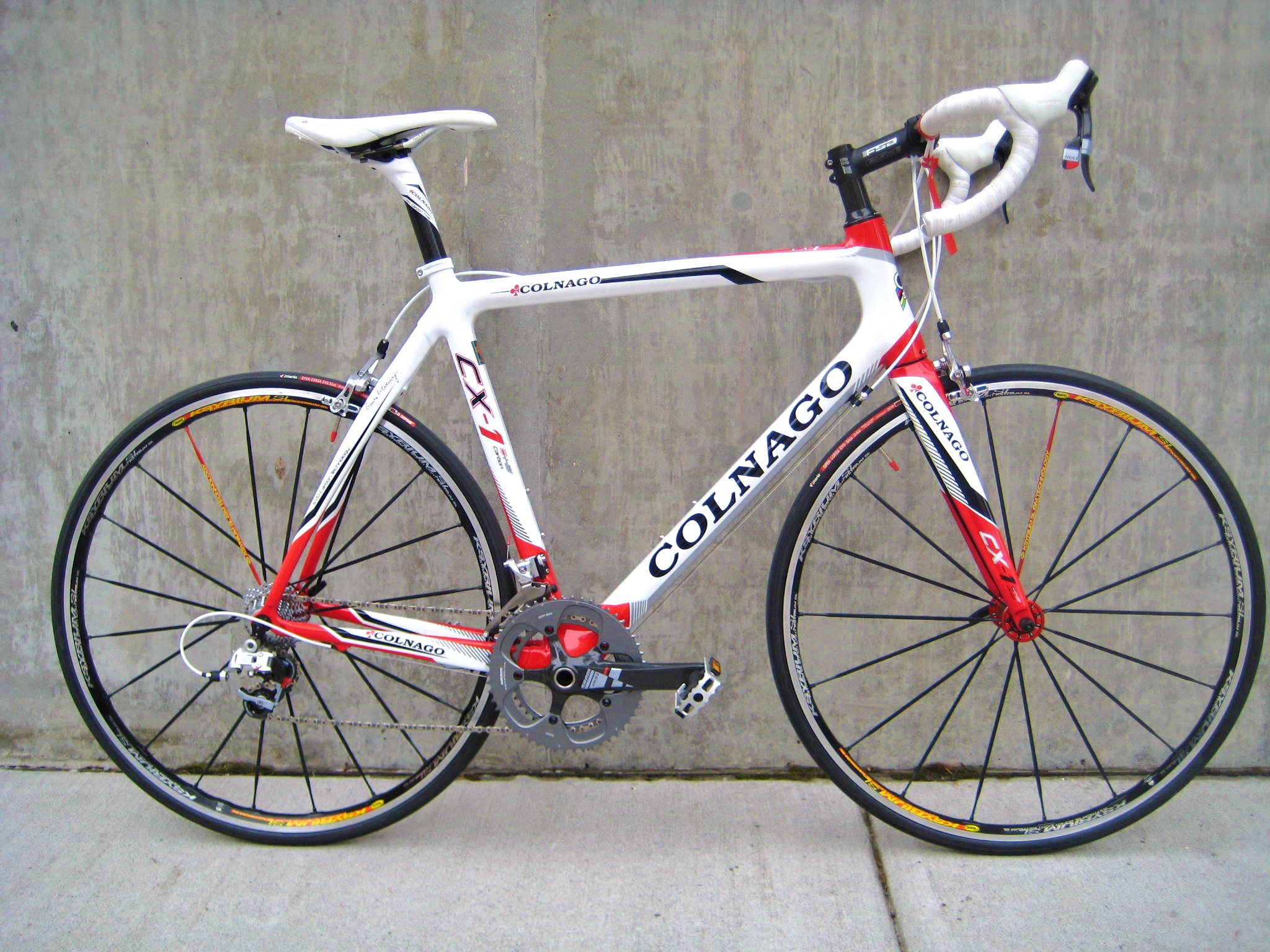
And I coveted a Colnago. It was a beautiful machine. (It looked like this.) So beautiful, and significantly less than the Trek. We had a moment, me imagining slinging it left and right as I stood out of the saddle, the Colnago knowing I could never handle the ride. So beautiful.

Good thing my Felt was downstairs. It doesn’t need to get jealous. Can’t afford a new bike. It “only” cost two or three grand.

Also, upstairs was this poster:

Bo

That was for Bo Jackson’s Bo Bikes Bama tornado relief ride last year, and a shorter tour this year. He’s raised more than $600,000 in those six days in the saddle. Still sad I couldn’t talk any of my media friends into letting me cover it for them.

But Bo rides a Trek, and Trek loves Bo. And he signed his left thigh. In the reflection off the glass frame you can see part of another Trek in the background.

The Yankee rides a Trek, hence she knows Bo.

Also, the DMV this afternoon.

DMV

We have a satellite office, and the people there are nice and courteous and they know their business. Still, this late in the month, it took an hour to weave through the line. I was going to ask “How did we do this before smartphones?”

Then I remembered: I used to take a book.

But everyone was pleasant and in a good humor. Many folks took a friend. As good a time as any to catch up. A lot of people ran into people they knew. Medium-small towns have those advantages.

I’d rather go to our DMV than our post office — where I have also waited an hour in line.

Also, when you park in a parking space that is for employees only the DMV staff will run the tag and call you up to the desk to move your car. And you get your space back in line. Two people had this problem while I was there.

I might have been one of them.

We went for a run late this evening on the nearby bike and running trail. It is three miles, round trip. I got out a little ahead of The Yankee and, as it got dark I stopped and waited for her so I wouldn’t be shuffling along by myself in the twilight.

This was a mistake because it turned into an all out sprint at the end. I was not prepared for the last 200 yards. But I did break the tape. And by tape I mean spiderweb.

That wasn’t nearly as exciting as I thought it would be.

I’m concerned I’ll soon come to enjoy running.

I do not know what is happening.

Things to read which I thought were interesting while standing in line at the DMV today …

Three bears and one tough hiker

Special Space Camp graduation: 200 vision-impaired students from 25 states, 6 countries

The Economist rethinks ‘lean forward, lean back’ model

Got a great weekend planned?


26
Sep 13

A fast Thursday post

Wrote a long email today, in keeping with my email style. I went through it to edit and did manage to eliminate 42 words. I also used the word “countervailing,” which I felt like was a good reason to go for a bike ride.

So I managed to wrap up the day on my bike, catching the last few rays of sun from the saddle. It was late enough in the day that I didn’t even wear sunglasses, because that just made it look dark. As it was I found myself way over in the lane as I worked my way along shaded roads. No need to blend in, as Richard La China taught me:

I’d just started out and noticed my front derailleur wouldn’t shift. I could feel it in the shifter, and I could see it bolted onto the frame. I was in the big gear and it was staying there.

Everything was spinning, but I only had about six gears at my disposal. So I did a short, easy ride and stayed away from any hills. That’ll be something I get to look at tomorrow.

Things to read, which I found interesting today …

Speaking of riding the bike, here’s a local story from earlier today about the local bike scene. Hint: it ain’t bad.

The Garths scrimped and saved for two years before starting their tour in 2011 in Maine. After pedaling through 41 countries, the couple has experienced some of the best, and worst, areas for cycling.

“Our favorite place, as far as scenery goes, and natural beauty…was Patagonia,” Dave Garth said “For cycling, it’s terrible.”

He added Auburn is somewhere in the middle.

“Auburn is definitely getting better,” Garth said. “At this point, having been to some places that are really modeling this well…there is definitely room for improvement.”

Alabama currently holds the second-to-last spot in a nationwide ranking of bike friendliness by the League of American Bicyclists, coming in just above last-place finisher North Dakota. But with the implementation of Auburn University’s more pedestrian and bike friendly campus, the city as a whole is working to improve its biking infrastructure.

“Auburn is currently the only bicycle friendly community in Alabama,” said Brandy Ezelle, traffic engineer and bicycle coordinator for the city of Auburn. She added the city has received a bronze ranking in bike friendliness by the League of American Bicyclists.

Thomas McCrary, thought to be Alabama’s oldest farmer, dies 4 days before 102nd birthday:

Up until a year ago, when he was 101, Thomas McCrary drove a tractor around his 200-year-old farm, ensuring operations were running smoothly.

The humble man from New Market said in December he cherished the land that was settled by his namesake and great-grandfather, the first Thomas McCrary.

“It means a great bit to me,” McCrary said of the farm, which since its founding 203 years ago had been divided among family members.

Mr. McCrary died Monday.

There’s a book about that family, and that farm, perhaps the oldest one in the state, a decade older than the state itself. It was written by an old newsman, Joe Jones. About Thomas it says “he loves all and is loved by all.” He stayed on the farm his entire life, except when he was in Burma and China during the war. Here’s his obit, which is full of old-fashioned charm.

Thomas McCrary would have remembered his grandmother, who lived until his 18th year. She remembered the Civil War. A link just two generations removed is now gone. The first plane was flown in the state in March of 1910 by Orville Wright. McCrary was born 18 months later. Think of all he saw in his life.

And that’s what you lose when you lose a centenarian.

Sounds like a longform story, really. Here are some chat tips on one could do that:

It turns out that long and short writing are not necessarily in conflict. Think for a moment about your favorite magazines. Compared to newspapers, the long stories in magazines are longer, and the shorter pieces are shorter. It’s the combination of short and long that make a publication versatile for readers.

Although I’ve met some writers who tell me “I want to write shorter,” that is the exception. Most writers I know — including me — want to go longer. The daily beat reporter wants to do a Sunday feature. The Sunday feature writer wants to do a series. A series writer wants to do a book. The book author wants to do a trilogy.

And Twitter goes to emergency mode: Twitter Alerts: Critical information when you need it most:

We know from our users how important it is to be able to receive reliable information during these times. With that in mind, last year we announced Lifeline (a feature that helps Japanese users find emergency accounts during crises), and since then, we’ve been working on a related feature for people around the world.

If you sign up to receive an account’s Twitter Alerts, you will receive a notification directly to your phone whenever that account marks a Tweet as an alert. Notifications are delivered via SMS, and if you use Twitter for iPhone or Twitter for Android, you’ll also receive a push notification*. Alerts also appear differently on your home timeline from regular Tweets; they will be indicated with an orange bell.

You can see a list of participating organizations here.

More on the multimedia blog, Tumblr and Twitter.


25
Sep 13

There was no gold. I looked.

The newspaper industry, they gave it away online for a decade or more, suddenly decided to charge for it online and now, I’m sure, are stupefied by this news:

Now that roughly a third of the nation’s newspapers are charging for access to their web and mobile content, the early evidence suggests that digital audiences aren’t nearly as enthusiastic about paying for news as publishers are about charging for it.

Although digital-only subscribers make up 37.6% of the total circulation of the Wall Street Journal and 34.4% of the total readership of the New York Times, the number of digital-only subscribers at Gannett, the largest publisher of general-interest newspapers in the land, is 2.2% of its average aggregate weekday circulation of 3 million subscribers.

Notwithstanding the relative productivity of their paywalls, the paid penetration at the Journal and the Times pales in comparison to the success that Netflix, Spotify, Major League Baseball and other ventures have had in selling entertainment-oriented digital content.

Some of those entertainment and news comparisons stretch the bonds of credulity, but they do say one thing: People will pay for a service online, just not the news.

It is simple economic theory, really. You can easily charge for a scarcity. There is a great volume of news, analysis and information around us. Some of it isn’t worth the download to be sure, but a great deal of it is readily available.

You might say it isn’t the news they need. You might be right, to an extent. You might also be called an elitist gatekeeper for saying that.

At the end of the day your news seeker is a resourceful individual. He or she has plenty of options to find what they want, or at the very least, enough to make them feel they’ve gotten what they need.

So the search for a compelling and profitable news model will continue. Even as I remind you that news has always been a (civically minded) loss leader.

Speaking of losses … now you can find out how much the Affordable Care Act is going to cost you. Finally.

Also, my insurance is increasing, so that’s nice.

Our state doesn’t get the opportunity to brag about education frequently enough, but here’s one where we are on the top of the list: Alabama high school students lead nation in increase in passing advanced placement tests.

Reviewed the newspaper this afternoon. They are designing a sharp looking product — and they were only in the newsroom until 2:30 this morning, so that is an improvement. Today we talked about story selection and word use.

Pretty soon I’ll run out of things to find wrong and will simply be down to the very subjective things.

Here is the rainbow I saw on the way home this evening:

rainbow

One of the meteorologists said there was a storm in some little town, a wide spot on the road really, to my east. I was on the interstate about 20 miles away. I glanced up and saw the clouds. I looked back to the road. I glanced up again and saw the rainbow.

Here’s a post on the multimedia blog.

Here’s something from Tumblr.

There’s more on Twitter.