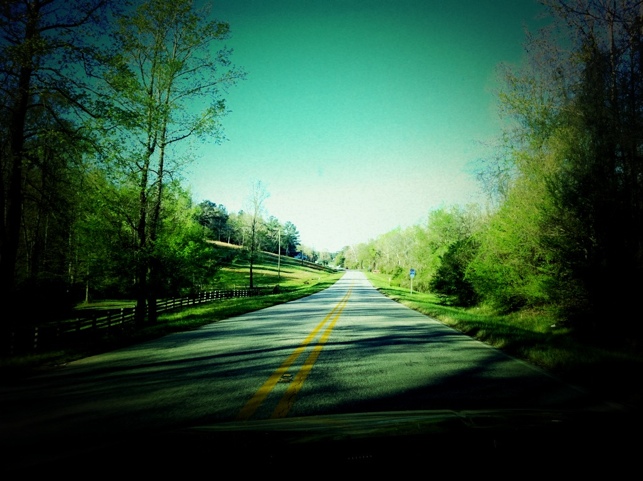
Thirty miles on the bike this morning and I feel fine.
I felt hungry by lunchtime, so barbecue was in order. Fairly certain that negated the last 18 of those miles.
Had my head in Dreamweaver all day today. Nothing like spending an exhilarating day in a piece of software that sometimes does brilliant things but otherwise generally manages to baffle itself. I’m still not sure that I’ve met a real person who likes this program. I want to like it, really I do, because it is just so much easier to gush than grouse. Fortunately shaking my head doesn’t require a lot of energy, though.
We’re using Dreamweaver in a class. Two or three of the students have really taken to it. The rest are trying their hardest. You have to have patience with this software, I’ve decided, and I’m proud of how much patience they’ve demonstrated. Their site designs, meanwhile, are coming along nicely. Some of them are incredibly sharp.
The rest of the afternoon was spent making recruiting calls. I’ve talked with about 100 people or voicemails. And then I spent a bit of time emailing some more people. We’ve got a lot of good things to brag about to prospective students. It takes more than a few seconds.
Tonight the student-journalists at the Crimson put together their next to last issue of the year. They were done early. We’ll find the typos together tomorrow. This editorial staff has done a very nice job. They’ve been solid and stable and handled a few delicate stories well. Proud of them too.
That point of the school year, then, where you tally things up and take stock of progress. You make mental notes, measure this against a previous year, project out against what might come next year. You celebrate those who are graduating and moving on to their next big adventure. It is an exciting time on a college campus. I’m thrilled to be here.
This is different:
That’s the courtyard of the University Center. It is all distorted and warped by a free panorama app I found recently called Photosynth. Oh, I am sorry. This isn’t a panorama. From their FAQ:
Panoramas are made stitching a set of photos taken from exactly the same spot and with exactly the same focal length. Synths are our invention, and use photos that were taken from different locations. Panoramas display seamlessly, synths display as a collection of individual photos.
Clearly, if you follow that link, I am doing something wrong. Maybe a cloudy, bright day is too dynamic. The good ones on the site — and there is some mind–boggling stuff on their site — This will take some experimenting. Or I could just call it the Dali app and let things slide and droop where they may.
It is amazing what you can do on this thing that has a phone attached to it.
I interviewed a former Heisman trophy winner this morning. Had a very nice chat. When I type up the notes in the next few days I’ll give you a little more insight into the piece, which is a freelance article I’ve been asked to write for a summer publication. So come back for more details on that later.
Hint: It was not Gino Torretta. He had a similar outcome to his post-Heisman bowl game, however. Like Torretta, it happened in the Sugar Bowl.
Much of the rest of the day was spent making recruiting phone calls, reading and grading. These things have seemed to take over most everything lately. But that’s fine. I enjoy talking with prospective students, though I get a lot of machines and write a lot of email. I do love to read. And grading is … well … everyone needs to have things graded.
This evening I visited the Galleria for the first time in probably a year or more. On Twitter I wrote, “Places I’ve been less crowded than this mall: Nevada desert, Belizian rain forest, Alabama library, IRS parties.” It was amazing how dead most of the place was.
Just for context, I worked there for part of my senior year in high school. A classmate helped me land the easy job of selling coupon books in those little mid-mall kiosks. You don’t antagonize people, you wait patiently for them to come to you. And the hourly pay, for a high school student, was extravagant. (I think I was making about $9 an hour.) Anyway, one night while I was not selling coupon books to the random passers by, a famous Southern winter storm descended upon us. Everything closed up quickly. This was like that. (Incidentally, that particular night, there was no snow if I remember correctly.)
There was no bad weather tonight, either. Just the economy, the Internet and people tired of malls, apparently.
I went looking for clothes sales. Finding none, I also left the mall.
Speaking of mall culture … Who’s ready for a third in Bill & Ted’s storyline? Besides Keanu, I mean.
“When we last got together, part of it was that Bill and Ted were supposed to have written the song that saved the world, and it hasn’t happened. … So they’ve now become kind of possessed by trying to do that. Then there’s an element of time and they have to go back.”
Ghostbusters III doesn’t look like a bad idea in comparison, now, does it?
Washington Post sports columnist — and former Redskins beat writer — Jason Reid was the Timothy Sumner Robinson lecturer at Samford University this spring. He spoke with many classes, the staff at the Samford Crimson, the radio station WVSU and more before delivering his Robinson lecture which focused on social media and sports reporting. Here’s a small sample of some of his advice to students early in the day.
The lecture series is named in honor of Timothy Sumner Robinson, a 1965 graduate of Samford University. He covered the Civil Rights demonstrations in Birmingham, the Johnson White House and, most famously, Watergate. Even amidst Woodward and Bernstein, Robinson wrote more front page stories for the Post than anyone.
Sumner would become a lecturer, an editor in Los Angeles (where he covered the Rodney King trial, the riots and the O.J. Simpson trial) and then Excite, Alta Vista, NBCi and AOL/Time Warner. He was a renaissance man before his time. His family, all charming people, put on this lecture each spring and it has become a highlight of the campus calendar.
(As an experiment: I took this audio via the open air microphone on my iPhone using the free Recorder & Editor app. I edited it in the app. I took the photograph with the iPhone’s camera and then put the two together in iMovie on my desktop machine. If I can move the file, as a wav, from the app to iTunes I could have produced the entire thing by phone. This process worked pretty well, otherwise, but the microphone picks up soft speakers best within two or four feet. A proper mic, or moving to the speaker, is desirable for good quality. Old radio guy that I am, I have a few other audio recording apps in line to try.)
The U.S. Space & Rocket Center in Huntsville will receive a space shuttle orbital maneuvering engine for display as NASA begins parceling out parts of the shuttles. The shuttle program is ending in June after two more flights.
“It’s fantastic,” Center Director Dr. Deborah Barnhart said shortly after the announcement. “Anything having to do with propulsion, that’s us.” Barnhart was referring to the fact that the shuttle’s propulsion system was developed and managed at Huntsville’s Marshall Space Flight Center.
After this summer’s last flight the only place you’ll be able to get a sense of size of shuttle plus rockets will be in Huntsville. Apparently they have the only full “stack” around. And in as much as the shuttle program was a detour of sorts, this is still somewhat sad. Given the nature of things the detour isn’t being corrected with newer and better rockets to the moon and Mars. Right now we’ll be lucky to hitch rides to the space station and send robots out beyond a Terran orbit.
If we stay here at home it’ll just be that much easier for the ads to find us. It is about to become a lot more easy:
Far surpassing the powers of print, broadcast and the web, a host of new technologies is converging on the opportunity to use smart phones to intercept – and influence – the consumer as she walks past a store, wheels through a supermarket or reaches toward a product on the shelf.
The technologies include not only the increasingly ubiquitous GPS-equipped smart phone but also window stickers that broadcast messages, interactive bar codes that instantly link to a website and increasingly sophisticated databases that track your individual activities so they can precisely target products or deals to you.
This has been discussed for several years now, but this particular future is here. How it is received will be interesting. I bring this up to students and they always gringe. They don’t want advertisers to know where they are. But they’ll grow used to it.
Just imagine what Don Draper would do with that. There are a few ideas.
Jeremy Davis can remember a picture he sketched at the age of 3, a squirrel sitting on a stump his mother always held in high regard.
[…]
It took years for him to get from a small town without a stop light to the University of Alabama in 2007, when he truly began to develop his artistic side.
Davis’ decision to return to school after a brief hiatus to earn more money resulted in the ultimate lesson while working on a unique project. Davis is credited with sketching and sculpting what developed into the Nick Saban statue.
Leaving aside the Alabama part and the inherently creepy statue-of-a-living-person discussion, that is a neat story.
Auburn, in keeping up with the Joneses at Alabama and Florida, is unveiling statues of the Heisman winners. If one must have statues I’d prefer a different group of individuals. We venerate football players enough and they’re in little danger of being forgotten, but that’s neither here nor there. The Auburn statues were designed and created by a Montana sculptor. He’s incredibly talented, his work is on display at the University of Texas and across the country, but it would have been nice for an Auburn artist to get the commission. It isn’t like they don’t have an entire academic department devoted to the discipline.
I go straight to the links today because one of my RSS feeds found this morning to be a good time to cough up 209 posts it had been saving for a while. I was goaded into reading them all. And, completist that I am, I would have. But they were all old posts from a year or two years ago. I’ve already read them. So now I’m giving my RSS reader a hesitant look. What else is it planning? And will it carry me away in the scheme?
The problem of the information age, really, is that no one moment will be the SkyNet moment. But any number of them could be the cumulative steps to getting there. By the time you, you pesky human, figure it out, the thing will be over. It will be too late. And then you’ll just try to remember what you learned from Noah Wylie in his gripping summer television series on how to fight back.
You are going to watch, aren’t you? Because this is the sort of information that could be useful at some point.
Class today. More Dreamweaver. That will be the operating condition between now and the end of the semester, as we work our way through the perplexities of fairly powerful software which is useful when it wants to be, and mysterious whenever a student comes up with an outside-the-box idea.
I come back from each class with a small list of things I’ve promised to investigate and resolve because “Why isn’t that working as it should?” is not a fun question for anyone.
Critiqued the paper today, where we were a bit late in getting the dormitory bathroom explosion prank story. We’ve only two issues left on the year. I hope they solve the mystery so we can put it in the paper.
Else we might have to do follow ups on snake sightings. They are prolific on our wooded campus.
Also had the first talk with next year’s editor today. He’s a sharp young man. I believe he’ll have a fine year.
Went to the movie trailers tonight. I watched a movie after sitting through 28 minutes of previews. I go to the dollar theater, so I’m always a little behind, but there are some woofers in these promos. As for the best commercial:
True Grit, though, was pretty good. At least Jeff Bridges is playing the part of Rooster Cogburn, rather than John Wayne saying Rooster’s lines and wishing he were Ted Williams. On IMDB the original film lists Wayne, and then Glen Campbell as LaBoeuf (also considered for the role: Elvis) and then Kim Darby as Mattie Ross. In the modern film the listing is Bridges, Hailee Steinfeld as Mattie Ross and then Matt Damon as LaBoeuf. That’s about right.
Darby, meanwhile, has played in 82 movies and last worked in 2007. Hopefully Steinfeld will still be working in 2051.
Did you see the LOMO blog today? Tree new entries for you there. That’s it for here. More fun will be had tomorrow.
If ever there was a device that science needed to bring us, it would be the one that tells us what our animals are thinking. There’s no thing as fascinating as the inscrutable, unknowing of knowing that goes on inside of a furry creature’s —
“SQUIRREL!”
You’re hoping for more, of course. Something just before Aristotle, and a full stop or three before Che because, let’s be honest, when the plotting gets too intricate, we’re toast.
So I’m sitting on one end of the sofa pecking away at the keyboard and The Yankee is sitting on the other end reading and she jumps up, crosses my lap, confusing the computer with the intricate kitteh combination of things she touches simultaneously while walking across the keyboard and track pad.
Did you know a Macbook can open a transwarp conduit? Oh the key combination is a bit more detailed than the digit-twister required to do a screen cap. I’ve yet to figure out how to fire up the tachyons, but I’m sure the Thinking Sphinx will demonstrate it before next weekend is over.
Where would we be without cats? I mean, aside from asleep at 7 a.m. like I should be? She thinks differently. I’m thinking of inventing a feline tossing sport.
On campus today there was class, where we are in full-on learning Dreamweaver mode. If you can sympathize, you can sympathize. If you can’t, don’t try. Dreamweaver, I mean. Don’t try it. Hire a third-party. Go push-button. Or write your code by hand. (I do. I find it relaxing. There’s probably a small problem with that.)
The student-journalists at the Crimson are churning out another copy of the paper which will be on newsstands tomorrow.
Over dinner I started a new book. I finished Sledge’s With the Old Breed. For me it was a fast read — which is saying something — and a look into the war in the Pacific. The focus is on Sledge’s war, not an overview or a recounting of general’s. Particularly you gain his insight into the horrible fighting on Peleliu, which has been all but forgotten, and the long trials of Okinawa.
The book went largely undiscovered for some time, but has always been well praised. It is a straight forward and feels as honest as a memoir possibly can. Sledge’s telling is gripping, but at times it feels as if things are missed. I’m calling it the passage of time from enduring those terrible experiences and writing it, but also possibly the desire to not put ink to paper. That reads as if he glossed over things. He did not. There’s more gruesome detail in this book than anyone should ever have to endure, but you get a sense that it isn’t everything.
Sledge came home after the war, the Mobile, Ala. boy had become a man and he enrolled at Auburn University. He’d settle as a professor at the University of Montevallo and live out his days in relative peace. This book was a key part of HBO’s miniseries, The Pacific.
That was the book I finished last night.
The book I started today was a Christmas gift from my mother-in-law. She picked it up, she said, because it seemed like something I would like. She was right. Every review has glowed and the subject matter is great. This is Daniel Okrent’s Last Call, the story of Prohibition.
I’ve read the first chapter thus far, and am hooked. I’d like to share with you a paragraph:
When Dr. Dioclesian Lewis showed up in town, he could usually count on drawing an audience. Dio, as he was called (except when he was called “beautiful bran-eating Dio”), was no doctor — his MD was an honorary one granted by a college of homeopathy — but he was many other things: educator, physical culturist, health food advocate, bestselling author, and one of the more compelling platform speakers of the day, a large, robust man “profoundly confident in the omnipotence of his own ideas and the uselessness of all others.” He was also the inventor of the beanbag.