Friday


17
May 13

A pitchers’ duel, videos, helmets

One of the more knowledgable people in our section — as opposed to the guy last night that called every ground ball a “can of corn” and his date who thought the umpires should reverse their hand signals for out and safe — said this evening that whomever scored a run would win. And he was right.

Game two of the last series of the season was a fine one. Auburn put Mike O’Neal on the mound. Check out this delivery:

MikeONeal

Have you ever seen a pitcher get that low to the ground with an overhand delivery? I’ve seen submariners with scrapped up knuckles, but this is a different thing. That’s long been O’Neal’s style, though, and I’m sure that’s what stymied Florida through nine innings last weekend in the most heart-breaking loss of the season.

But O’Neal shook it off, took the ball and delivered again. Seriously, though, the guy is down if he played college football:

MikeONeal

O’Neal allowed four hits and one run through seven innings and 100 pitches. The junior has had some hard luck lately, with a record now sitting at 8-4, but he’s got a great command of the mound.

Tonight he just happened to be facing the guy who is perhaps a first-round pitcher:

MikeONeal

Seriously, between Arkansas’ Ryne Stanek and two LSU pitchers, we’ve watched a major league pitching corps this year. Stanek scattered six hits and four walks in seven and two-thirds innings and was never not in control of the game. Just a rock steady performance as Arkansas defeated Auburn 1-0. The guy in our section was right.

Here are the highlights, including a 98 mile per hour fastball from Stanek. He was throwing into the mid-90s in the sixth inning:

Auburn did, by virtue of other teams’ play, manage to secure their 10th seed in next week’s SEC baseball tournament. Now they have to go out and beat Arkansas tomorrow to end the season on a high note.

Things to read and watch: This video is described as “A crowd-funded video trailer boosting America’s future in space” which is in the trailer package of the new Star Trek movie. It was shot in Huntsville, which is reason enough to watch it I guess. I share it because it looks pretty awesome, and someone booked Optimus Prime to do the v/o.

In 1910 the USS Birmingham was the first warship to launch an airplane, which would be cool enough to say since the ship was named for Birmingham. Today the navy is launching and landing UAVs via aircraft carrier.

Murder rates? Early data suggests way down. How far down? Century-record lows. There’s an interesting hypothesis:

Analytically speaking, murder is an especially interesting crime because we have pretty good homicide statistics going all the way back to 1900. Most other crimes have only been tracked since about 1960. And if you look at the murder rate in the chart below (the red line), you see that it follows an odd double-hump pattern: rising in the first third of the century, reaching a peak around 1930; then declining until about 1960; then rising again, reaching a second peak around 1990. It’s been dropping ever since then.

This is the exact same pattern we see in lead ingestion among small children, offset by 21 years (the black line). Lead exposure rises in the late 1800s, during the heyday of lead paint, reaching a peak around 1910; then declines through World War II; and then begins rising again during our postwar love affair with big cars that burned high-octane leaded gasoline. Lead finally enters its final decline in the mid-70s when we begin the switch to unleaded gasoline.

This is powerful evidence in favor of the theory that lead exposure in childhood produces higher rates of violent crime in adulthood.

Meanwhile, in Washington D.C. …

If you’ve been glossing over the IRS hearings, that’s a good place to start.

Meanwhile, also in Washington, D.C. …

My second-favorite part of that Eric Holder press conference, after when he ignored a reporter’s question of about if the attorney general can see how the media “would find this troubling” was that claim about national security. That, with the actual timeline in place, stood up to scrutiny for several full minutes:

(I)t seems fairly clear that the claim that this leak was among the most damaging in American history simply doesn’t add up. If that’s the case, then why would the CIA have told the AP that the national security concerns it had previously expressed were “no longer an issue?”

All of this took about six seconds to become political. There was probably never a time when we seized on things purely in the pursuit of good governance, but I wish that time were now.

Finally, I’ve probably talked about helmets and bicycle crashes enough here in the past year. The farther removed from all of the events of last summer the more convinced I am about how lucky I was, head trauma-wise, and how bad that hospital was, head trauma-wise. (Here’s my helmet after the crash. The sum total of my head exam was telling a triage nurse I was cognitively fine. That’s it. Frightening. I have some generally spotty recollections of things between the trauma and the surgery and the recovery. It is disconcerting, to say the least, to hear about things I don’t remember, or read things I have no recollection of writing after the fact. And my old helmet, by definition, more or less completely did its job.) Anyway, this is one more story worth reading, and probably Bicycling’s best piece in some time:

If you crash and hit your head, there are two types of impacts. One is known as linear acceleration. That’s the impact of skull meeting pavement. Today’s helmets do an excellent job of preventing catastrophic injury and death by attenuating that blow.

The second type is known as rotational acceleration. This is where things get tricky. Even if the skull isn’t damaged, it still stops short. That causes the brain to rotate—the technical term is inertial spin—which creates shear strain. Imagine a plate of fruit gelatin being jarred so hard that little cuts open throughout the jiggly mass. That strain can damage the axons that carry information between neurons.

There are other factors involved, but research has consistently pointed to rotational acceleration as the biggest single factor in a concussion’s severity. The CPSC helmet benchmark is based solely on linear acceleration. There’s never been a standards test, required or voluntary, for rotational acceleration.

[…]

A report last year by the International Olympic Committee World Conference on Prevention of Injury and Illness in Sport summed up the state of the art in a sentence: “Little has changed in helmet-safety design during the past 30 years.”

[…]

There may never be an improved government standard for bicycle helmets. Experts may never come to a consensus on a standard for testing the forces most closely associated with concussions. But one test can be administered now: the market test. After all, new technology costs more. “Adding that upcharge to a $50 helmet,” Scott Sports designer John Thompson told me, “is a harder sell.”

This is the bike-helmet industry’s ­air-bag moment. The new rotation-­dampening systems may not be perfect, but they are the biggest step forward in decades. The choices cyclists make with their money matter. You can pretend to protect your brain, or you can spend more money and get closer to actually doing it.

The science isn’t settled by a longshot, the industry is filled with legal frights and there are all kind of marketing concerns. But there’s also plenty to consider in that full piece, which is worth a cyclist’s time.

10
May 13

At least it wasn’t a sneeze

Do you believe in ghosts? That is the weirdest dateline I’ve seen for a story in a while, particularly since it isn’t specific, and the story is hardly comprehensive. Also it is … lacking. It refers to video and audio and all manner of things the ghost hunters — believers and skeptics alike — use to search for ghosts. But it doesn’t share any of them.

I suppose my first personal ghost story — that didn’t have to do with the great Kathryn Tucker Windam’s 13 Alabama Ghosts and Jeffrey which were amazing reads that haunted every child that cracked the spine of the text — were stories from some family member. It seems they had friends who lived in a civil war officer’s home. They’d go over to play cards and every so often the spirit, according to their story, wanted a little recognition. So he’d make noise upstairs somewhere. They’d acknowledge him aloud and all would be well.

We had a neighbor once who said her house was haunted, but that was the sort of thing that kids would tell to other kids. I probably said our house was haunted too. She said that her ghost would open doors and things. So one day we opened every cabinet and drawer in her kitchen. Before she went into the kitchen and noticed it her dad came home. He was not pleased.

My high school, which was a 1930s WPA project, had a restroom light that liked to be on. No one could explain that. The school doubled as something of a community center, so it never shut down promptly at 3 p.m., which meant someone had to always be on hand. This poor math teacher somehow managed to have that job and that light drove him crazy. (It was a short trip.) So we decided there was a ghost in the boys restroom in the junior high wing.

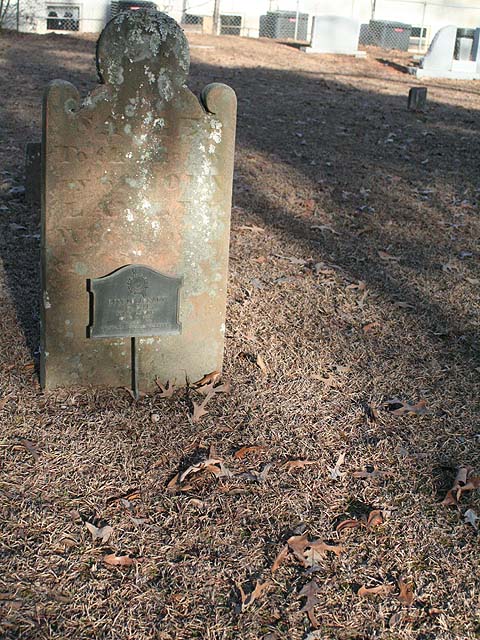
Every now and then we’d try to trick people into thinking there were floating orbs in an old cemetery in our neighborhood. This was before, as far as I know, we knew that people talked about floating orbs, so at least we had good details. I noticed years later there was a Revolutionary War veteran buried there, which is still one of my favorite things about the place:

Lawley

A geneaology site says about John Lawley, who moved there in the 18-teens:

The land was productive and required but little labor to produce the necessaries of life. The woods were a hunters paradise a paradise abounding in deer, turkey, with some panther and bear. The winters were not so cold then as now. Cattle and horses were raised in the woods and afforded all the butter beef and milk that was needed. Not with- the glowing description given to prospective settlers, these early men and women and children knew the meaning of hard work and sacrifice, but knew, too, the delight of living in a new land.

He lived as a royal subject and then as an American under Washington through Andrew Jackson. He died an old man, in 1832. But he’s probably not a ghost.

We have a lot of those tales in the South, which is the foundation of the story initially linked above. There’s supposed to be a ghost of a soldier in the chapel at Auburn. The Roundhouse at the University of Alabama has a similar story. Here’s a Georgia one that landed in my inbox today, in fact, with supposed photographic proof. In Savannah the dead are an industry unto themselves, and the ghost tours are an important tourist activity:

I’ve never seen any ghosts. But I have been to a few battlefields.

Stuff from Twitter: because why not?

I have this feeling that it all get worse before it gets better.

I looked at the drought monitor today and saw something unusual:

Drought

That chart is updated weekly. Last week the two southernmost counties, Mobile and Baldwin, still had a good deal of yellow covering them. And then it rained about eight inches in one night down there. This is the first time since 2010 that no county in the state has not reported dry or drought conditions.

Pretty tough times in the plains states, though. James Lileks, last week on the drought breaking in Minnesota:

well, well, what do you know: the drought lifts. The dryness of the last few years is forgotten as the mean reasserts itself over the long run of the decade, which itself will be a wink, a blip, an inhalation to the next decades exhalation, just as the universe itself is a bang at the start and a great collapse at the end, like two flaps of a heart valve. Assuming there’s enough matter to cause the universe to contract, that is. I hope so. I hate the idea that it begins with a great gust of matter, spreads and cools and ends in silence. Because that would make the universe, in essence, a sneeze.

Swam 1,200 meters today. When I went down the pool to start that last lap The Yankee — who is a champion swimmer, mind you — said “If you do 16 it’ll be a mile.”

Don’t tell me that.

But I did get in three-quarters of a mile. And then I rode 15 miles on my bicycle, just because it was a longer way home.

I do not know what is happening.


3
May 13

Confirming the Not Good At That list

I did something unusual today. I got in a pool.

Now, I like the water. One of my earliest memories is being fished out of the deep end of a pool I had no business being in. As a child the local YMCA had the fish-themed swimming lessons and I made it up to the shark level. I was a certified lifeguard, back in the old style where you had to go get people and in the kinder, gentler, let’s don’t get hurt or sued and throw in a float instead style. I have memories, for some thing or other, of turning blue jeans into a floatation device. I’ve treaded water for more than an hour. I’ve been a SCUBA diver for two decades.

I’m good with the water, at peace with what I can and can’t do there, particularly below the surface. You still have some control of things there. If you know yourself you have fairly defined ideas of your limits, and that is satisfying and comforting; I’m not afraid of the water because I know what I am and what I am not, he said, hoping that sounded wise. But I treat it recreationally.

One thing I am not is a lap swimmer.

Never could hold a straight line. That’s just the basic problem. Olympic and national champion swimming coach David Marsh once told me “You have to respect someone willing to spend hours and hours, swimming hundreds of laps, to shave a thousandth of a second off of their best time.”

I respect that level of dedication and discipline, even more in the context of things I’d never do. I’m not that kind of swimmer.

So there I was today, cool new reflective race goggles, in an outside lane of an outdoor pool with the temperature hovering around 65 degrees and falling and trying to swim.

I haven’t done anything more than tread water or float on my back in a year or so.

Today I just tried to make the goggles fit. They didn’t. Water got in. I don’t like water in my eyes. So I quickly realized you don’t clear goggles like you would clear a diving mask:

It just brings in more water. Because your nose isn’t inside the confined area, of course. But, hey, the training is never forgotten. So up on the rope line, work on the goggles. Swim a bit, fiddle a bit, swim a bit, drown my eyes awhile. And so on. Finally this was resolved. Finally I can swim. Only I’ve all but forgotten how to breathe. I like to breathe. Breathing, in my book, is vastly underrated. This goes on in a thoroughly unsatisfying manner.

Finally it all comes together. I can see. I can breathe. I can actually think about the stroke. I get through four circuits of the freestyle stroke — really bringing my arms and shoulders out of the water and overhead and down properly — and realize this hurts my shoulder. So the now 10-month old injury and surgery still limits me.

So I do other things, try other strokes. Back to the sidestroke and a modified breaststroke and my favorite: underwater, handcuffed criminal stroke.

But I did 700 meters — a warmup, really — which is more than I would have done otherwise.

Also, it turned cold again today. Chilly, in fact. Downright unseasonable and noticeable, too. I’d complain, but there is snow in places like Iowa and Minnesota that would also like a bit of May, thank you. I’ve mentioned it. Remarked, maybe. But I haven’t complained too much. And if I have, it was entirely good-natured, because some places are dealing with unseasonal May snows.

But I would like spring to come back, because the first part of summer can hurt if it just shows up without a preamble.

Tonight, baseball:

After falling 6-1 to Ole Miss tonight, Auburn is now 16-51 against the SEC in the big four sports — football, men’s basketball, women’s basketball and baseball — since the 2012 SEC baseball tournament. That’s a bad year.


26
Apr 13

No filling those shoes

Rode this route this evening:

The Yankee is racing on that tomorrow and I was doing the scouting work. The opening rollers can get you. Your eyes will deceive you. Watch out for that pothole. When you get here shift up. You’ll ride along the top of the hills, so pedal hard.

Gear up when you hit that stop sign. Crush it here. Be careful of that intersection, it feels crazy on the bicycle. Get over your gears on that roller. When you come back in toward the park sprint the last leg. I was breaking 30 through there.

Tomorrow she’ll do her second aquabike, a swim-ride race. Last year, in her first one, she took third place. And now she has another 600-meter swim and a 14-mile ride at John Tanner State Park in Carrollton, Ga. It boasts 28 acres of lakes, the largest sand beach of any Georgia state park and the nicest state park restroom I’ve ever seen. And also really, really cold water in the swimming area.

Things are still unseasonably cool, which feels great in general. But if you have to swim in it at 8 a.m. probably is a different story.

John Tanner was a local business owner who opened and ran the park from 1954 through 1971, when he sold it to the state. Actually it is now a county park. Even better. The state was going to close the park in 2012, but it went back to the locals instead.

The ride felt slow to me, I started cold, I hadn’t eaten enough and I’d gotten right out of the car and on to the bike. But my computer disagreed. It said I had a fairly nice pace for my first time on that route. Nice for me, put still slow, we agreed.

That’s OK, because pasta for dinner! We found our way to a Carrabba’s after noting the local Mellow Mushroom was closed and avoiding the many Captain D’s that seem to populate that part of the world.

They are presently offering a menu that includes seconds. They know their audience, namely, me. Only they brought out both plates at the same time, which didn’t make me look very good I’m sure. Joke’s on them. I still had bike grease and tire dust on my face, apparently.

Badges of honor, I say.

Not much else to say after that. This week’s YouTube Cover Theater features covers of the timeless, brilliant George Jones.

Charlie W. uploaded this video from Belgium today:

Sitting on a porch with crickets buzzing in the background, playing a pretty Gibson Hummingbird and singing about drinking. That’s a George Jones tribute if ever there was one:

Jim Arkus here says he heard the news and sat down on his porch and put this cover of The Door on video:

There are a lot of Jones covers popping up today, and so their traffic is necessarily low. This one has been up for more than a year and I do not understand how it has less than 200 views.

The Opry dedicated their show tonight to Jones, who became a member in 1956:

George Jones had number one singles in four different decades. He marked 26 albums that charted in the top 10 and 72 singles reach such lofty places.

George Jones gets the final word, of course. This was a title track in 1985 and still a fan favorite a decade later, when he performed it in this 1993 concert. It reached number three on the charts as a lament and a criticism and it is even sadder today:

OK, Merle gets the last word, because it is likely the truth:


19
Apr 13

Neva betta

We held a big committee meeting today and held interviews and selected next year’s student media leaders. This is always a great day because our most motivated students come forward and share their ideas and answer a few questions and we try to make sure we pick the right people, and there are so many fine choices for most of those jobs.

I haven’t been to this meeting on a day when the sun wasn’t shining and the people in the room weren’t pleased to be there. Some of the elements of what happens in that meeting are among my favorite things about being at Samford. I get to watch highly-placed people in the university thinking about the best possible thing for a particular student. To be a part of that is to realize you are in a great place, surrounded by people there for the right reasons. That’s a fine thing to know.

Made it home in time to enjoy dinner with our friends Barry and Melissa, who were in town for meetings and things. We’d just spent the weekend with them and others in Louisville, but now they had their sun, who is a huge ball of 5-year-old energy. We saw Dr. Magical, who made Matthew, who is awesome, a balloon. He likes Angry Birds so …

Matthew

I mention the Boston scanner and listening to that last night. I stayed up until 3 or 4 a.m., late enough to not be sure. I fought my eyelids for a good long time and then when the officers decided to tighten their perimeter and wait until daylight it seemed a good time to get some rest. So I had about three hours last night. And when I woke up they’d turned off the streams to their scanner chatter for security reasons.

That made sense, but it was unfortunate in a way. All last night, when they were chasing people they didn’t know, when they were taking automatic fire and explosions in a suburban neighborhood, when they were searching door to door in the darkness and didn’t know what they’d find, they exhibited the best of their professionalism.

The good people of the great city of Boston have a lot to be thankful for. Their police, and the feds and other municipalities who were involved in all of that performed admirably. Today, too, we found a link to a still-active scanner feed for about a half hour before dinner and it was the same thing, even as they were drawing close, and even as they realized they had their suspect contained.

And so when they announced, when we were at dinner, that they’d caught their man, and started pulling out of town, the road lined on either side with neighbors who looked like the Celtics had just won a championship, when the SWAT team took to their loudspeaker and told the people of that neighborhood that it was their pleasure to be there, that was a beautiful site.

Here is the scanner chatter as they caught their man. “Neva betta” indeed.

There are, already, at least two sites taking donations to collect money to buy the Boston police officers a beer. That seems fitting.

YouTube Cover Theater: Where we irregularly celebrate the talent of the undiscovered, who take their guitars and their computers and show off their song stylings to the entire world, by showing off people covering popular performers. It is a testament to all of the talent that is out there that ought to be acknowledged, and only gets mild notice. We do this by picking one musician and finding people who are covering them. This week’s featured artist is Colin Hay.

This version of I Just Don’t Think I’ll Ever Get Over You is by the U.K.’s Kieran Smith, who is a music teacher, it turns out:

Australian Jace Leckie’s cover of Beautiful World has only been watched 62 times, which is a shame. It is a chill cover of a terrific song:

Here’s a guy sitting at his desk, just strumming out Maggie. No big deal:

Guess it wouldn’t be Colin Hay without some Overkill. Monica Brentnall is handling it. It really needs some more views:

And, finally, a bit of Colin Hay himself. Another great song, Waiting for My Real Life to Begin:

Hope you have a great weekend. Let’s all celebrate it like we’re in Boston.