bluesky


20
Jul 26

Evidence of our natural environments

Guess what I did this weekend …

I sat next to that leaf, and read. But more on that below.

Today was even more fun. The kitties received some mail from my mother. She bought a cheap little cat tunnel years ago, and I mentioned that it was showing some wear and she immediately leapt into action, seeing to it that the cats will want for nothing. (I had to talk her down off other presents because, truly, these cats want for nothing. But this came with the mail.
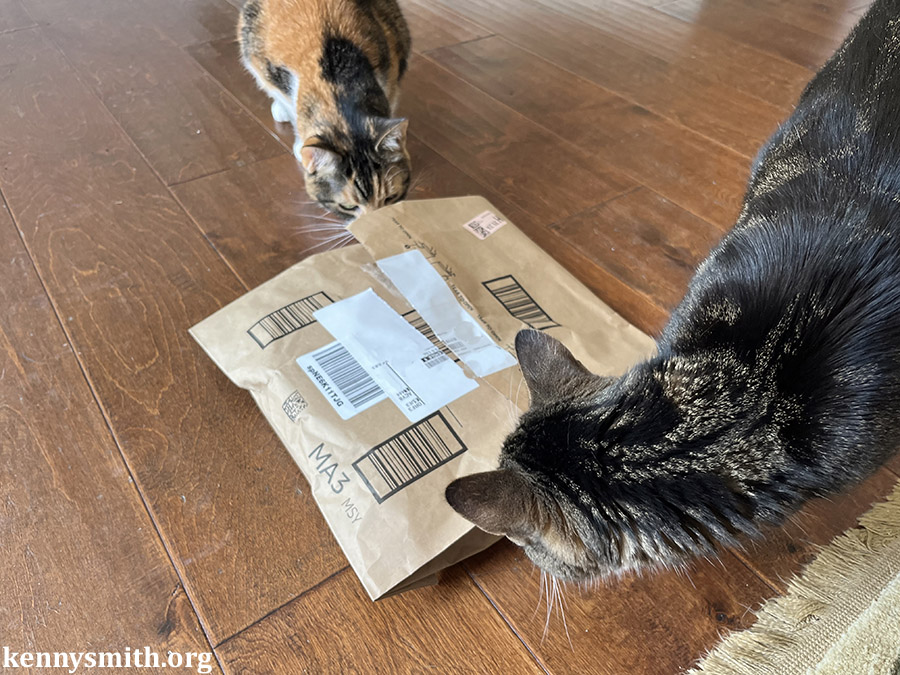
And though they were quick to inspect it, I had to help open the packaging. Thumbs and all that.
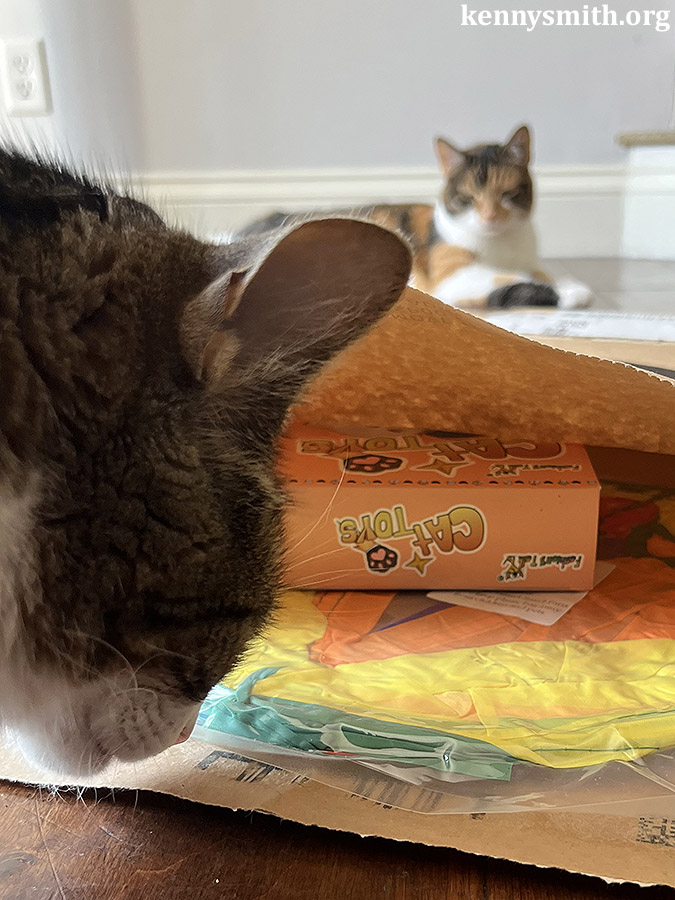
They were, of course, intrigued by this new addition to their environment. But I guess you don’t recognize a tunnel until it is in its tunnel form.
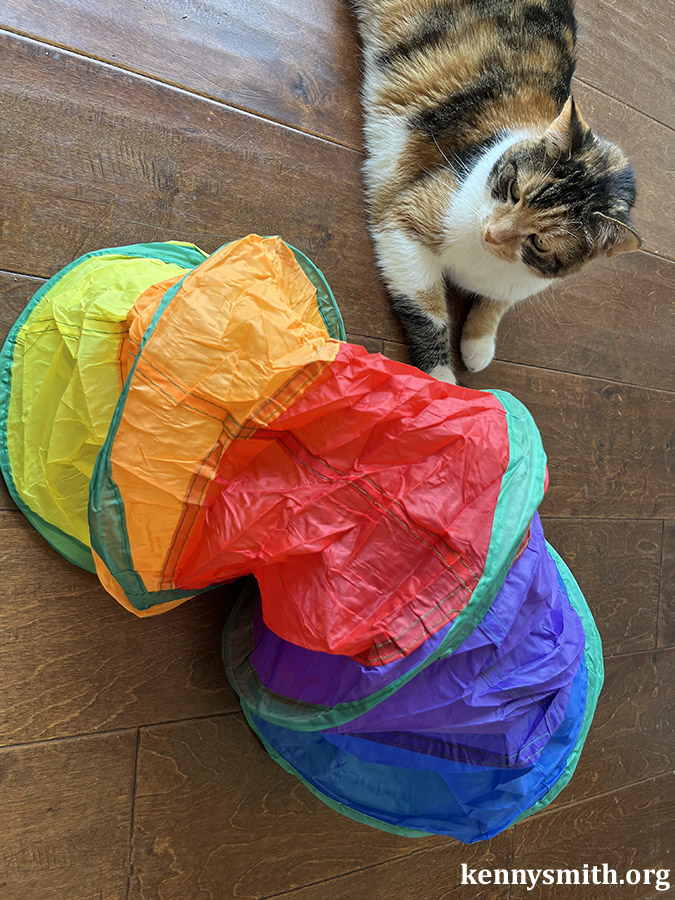
This will mostly be a Poseidon thing. Phoebe will sit in the tunnel some, but he uses it a lot. It is a hiding place, a napping place, a play place, a place where he can, somehow, approach the speed of sound as he runs through it. And he usually takes over spaces.
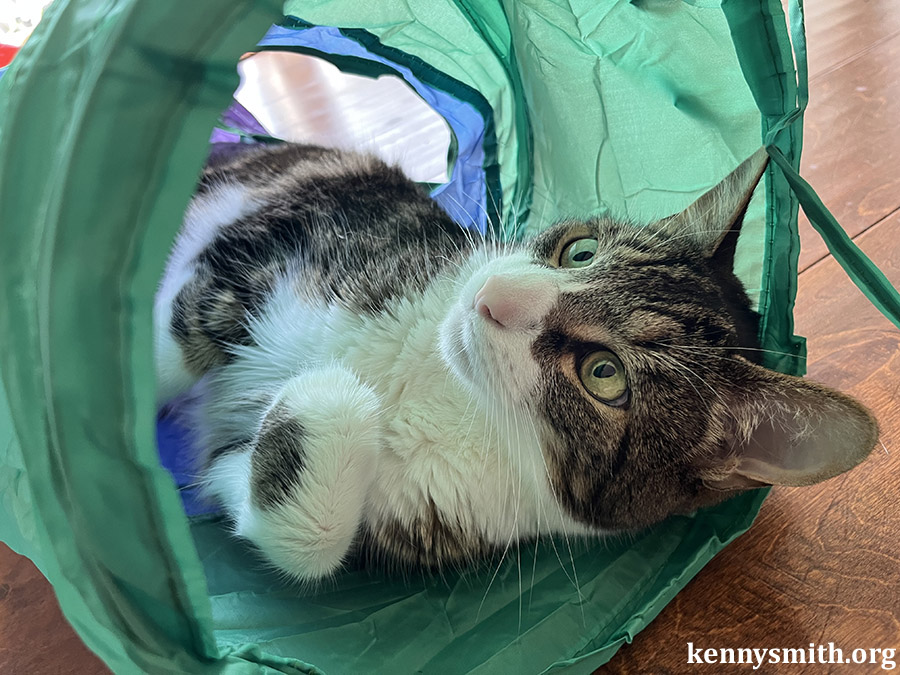
But now we have two tunnels, so maybe that dynamic will change. Tunnels for every cat! But, first, I wanted to see what he thought about a giant tunnel. He was pleased with my innovation, as if I had, finally, achieved my purpose in his life.
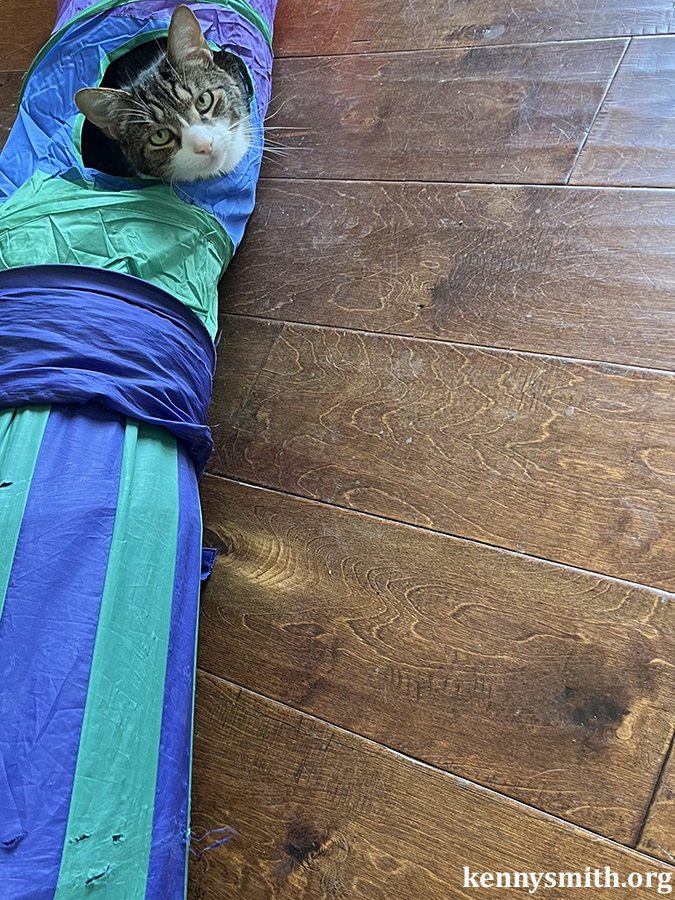
Both tunnels are sitting in the living room, but I think I’ll move them around, for variety’s sake. It could be a long-term experiment, studying where they like them the most. I promise to not report every little tunnel move and finding here, only the interesting ones.

I’ve finished Diane McWhorter’s incredible Carry Me Home. My last notes on Bluesky:

I have a great respect for Diane McWhorter’s work, but this is a reach. Standards of good and right and wrong and evil of the 20th century weren’t so different that we should see them as a kind. We, they, have the same problems: a willingness to confront actions and what is supported or opposed.

[image or embed]

— Kenny Smith (@kennysmith.org) July 17, 2026 at 3:40 PM

She proves the point with 2010’s HB 56, paranoid and nasty immigration legislation — most of which was overturned in court.

People were either ignoring him or telling tales out of school about the former AG, who was upfront about what he was.

That second highlight? Classic B’ham finger pointing.

[image or embed]

— Kenny Smith (@kennysmith.org) July 17, 2026 at 3:57 PM

One footnote:

Thousands of Birmingham News photos from the era were rediscovered in 2004. They’d been marked "Do Not Sell.” The editor, Vincent Townsend, it is said, didn’t want them to sully the city’s good name. Later, a selection was published to @al.com. Today, however, …

(Note the URL.)

[image or embed]

— Kenny Smith (@kennysmith.org) July 19, 2026 at 11:58 AM

I’m sure that’s just general content migration and site rot, rather than something nefarious, but it is both sad and illuminating.

Finally, Diane McWhorter, who lived the moment, though as a child and over the mountain (which is to say, for out-of-towners, at some remove), spent two decades working on this book (which is incredible) and won a Pulitzer for it, deserves the last word.

I’ll just say, read “Carry Me Home.”

[image or embed]

— Kenny Smith (@kennysmith.org) July 19, 2026 at 12:02 PM

And now I’ve started reading Rick Atkinson’s Fate of the Day, the second installment in his Revolutionary War trilogy. A few years ago my mother-in-law gifted me the first, The British Are Coming, which was everything I’ve come to expect from an Atkinson book. Last year I asked her for this second book, which is one of four presents I can recall having ever requested in my adult life. It’s just been sitting here, on a bookshelf, staring at me staring at it. It is astoundingly good already.

A hallmark of Atkinson’s work is how he synthesizes so, so much source material, while maintaining his journalism sensibilities, letting the original language speak for itself. This is about the American general, Arthur St. Clair, mulling over certain fate in staying at Fort Ticonderoga or ignominy in retreat. St. Clair’s quartermaster wrote “He faced an agonizing decision, as his deputy quartermaster later recounted: ‘If he remained there he would save his character and lose the army. If he went off, he would save the army and lose his character.’

St. Clair ultimately decided to retreat from Fort Ticonderoga, where his supplies were running low and he was outmanned something like 3:1 by the British Canadian army. He would be later be court-martialed and vindicated. He was retained by George Washington for staff work, served as the president of the Continental Congress, presided over the Northwest Ordinance, later led a lot of people to their doom in Ohio, and then served as a governor … St. Clair is a complete character in American history that all too often gets overlooked.

The scale and the scope of Atkinson’s work in this trilogy is such that a lot of these people that are introduced to provide the rich texture of the moment only come and go — indeed, what we know of some of them may be well limited to the letters from them or about them — but I want to look into a lot of these people. Atkinson can’t answer every one of those questions, in this format, but I like to look up people and see what became of them. Did they survive the revolution? What became of them?

Sir Francis Carr Clerke wrote a friend back home in England that, “The British bayonet will ever make its way.” Clerke was a secretary to the Canadian Army’s general, John Burgoyne. You give a quote like that, I’m going to look you up. Clerke would die at Saratoga just a few weeks after that letter.

On the very same page you meet Seth Warner, an American officer in the Green Mountain Boy. He’d been at Bunker Hill, invaded Canada and fought pretty much everywhere up north, it seems. He was highly regarded by his contemporaries, but got edged out of Vermont politics. Also, he had some financial issues and died at 41 in 1784.

I wonder which new-to-me noteworthy person will be introduced next.

You’ll have to read the book, and this space, to find out.


16
Jul 26

The air is gross

However hot it was yesterday, and the heat index reached 110 degrees, it felt much the same today. The heat index reached 108 today. I am of the opinion that anything over 106 is just pain, anyway. The rest is semantics.

Except for this, those poor electricians were back at it today, running wires and cables and connections this way and that, all so that we might one day have a generator operational. They sweated and melted and crusted over and sweated again. They had to turn the power off today, which they did one minute after their projected time. They predicted we would be without power for four or five hours. And after five-some hours they restored power. We stayed in the house, stayed still and read. For most of the time it was fine; the ambient temperature inside served us well as the sun baked us. I was still handing out water, checking on my guys, trying to stay positive and encouraging them to come inside from time to time. They never really would, but they did enjoy working in the basement the best.

We hired these guys, and their company needs to make money and they need to make money, and we’d booked this however far in advance, but sending these fellows out this week, during another intense heatwave, seemed rude.

I poured them water, scooped them ice, offered every little solution I could think of. When it felt like inside of the house was getting too warm I thought to go check in with them again for the fourth or fifth time. When I came back in, the house, which had felt warm a few moments ago, felt absolutely delightful. And that, friends, is relativity.

Still a third man, a gas man, came to the house this afternoon, too. His job was to run a bit of gas line from the new gas meter to the new generator. I think we’ve exhausted the electricians with the conditions and the demands of the job. They will come back again in a week or so to finish up the work. And then the final connections will be made. And then some municipal inspections of their work must be done. And then we will have a generator. Wouldn’t it be hilarious if we lost power sometime between now and then?

Anyway, near the end of the month, sometime in the very early part of next month, we should be set. One less thing to worry about, which we don’t worry about.

But, you know, different people have told us how many of our neighbors have gotten generators around here. Apparently it’s been a big acquisition since 2020. Indeed, as we stood outside looking at the latest work today you could see two of them sitting patiently next to neighboring houses. And, soon, we’ll be set up just so, too.

May we never need them. And may those guys get re-hydrated this evening.

Speaking of books, I finished Carry Me Home. I’ve been putting my observations on Bluesky, for some reason. Here’s the first batch. And so here’s most of the rest of them. I have one or two more that I’ll put here tomorrow.

That footnote, though.

[image or embed]

— Kenny Smith (@kennysmith.org) July 8, 2026 at 12:20 PM

One of the things that people told themselves, and one of the things McWhorter repeats now and again, is that the real problem was one of peer pressure. People didn’t want to be ostracized from their class and people because they treated others with kindness or decency or fairness.

Which …

[image or embed]

— Kenny Smith (@kennysmith.org) July 8, 2026 at 12:20 PM

We turn, now, to the Children’s Crusade.

[image or embed]

— Kenny Smith (@kennysmith.org) July 9, 2026 at 12:43 PM

We should remember that a 12-year-old in this story is 75 years old today.

Living memory.

[image or embed]

— Kenny Smith (@kennysmith.org) July 9, 2026 at 12:45 PM

Beyond even the nuance in this incredible well-told story, the occasional human insight, the glimmers of social realization, things that read like an actual spiritual conversion, is fascinating. It doesn’t happen to everyone, and certainly not at the same times, but there are these moments …

[image or embed]

— Kenny Smith (@kennysmith.org) July 9, 2026 at 12:50 PM

Minimal experience, but quick to violence, loved confrontation, so, of course, qualified. An “addled racist” said NYTimes’ Howell Raines.

Crying scapegoat, Lingo ran for sheriff of Jefferson County (where much of this story is focused). He lost. He died of “a heart ailment” in 1969.

[image or embed]

— Kenny Smith (@kennysmith.org) July 10, 2026 at 1:22 PM

These Wallace anecdotes exist within a few dozen pages of one another. In retrospect they can read almost as an explanation, an excuse, “We’d no idea, ” a “It’s out of our hands,” which is common. But that’s the compression of time. People understood — for good, bad, or worse — what he was.

[image or embed]

— Kenny Smith (@kennysmith.org) July 14, 2026 at 12:23 PM

After the bombing of the Sixteenth Street Baptist Church that killed four little girls, Chuck Morgan gave a speech so moving, so powerful it got national attention, and ultimately pushed him out of town, to Atlanta.

digital.archives.alabama.gov/digital/coll…

[image or embed]

— Kenny Smith (@kennysmith.org) July 14, 2026 at 12:23 PM

The period in which my peer group grew up … and why so much of this book is a revelation…

[image or embed]

— Kenny Smith (@kennysmith.org) July 15, 2026 at 2:34 PM

Quick aside, the Civil Rights Institute is a fantastic visit.

The book ends with this, “America’s city in a valley, but out of the depths rose a city upon a hill. Beauty from destruction. There is magic in that."

But there are multiple epilogues, because of timing and cosmic inquiry.

— Kenny Smith (@kennysmith.org) July 15, 2026 at 2:37 PM

After “Carry Me Home” was published came a new round of trials. I covered the Blanton trial. (I don’t think I used the “closure” framing.)

Asides: Rudolph, not involved, but in common, was captured, tried and sentenced. US attorney Doug Jones later became senator and is now running for governor.

[image or embed]

— Kenny Smith (@kennysmith.org) July 15, 2026 at 2:46 PM

There are, functionally, four epilogues in this book. Some of them necessary due to timing, others due to contemporaneous events that have echos of the past. McWhorter spent 20 years putting this together and so it doesn’t seem indulgent at all. Here is her summary of the book’s thesis.

[image or embed]

— Kenny Smith (@kennysmith.org) July 16, 2026 at 12:43 PM

I have one or two more that I’ll embed in this space tomorrow. And, of course, we’re on to the next book, which is also a great read indeed.


7
Jul 26

A read to chew on

I bought this book online last summer and finally got around to reading it. By the time I finished the foreword I was already thinking of who I could get to read this with me. I got one taker. The rest, frankly, were missing out. Carry Me Home is a book about home, and every page is about a place I know. Sometimes it’s about a person I’ve heard about, or a person I reported on.

I’m learning all over the place. I think I also said that right from the beginning, and I’ve said it throughout. Also, I’m still reading.

Diane McWhorter grew up during the Civil Rights Movement era in Birmingham, which is to say she was a child and it was above her head at that moment in her life. She grew up over the mountain, which is to further say about six miles and a whole culture away. None of this is a criticism. We are from where we are from, and she would later spend 20 y ears on this book trying to understand her place, her people, and her father. Some of that she gets to better than others in this book, which won (and deservedly so) the Pulitzer Prize.

It’s a bit clunky sometimes, a bit dense sometimes, but it is a terrific and eye-opening read. I can’t recommend it enough.

Currently reading “Carry Me Home Birmingham, Alabama: The Climactic Battle of the Civil Rights Revolution,” by Diane McWhorter

www.simonandschuster.com/books/Carry-…

[image or embed]

— Kenny Smith (@kennysmith.org) July 2, 2026 at 9:32 PM

McWhorter was thorough and unsparing.

[image or embed]

— Kenny Smith (@kennysmith.org) July 2, 2026 at 9:59 PM

Rev. Fred Shuttlesworth is at the center of all of this, as he should be. A fascinating, critically important leader. He was assaulted, bombed, beaten and while creating a Movement.

He also had a saying,“If the Klan don’t get you, the police will; and if the police don’t get you, the courts will.”

[image or embed]

— Kenny Smith (@kennysmith.org) July 2, 2026 at 9:59 PM

This tale is full of curious and odd and frustrating little circular ironies. That was by design, of course, even on an ad hoc basis.

[image or embed]

— Kenny Smith (@kennysmith.org) July 5, 2026 at 12:36 PM

This part fascinates. I had never heard of this audit. (I mean, why would you?)

But growing up and working there, I’d always heard people stewing in that outside perspective and wondering how to overcome it.

Smyer commissioned this, waited ages for it, and then fired the firm that sent this in.

[image or embed]

— Kenny Smith (@kennysmith.org) July 5, 2026 at 1:19 PM

If it feels familiar that’s because it has been used before. If it has been used before and used again that means it works.

[image or embed]

— Kenny Smith (@kennysmith.org) July 6, 2026 at 4:47 PM

John Temple Graves II considered himself “a professional southerner” which had a particular cheerleader meaning at the time.

time.com/archive/6604…

He was a regionally syndicated morning columnist for a while, but found his copy dated by the afternoon. The timing of his death was something.

[image or embed]

— Kenny Smith (@kennysmith.org) July 6, 2026 at 4:56 PM

Sometimes it’s just human and wryly funny.

[image or embed]

— Kenny Smith (@kennysmith.org) July 7, 2026 at 1:12 PM

I’m coming to parts of the story that more regularly entered into the wider historical context. This has long since become a story that reminds readers that the compression of history necessarily leaves so much of the story on the sidelines. Soon, we’ll get to the parts that everyone remembers, the Children’s Crusade and the Sixteenth Street Church bombing, and so on. Almost with every page now I’m wondering if the next person that is introduced will be someone that I met or knew or covered. The last one, for certain, is going to happen.

It’s a great book. I’m learning all over the place.


3
Jul 26

The Third of July

We got VIP parking. We sat in lawn chairs in a public park, alongside the food trucks and across the way from the launch site and whoever put together the playlist. Just before it got fully dark the fireworks began, and they ran to their logical crescendo. There are fireworks across the country. I’m not sure how many of those will feel like 250, or how many will feature, for inexplicable reasons, Free Bird, but this show did.

The small towns have fireworks on the 3rd, I think so they will have an audience because of the much larger nearby show on the 4th.

The one we attended tonight had a musical pairing. The finale was Free Bird.

[image or embed]

— Kenny Smith (@kennysmith.org) July 3, 2026 at 10:02 PM

It was nice. It was easy. It was warm. The air quality was better, I guess, and then of course, we put a bunch of explosive propellants and smoke (during a drought) in the air for all of us to enjoy. Free Bird, indeed.


13
Apr 26

Wrapping up my last conference of the spring

On Saturday I took part in two panels at the conference. The first was the now traditional roundtable discussion of issues in the upcoming midterms. We decided there was not a thing at all going on, the republic is safe, the economy is great, we are at peace and universally beloved, our style of representative democracy is health, and no one need pay attention.

That last sentence is in code. The key to breaking the code is in realizing that the opposite of everything listed there is true.

In the afternoon I also participated in a more structured panel. I believe I pitched the idea for this one, in face. The premise was that modern media has changed the format of the foundation and persuasion components of political campaigning. Basically, comparatively inexpensive equipment and online platforms are changing the messaging we’re seeing. (To say nothing of AI.)

I talked about how Jerri Green, who is one of the seven prominent candidates running for governor in Tennessee. The Memphis City Councilor is introducing herself with an extensive bio video.

There are strengths and weaknesses to the spot.

I talked about Fred Wellman, who is his socials (and some genAI that is both clever and weird) to show his family’s military heritage (dating back to the French and Indian War) and his time as an Army aviator to explain how his career of service began.

He’s one of nine people (and no incumbents) running for the 2nd Missouri seat. The primary is in August.

I explained the social media efforts of Zach Wahls, who introduced himself as an Eagle Scout, and then a state senator, and then a sixth-generation Iowan. And then a new generation of Democrat. He’s campaigning for the U.S. Senate.

There’s a lot clever production techniques in each of these. They’re professionally done, but not overbearingly so. In each of them you see longer stories you can’t get in a pricey 30-second spot.

I also mentioned Andrew Cuomo’s published an AI-generated negative ad while running for mayor of New York. It might be the worst spot I’ve seen in my life. It’s certainly the most grotesque attack ad.

Andrew Cuomo’s campaign just posted — and quickly deleted — this AI-generated ad depicting “criminals for Zohran Mamdani.”

Features a Black man in a keffiyeh shoplifting, an abuser, a trespasser, a trafficker, a drug dealer, and a drunk driver all declaring support for Mamdani.

[image or embed]

— Prem Thakker ツ (@premthakker.bsky.social) October 22, 2025 at 8:08 PM

Depicting “criminals for Zohran Mamdani” highlighting shoplifters, domestic abusers, pimps, drunk drivers, drug dealers, speaking directly to camera it finally ended with an entire city block on fire. It was quickly, and quietly, deleted. Here’s some coverage of this from last October. https://www.theguardian.com/us-news/2025/oct/23/cuomo-zohran-mamdani-ai-ad”>Cuomo condemned over racist AI ad depicting ‘criminals for Zohran Mamdani’:

This video follows a trend from the Cuomo campaign, who have published a handful of AI-generated videos in the lead up to 4 November. In one early October video, Cuomo was seen performing various jobs around New York City including driving a subway car, trading on the New York stock exchange and washing high-rise windows.

In response, Mamdani posted on Instagram: “In a city of world-class artists and production crew hunting for the next gig, Andrew Cuomo made a TV ad the same way he wrote his housing policy: with AI. Then again, maybe a fake Cuomo is better than the real one?”

Just this week, Cuomo shared a video featuring an AI-generated Bill de Blasio and, again, Mamdani. That video attempted to paint Mamdani as a “mini” De Blasio and emphasize a moment from the first debate where Cuomo compared the former mayor to the mayoral hopeful.

Cuomo, of course, lost convincingly.

I touched on the Hell Cats, four female veterans of the American armed forces now running for Congress in New Jersey, New Hampshire, New York, Arizona. Their introductory ad was a 68-second montage piece featuring all four of these accomplished women leaning into their service, and the proud history of the Hell Cats name (the first all-female Marine unit, dating back to WWI). I also mentioned Doug Jones’ stumbles out of the media gate in his gubernatorial bid in Alabama (Update: he won his primary and will be trounced in the general) and the Mr. Rogers-esque feeling of some of Brad Landers’ congressional content in New York (they primary in June).

It’s been interesting to watch the evolution of campaign messaging in these last few cycles. The notion of what is effective is changing on every media front, and is different, in subtle ways, from platform to platform and format to format. I could talk on the finer points of that, the evolution, the concerns, the consultants, and the grassroots feel of authenticity in politics all day. We could also talk about the use of AI in this messaging.

But what you really missed were the campaign efforts that others discussed. Derek Dooley — famous for being his father’s son and an underwhelming football coach — stepped into the senate race in Georgia. And this is how you introduced himself.

The Georgia Democrats, a few days later, ended Dooley’s political career and any hopes he might have of returning to big time football, in a 95 second spot without saying an actual word.

The Georgia Democrats didn't just destroy Derek Dooley they buried him 100 feet under the earth.

[image or embed]

— Dan Weiner (@danweiner.bsky.social) February 4, 2026 at 8:14 AM

(Update: Dooley finished second in his primary.)

And you’ll absolutely want to read up on Aaron Spencer, who is running for sheriff in Arkansas … in the same county where he’s facing second degree murder charges. It’s a real Walking Tall story. He handily won the Republican primary, and is currently in pre-trial motions for his murder charges.

Things I saw before the conference ended … this delicious noodle bowl.

I want some more, please and thank you.

This colorful tunnel.

This cup of M&Ms. One of our colleagues found a giant jar, produced a huge plastic bag and took his fill. We just borrowed this little cup from the juice and coffee stand.

This awesome mural. The only not-awesome thing about this is that someone has places crowd control ropes right up next to the wall, crowding the whole mural. This is awesome. Fred should just be reaching out of the wall, all fierce and kind.

The problem with this conference ending is the idea that we won’t see some of our dear friends until next year’s conference. This is an unfortunate and unacceptable annual realization.

Back to it tomorrow. Back to classes, back to whatever else comes to mind, and back to those great Irish videos. (We’ve only just begun to recollect.)