


Guess what I did this weekend …

I sat next to that leaf, and read. But more on that below.
Today was even more fun. The kitties received some mail from my mother. She bought a cheap little cat tunnel years ago, and I mentioned that it was showing some wear and she immediately leapt into action, seeing to it that the cats will want for nothing. (I had to talk her down off other presents because, truly, these cats want for nothing. But this came with the mail.
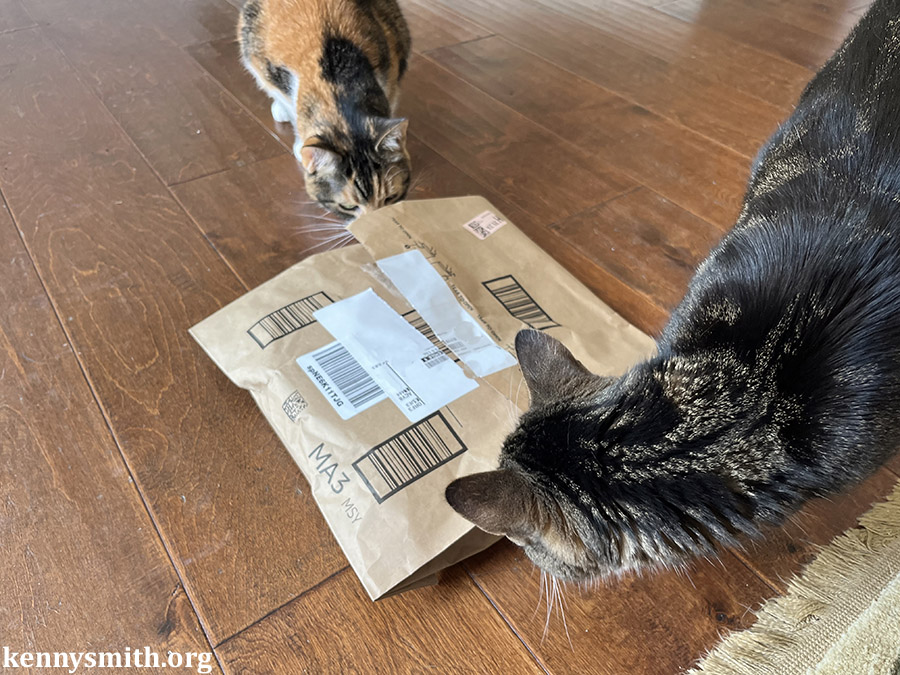
And though they were quick to inspect it, I had to help open the packaging. Thumbs and all that.
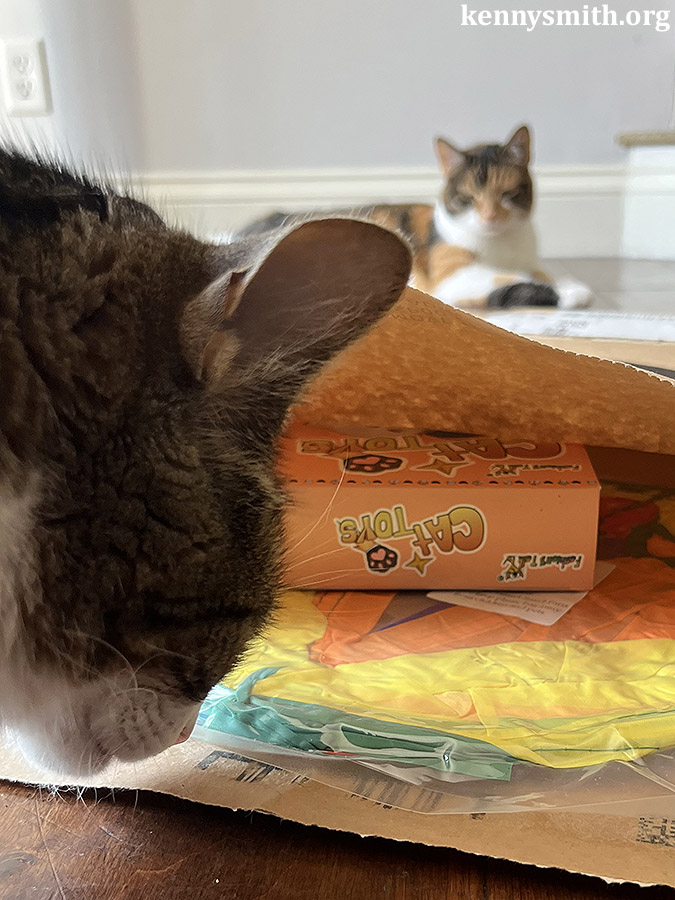
They were, of course, intrigued by this new addition to their environment. But I guess you don’t recognize a tunnel until it is in its tunnel form.
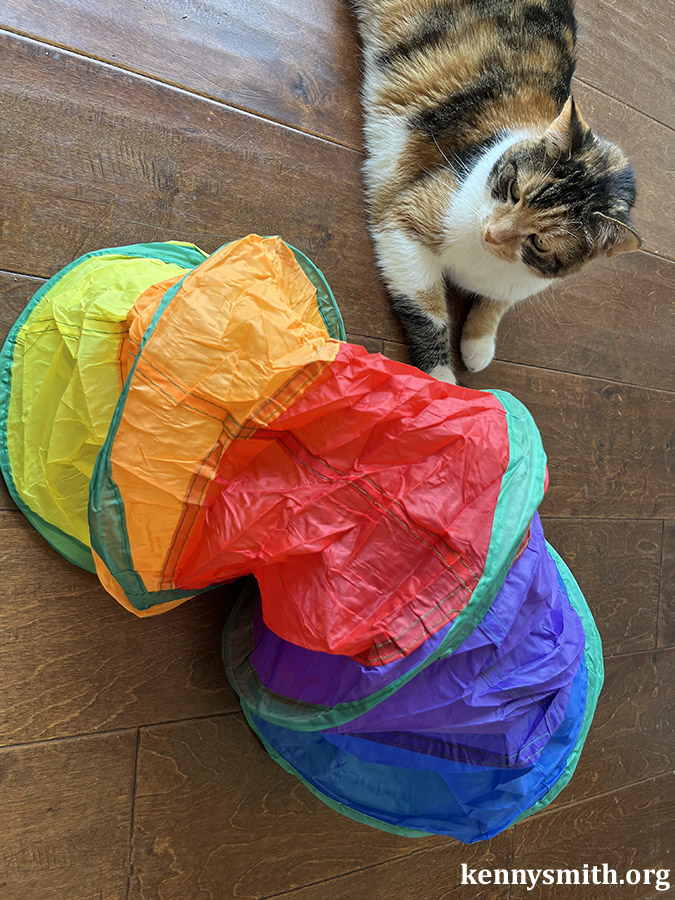
This will mostly be a Poseidon thing. Phoebe will sit in the tunnel some, but he uses it a lot. It is a hiding place, a napping place, a play place, a place where he can, somehow, approach the speed of sound as he runs through it. And he usually takes over spaces.
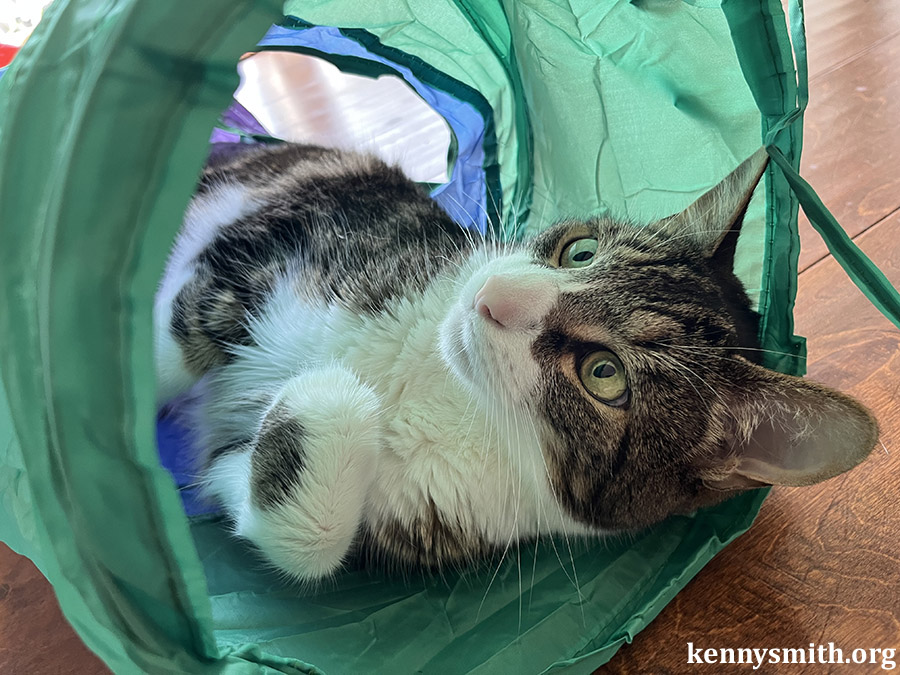
But now we have two tunnels, so maybe that dynamic will change. Tunnels for every cat! But, first, I wanted to see what he thought about a giant tunnel. He was pleased with my innovation, as if I had, finally, achieved my purpose in his life.
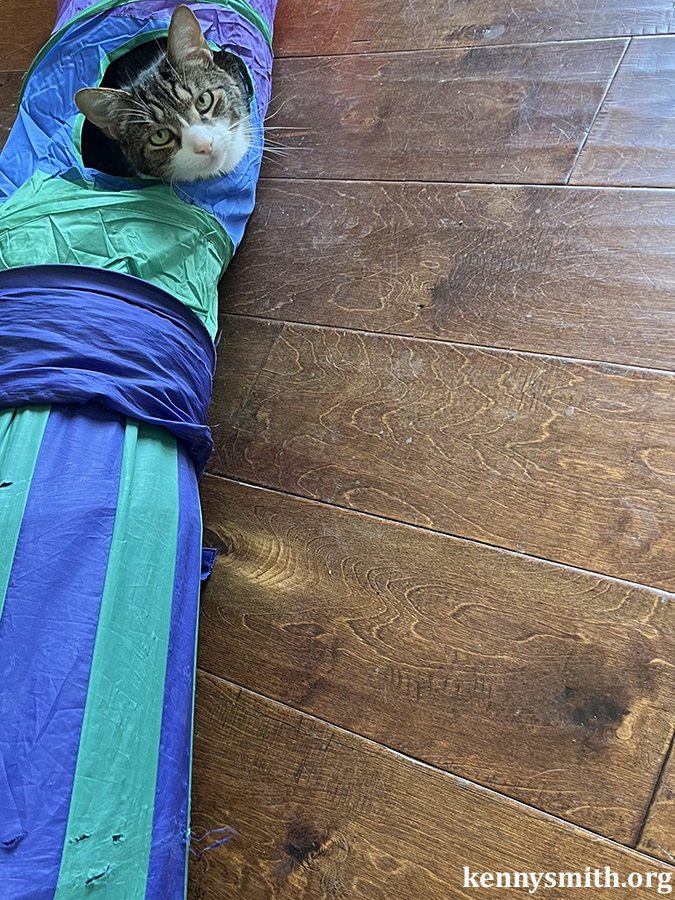
Both tunnels are sitting in the living room, but I think I’ll move them around, for variety’s sake. It could be a long-term experiment, studying where they like them the most. I promise to not report every little tunnel move and finding here, only the interesting ones.

I’ve finished Diane McWhorter’s incredible Carry Me Home. My last notes on Bluesky:
I have a great respect for Diane McWhorter’s work, but this is a reach. Standards of good and right and wrong and evil of the 20th century weren’t so different that we should see them as a kind. We, they, have the same problems: a willingness to confront actions and what is supported or opposed.
— Kenny Smith (@kennysmith.org) July 17, 2026 at 3:40 PM
She proves the point with 2010’s HB 56, paranoid and nasty immigration legislation — most of which was overturned in court.
People were either ignoring him or telling tales out of school about the former AG, who was upfront about what he was.
That second highlight? Classic B’ham finger pointing.
— Kenny Smith (@kennysmith.org) July 17, 2026 at 3:57 PM
One footnote:
Thousands of Birmingham News photos from the era were rediscovered in 2004. They’d been marked "Do Not Sell.” The editor, Vincent Townsend, it is said, didn’t want them to sully the city’s good name. Later, a selection was published to @al.com. Today, however, …
(Note the URL.)
— Kenny Smith (@kennysmith.org) July 19, 2026 at 11:58 AM
I’m sure that’s just general content migration and site rot, rather than something nefarious, but it is both sad and illuminating.
Finally, Diane McWhorter, who lived the moment, though as a child and over the mountain (which is to say, for out-of-towners, at some remove), spent two decades working on this book (which is incredible) and won a Pulitzer for it, deserves the last word.
I’ll just say, read “Carry Me Home.”
— Kenny Smith (@kennysmith.org) July 19, 2026 at 12:02 PM
And now I’ve started reading Rick Atkinson’s Fate of the Day, the second installment in his Revolutionary War trilogy. A few years ago my mother-in-law gifted me the first, The British Are Coming, which was everything I’ve come to expect from an Atkinson book. Last year I asked her for this second book, which is one of four presents I can recall having ever requested in my adult life. It’s just been sitting here, on a bookshelf, staring at me staring at it. It is astoundingly good already.
A hallmark of Atkinson’s work is how he synthesizes so, so much source material, while maintaining his journalism sensibilities, letting the original language speak for itself. This is about the American general, Arthur St. Clair, mulling over certain fate in staying at Fort Ticonderoga or ignominy in retreat. St. Clair’s quartermaster wrote “He faced an agonizing decision, as his deputy quartermaster later recounted: ‘If he remained there he would save his character and lose the army. If he went off, he would save the army and lose his character.’
St. Clair ultimately decided to retreat from Fort Ticonderoga, where his supplies were running low and he was outmanned something like 3:1 by the British Canadian army. He would be later be court-martialed and vindicated. He was retained by George Washington for staff work, served as the president of the Continental Congress, presided over the Northwest Ordinance, later led a lot of people to their doom in Ohio, and then served as a governor … St. Clair is a complete character in American history that all too often gets overlooked.
The scale and the scope of Atkinson’s work in this trilogy is such that a lot of these people that are introduced to provide the rich texture of the moment only come and go — indeed, what we know of some of them may be well limited to the letters from them or about them — but I want to look into a lot of these people. Atkinson can’t answer every one of those questions, in this format, but I like to look up people and see what became of them. Did they survive the revolution? What became of them?
Sir Francis Carr Clerke wrote a friend back home in England that, “The British bayonet will ever make its way.” Clerke was a secretary to the Canadian Army’s general, John Burgoyne. You give a quote like that, I’m going to look you up. Clerke would die at Saratoga just a few weeks after that letter.
On the very same page you meet Seth Warner, an American officer in the Green Mountain Boy. He’d been at Bunker Hill, invaded Canada and fought pretty much everywhere up north, it seems. He was highly regarded by his contemporaries, but got edged out of Vermont politics. Also, he had some financial issues and died at 41 in 1784.
I wonder which new-to-me noteworthy person will be introduced next.
You’ll have to read the book, and this space, to find out.

