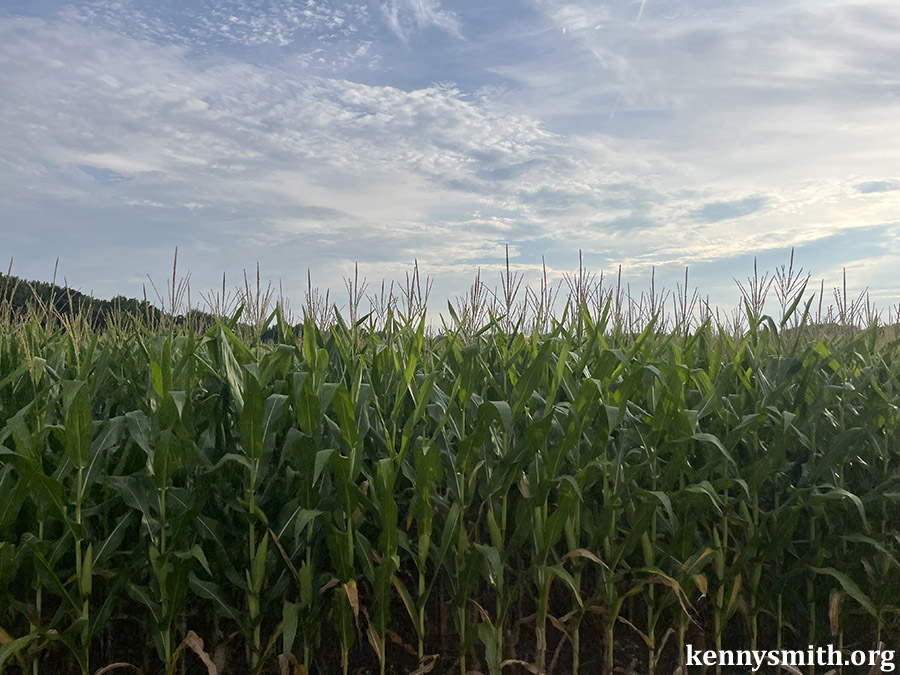
site


12
Aug 26

I can see mulch and top soil again

What a fine day. Productive and rewarding in several senses, but not in all of them. One can’t be productive in every sense. We weren’t designed for that. How else would we have developed imagination, hope, and ambition? How else would we have ever learned to fly, go to space, develop life saving vaccines, study the planet and what we’re doing to it? If we could do everything all at once, how would we have internalized concepts like dreams, lists, and ways to judge our neighbors against our efforts? Someone had to have the idea of emulating the birds, and s/he and their ilk were scorned for generations, until one day it wasn’t a flight of fancy, it was a flight. And you couldn’t do that or go to space or any of our other marvels, really, without the ability to create and pursue lists. We’re talking about human pursuit here! You can’t pursue everything at once. The neighbors would stare and talk.

I hope not too many people are doing that around here, because we’ve given them something to judge of late. There’s a lot of weeding to be done, but it’s been so deliriously hot. The temperatures settled into the low 90s today, however, and I went outside in the morning and pulled things out of the ground for a while.

My first job was a summertime thing working for one of my teachers. She was a horticulturist, and she had a summer side hustle landscaping one of the big houses on the mountain. The husband was a surgeon. A plastic surgeon, I think. Or a heart surgeon. Something that set him up well enough to marry a woman who descended from old money. (People knew the family name.) It was a gorgeous house, made to look ancient by the stone work that didn’t come from our red clay hills. It had a commanding view of the city in the valley below, the city her family had left a few generations before. The city where her family name was on one of the skyscrapers downtown, which you could see standing at their sink, or at their pool, or in any part of the house that looked to the northwest. They had a Rolls Royce Phantom 2 in the garage, giant oil paintings of themselves in the foyer that was, itself, bigger than any house I’d ever seen. And they had landscaping needs that meant after we’d worked our way across the whole of the yard it was time to go back to the other side and start again. I was in the 8th grade and it was incredibly hot and that job taught me a lot, namely that I didn’t want to do that kind of work. My teacher also taught me about Tracy Chapman that summer. Everyone knew Fast Car, but she talked about that debut album and the followup, Crossroads and how somehow that had inspired her to go into the Peace Corps. That didn’t make sense at the time, but I guess I can see it now.

Anyway, I was thinking about that today, pulling weeds in my own flowerbeds, stuffing lawn bags and sweating and listening to Tracy Chapman. I was also hoping none of the neighbors would walk by, notice me doing all that and giving me the nod of disapproval.

“About time he got around to that.”

“The last owners would have never.”

“No they would not.

Yeah, well, they had kids and I’m guessing the children got sent out to do their share of the work. Or they hired someone. We’ve done that. It’s been … spotty. Sometimes great. Sometimes aggressive. Sometimes questionable.

Anyway, one man did walk by and, even across the yard, you could hear that he was on the phone. I paused to listen, wondering if he’d say “He’s actually doing it. I know. I know! No really, he is!”

I didn’t get it all today. I don’t know that I can, or want to get it all. Pretty much the entire Tracy Chapman catalog is great, much of it peerless, but it would need to be much larger for me to get of this weeding finished. Plus, there’s other work to be done. But there are things on the southern side of the house that I didn’t want to get choked out by undesirables, so I did that for a while, until it was time to come in and cool off. Because while it was only 88 degrees, I still managed to do a credible sweat test this morning. But two hours, noon, 88 degrees, and three comically large bags of now dead green things are ready to be disposed of. The bulk of the work on the south side of the house is done. I could still probably pull weeds for another hour there, plus a good 20 minute weed-eating session. But enough is enough.

Also, we had afternoon plans.

A while back we met a man at a conference who runs this development program for kids where soccer is the entryway, but they’re ultimately working to create scenarios where preschool through high school kids and beyond can build healthy bodies and minds. They have an indoor park, outdoor fields and people show up for the soccer, but find a full slate of programming and services for their community. It sounds amazing and so today we went to see the operation.
There was some high school pick-up soccer underway on their indoor pitch. No one invited me to play, thank goodness. We saw the rest of their facilities, which are lovely and growing. It’s not a community center, it’s more than that. We talked with the people that run the place for about 90 minutes. They’re six years in and still growing and doing some great work. It’s not just sport. Sport gets kids in the door, but then there is programming that helps the children learn about things like nutrition, interpersonal skills, money management, confidence building, and so on. They aren’t trying to build soccer players, the goal is to help kids in ways that matter on a real and human level. It’s quite charming, they’re very passionate about it, and it’s easy to see why.
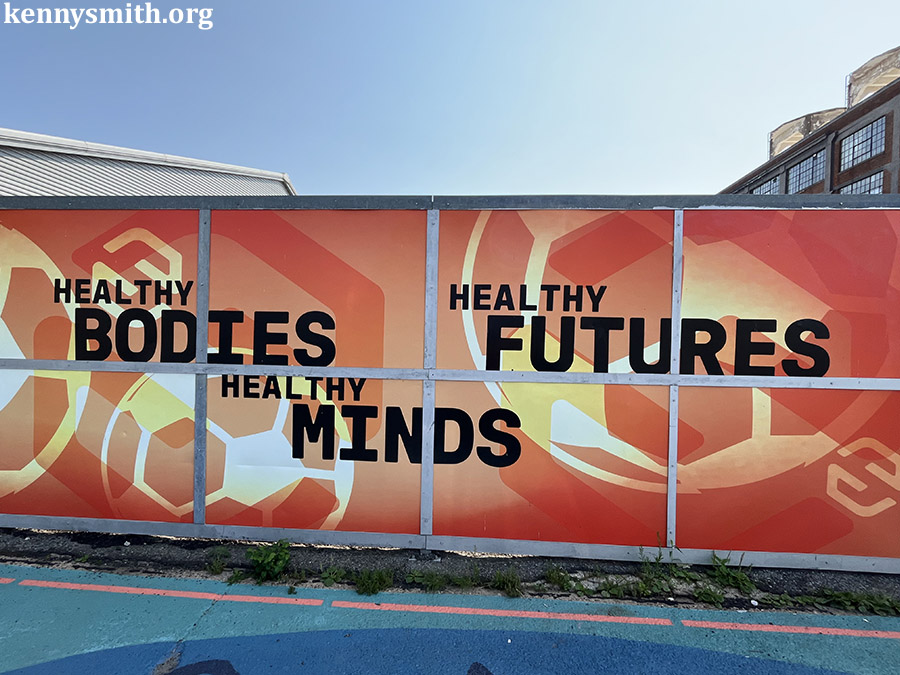
Sport, as we talk about in classes a lot, means a lot more than just what happens on the field. In one class I teach a section on the real values of youth sport — fair play, collaboration, health, socialization, discipline, rules, respect, etc… — and that’s what this organization is after, too. What’s really interesting, to me, when I talk about those life lessons with other people that played youth sports, even college students who aren’t that far removed from it themselves, they quickly see how it helped them. We don’t always realize it at the time, but it is apparent in retrospective. It is obvious the value we can offer people. It is a mystery there aren’t more deliberate programs just like that.

And when you compare that to the infamous travel ball experience … no contest.

Stuff on the site I’d like to do, since I mentioned it … There are two or three of the old running projects I’d like to return to, and I will. I have to wrap up the local markers project. Easy enough, and that’s the one I combine with bike rides anyway. When the weather turns. I want to return to the happy habit of scanning photos from old books. It’s time intensive, and that’s the problem, but ultimately it entertains me and makes this place look, determined to follow ancient thing.

Another thing I’d like to do more is diving into old newspaper clippings. It’s a great way to learn about a place, or remember about a place. But it seems odd to do that about places where I no longer live. And the place where I do live doesn’t have a wealth of digitized newsprint online. This could devolve into a “where do you belong?” paragraph, but this is Wednesday and while all of my projects on the site ideally would have a day of the week, roughly, the old existential issue is not a Wednesday item. (Wednesdays are for markers, if you’ll recall, and they will be so once again.

These projects one need only invest the time and I say the thing I always say to myself, “After so and so … then you can do that.” And that never changes, but it at least has the added advantage of being frustrating.

Tomorrow, back to the classwork. If I can bend my fingers to the keyboard.

5
Aug 26

Happy Birthday to the website

Two things started within 367 days of one another. On August 4, 2003, while reading a lot of Salam Pax (who may work for UNICEF now?) and Raywat Deonandan (who is definitely at the University of Toronto) and a local guy named Terry Oglesby and a few of the newfangled political blogs, I started a blog myself. It was going to be bad, I knew it was going to be bad. I thought it might get better. (And 23 years later the jury is still out.) But you know what? I had free time and no money and I needed a cheap hobby.

On August 6, 2004, some friends at work, most notably Brian McAlister, (now at Advance Local) convinced me to drop a few bucks on an actual URL because I had free time and just a few bucks.

Spending money is always tough, but I was sick of temporary sites and pop-ups and losing control of what my three visitors saw when they remembered to visit. I knew what I wanted, somewhere I could put some things from time to time, and some place I could play with coding from time to time, some place without ads.

But we must back up. A college buddy of mine, Stephen Kiser (now an economist and professor), sold me a line about how if I learned some HTML I’d add $10,000 to my salary. I was in undergrad and believed him because he was a bit older than me and seemed like he knew what he was talking about. So I spent a summer in college teaching myself how to code, and found that there was something about the process that was satisfying. I never got great at it, but I never wanted to be a computer scientist or a backend developer anyway. I was this other thing. I was the person who could write both HTML and AP Style. There was exactly no one else like that around when I graduated college. In everything else in his life, Kiser might have been right, but I’m still waiting on that extra cash. Though, writing in, or dabbling in, code figured into every job I had in those early years.

Here’s a screen grab of what the site looked like in 2006 (just the second or third version of the site).

I like sharp, clean design. I was trying to write that with as little code as possible, just for the challenge of it. I was editing the photos by hand, and in probably the hardest way possible in 2006. Because I always got bored with images — that hasn’t changed — I would regularly update them.

The general way I display the site has changed. I have the front page, of course, with all of the buttons, and most everything else I put through here, or just store on a hidden page deep within the recesses. The traffic has changed, a little. That first August I had 3,670 visits. Now I get about 200,000 a month, for some reason. Some of that is bots and various bits of code, sure, but there are a lot of people in there. May of this year was the biggest month of the site’s history, and what people saw the most that month was one of the cats being silly. Perhaps later this year the 10 millionth visitor will swing through. I wonder what will bring them in. There’s only 22 years of the things that interest me that might catch their eye.

This has been, and remains, a hobby — a place to ramble on about whatever has caught my interest, a place to memorialize photographs and other files, and the occasional thing I am fortunate enough to post elsewhere. While websites have taken a hit in popularity because of the dopamine that sits inside the walled gardens of social media, I didn’t start this to try to attract crowds. Still, it amuses me that, so far this month, folks from Belgium, Great Britain, Japan, and Canada have been on the site. Germany, Brazil, India, and other nations, too. One person, each, from Andorra, Anguilla, Bahamas, Iceland, Maldives, Mozambique, and Zimbabwe have been here. And you, wherever you are at. I’m glad you’re visiting what is, ultimately, a semi-casual, personal site.

I don’t know why you’ve come here, but I am grateful that you came back. I hope you’ll come back again.

Tomorrow, we’ll be checking in on the kitties, I’ll ramble on about school work, fret over this and that, and more.

Thanks for being a part of this.


3
Aug 26

This covered more ground than anticipated

It was oppressively muggy — central Arkansas muggy — last night. Also it rained. Rained all night. Rained into the morning. Thunder was my alarm clock. The storm front blew away mid-morning. We’ve been in triple digits with the heat index into the early evening. I’ve sat here to sweat.

I spent several hours doing work stuff today. Don’t you want to know about it? I had to find the notebook that held the fall 2025 notes for a class I’m teaching again. I figured it was in one of three places, and I found it in the third place: a bookcase. Also, there were two notes books. So many notes I made for myself! I’d forgotten that.

When last this class met it was a twice-a-week class. This fall it will meet once a week. So the bulk of my day was in starting the reorganization process. Moving things around, renaming modules. Oh, and I updated this document I maintain with pages and pages of university resources. And I updated the syllabus for the course. It’s funny: some parts of working through all of those details can be easy, and some parts seem like a huge effort.

Apply that nonsensical observation for most of my days for the next five or six weeks.

Tomorrow I’m going to restructure the outline of that class. Hopefully that will be done by Wednesday. The rest of the week will be spent in making sure the work works right for both the style, and schedule, of this new version of the class. And I need to figure out how I’ll update the old slides in an efficient way.

That, I think, will be solved by some inspired bit of epiphany. Or I’ll just do it the long way 15 times in the next few months. Copying and pasting is such a bother, innit?

Also, I have to work on two other classes. I suspect I’ll begin one of those next week. The good news is that they aren’t starting from scratch. I’ll just agonize over them as if they are.

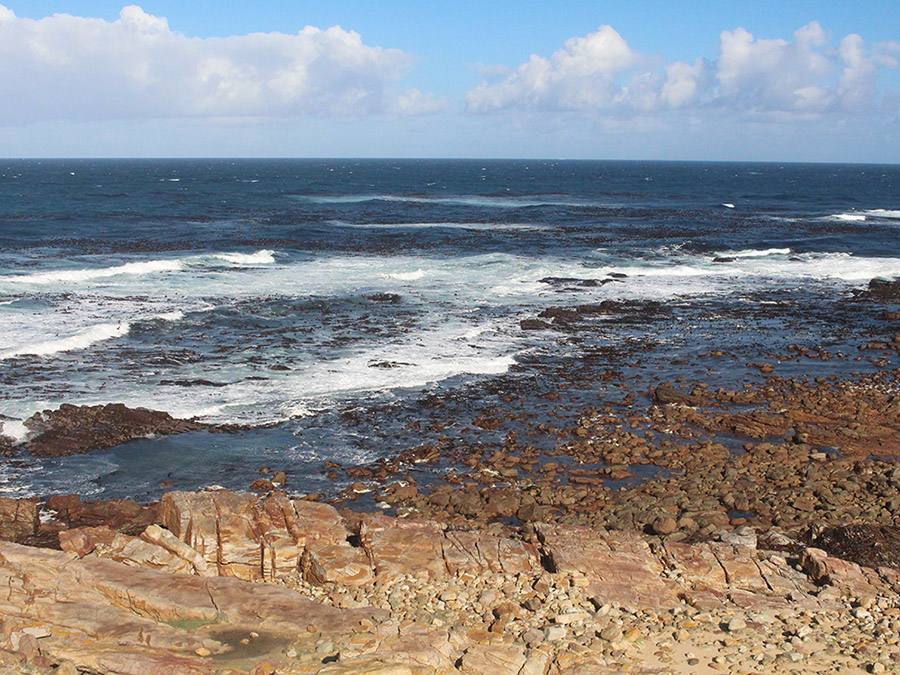
There’s a new look to the site, and if you go to the front page you can see it now. It starts like this, the Cape of Good Hope, South Africa.

Go ahead and look. That link will go to a new tab. Give it 60 seconds of zen. This page will be here when you’re ready.

The new idea for the front page is to update those images each month. If I don’t mess that up I have front page updates prepped to take us into next June. If I don’t mess it up.

I also updated the mobile version of the site. Just some easy text corrections and changing a few buttons that needed changing. Still not sure why it looks as intended on a phone, but broken in a computer browser. That’s an issue for another day. I wonder how many times I’ve said that about this issue.

And, of course, because the first of the month was this weekend I also did all of my regular monthly computer updates, changing various files, updating spreadsheets, cleaning up files, and so on. It’s not the most fun thing to write about, but this is is an old machine now, and it’s necessary. Fortunately these are easy chores.

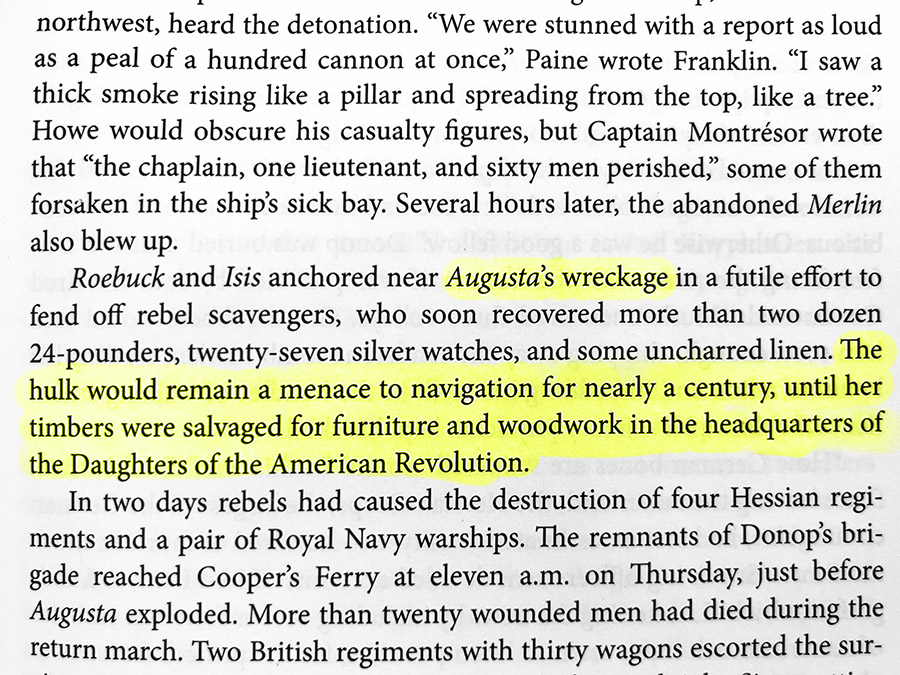
Do you know that feeling when you learn something new and you just have to tell someone about it? I learned this yesterday and I have to tell people about it. Admittedly, I like this tale more than anyone else will, but I have that feeling, and so now you get to learn about this too. And for that we must return to Rick Atkinson’s Fate of the Day, the second in his Revolutionary War trilogy.

When the Augusta’s ammunition and gunpowder burned off the explosion was heard more than 50 miles away. The vessel’s remains sat in the water for about 90 years, a sometimes navigational hazard. I found a great 2015 lecture that talks about the ship, recovering the vessel’s remains, a tourist attraction, scavengers, and then …

That appeals to me in more ways than one. I’d just like to make things and then point to them later and say “That came from …” and the rest of that sentence not be “the lumber yard.” You can see some better photos of the HMS Augusta furniture and paneling from the DAR themselves.

Here’s one other, unrelated, Revolutionary War note for the day. Just 250 years and one day ago, John Adams wrote to Richard Cranch, the colonial watchmaker, clockmaker, and repairman of Boston. He talks about the inoculations against smallpox and a few other events of the day. But also this.

You mention the Exultation at a Declaration of Independence. Is not the Change We have seen astonishing? Would any Man, two Years ago have believed it possible, to accomplish such an Alteration in the Prejudices, Passions, Sentiments, and Principles of these thirteen little States as to make every one of them completely republican, and to make them own it? Idolatry to Monarchs, and servility to Aristocratical Pride, was never so totally eradicated, from so many Minds in so short a Time.

I’ve rambled on a bit, as it turns out, a few times recently about the public moods of those heady, dangerous, uncertain days. It’s not as if they had a bunch of surveys in the field to gauge things on the home front, or beyond their own social circles. They just knew what they knew, heard, read, and felt as they did. But there’s the great John Adams, certain of a sea change all the same.

It’s a remarkable kind of public politics, really. A revolution of its own, perhaps. Gauging the public interest like that wouldn’t have mattered quite the same way to a monarch. And it matters, of course, more and more now. Also, we still find the pros guessing at it often as not.

Cranch and Adams had been friends for decades. It was the watchmaker that introduced Adams to his future wife, Abigail.

I guess you could say, at both points, Adams knew what time it was.

Cranch married Abigail’s sister, so they were all related. And while the couples remained close, John kept his friend at arm’s length over money-making schemes. Cranch was not lucky in business. But, he served in the Massachusetts legislature, and was a trial court judge for almost 30 years. He and his wife died within a day of one another. He was apparently a forgotten man until modern historians wrote about him in just the last few years. His son became a federal judge in D.C. Two of his grandchildren became a painter and a minister. One of Cranch’s great-grandchildren was a man named Henry Ware Eliot, who became president of a brick making operation in St. Louis. And this is how history never ceases to astonish me. This man, the great-grandson of a Revolutionary War era man, died in 1919. Henry Ware Eliot, by the way, was also the father of T.S. Eliot.

I didn’t see that coming, either.

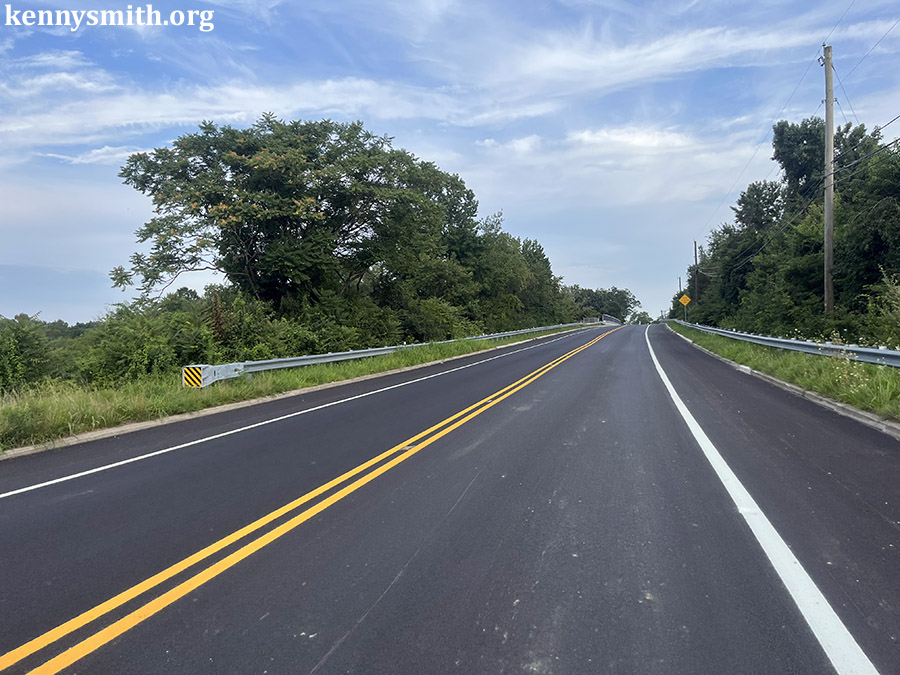
I had a nice ride Saturday evening. My lovely bride was off having a girls’ day and by the time I set out I had most of the roads all to myself. It’s quite lovely to be out when most everyone is already where they need to be. I did the river ride, which is the second route we designed for ourselves when we moved here in 2023. We haven’t done it in a good long while because a bridge has been closed since July of last year and there’s a sad and spooky part after that, but the road is opened once again.

Just behind me in that photo is where that new asphalt begins. If they’d just paved down another 100 feet or so (and, again, this road was closed for a year, they had time) they could have repaired the biggest mess of potholes you can find in the county.

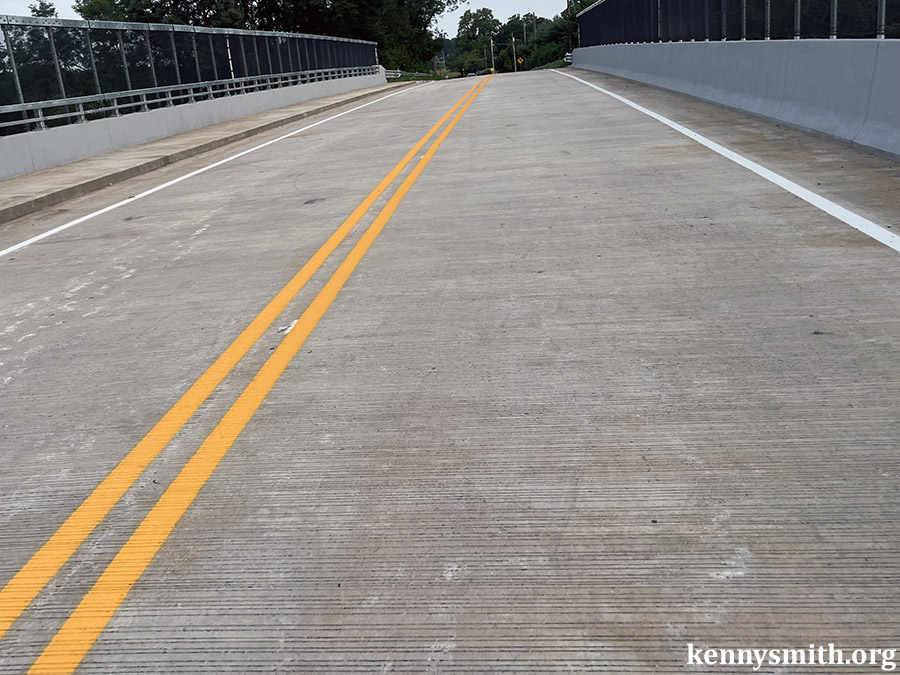
When you get to the bridge it has that new overpass smell.

New overpasses have smells. Turns out it is not a pleasant smell, but surely it will descend upon the highway below it.

On the other side of the overpass we regained a pleasant little downhill, and a stretch of land that gives you three or four houses on one side, and a cornfield on the other. There is an intersection soon after that, so it was only ever a closure effecting about 1.5 miles, but still, it’s nice to have that road back. This corn is a definite change of pace.

From there you go up a little hill, through more fields, past the famous local artist, respectfully cruise by a memorial, and sprint through a tree canopy so you can get to an access road that’s a half-mile, tree covered stretch of brand new asphalt. A car followed me down that road, but the driver stayed respectfully behind me while I tapped out something in the 20 mph range. After that, back off the access road, another overpass, more trees, watch out for deer, go as fast as you can by the house where the people always yell, and then into the wind.

If I go the way of our designed route I would eventually get to a four-way stop and go straight, but last year the county made a shambles of that stretch of road. If I turn to the right I can stretch this ride. The weather was nice, I was not pressed for time, and so I went that longer way, making my road selection as it suited my whim and wind direction.I stunk it up on the one real hill on the route, as usual. Twice, though, I broke 34 mph on a flat stretch. Haven’t done that recently.

Maybe I’ll do it again!


1
Jul 26

Happy July

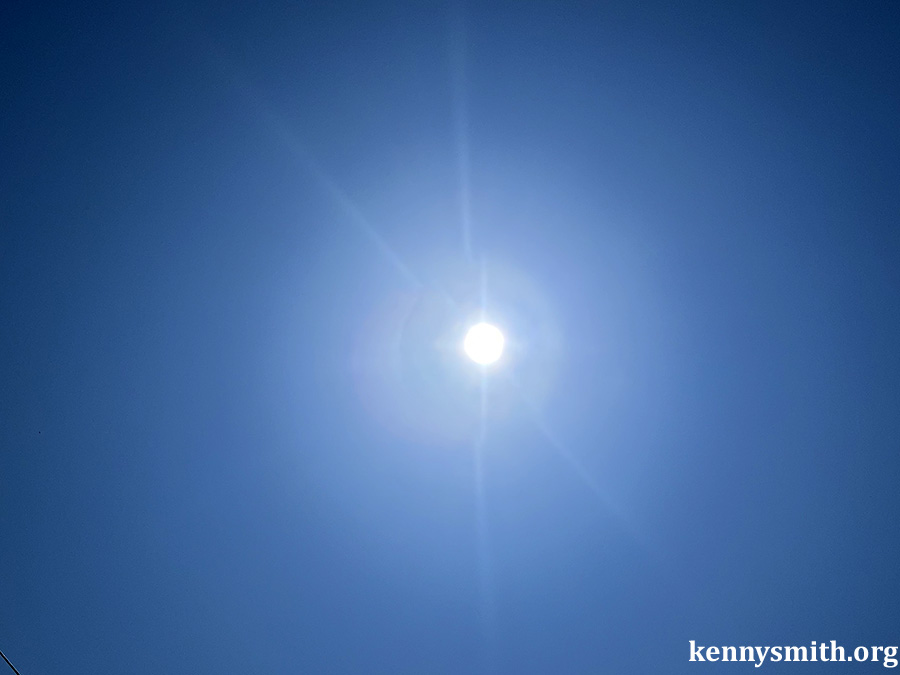
I went for a ride on the surface of the sun today and this will be the last time I do that for a few days. It’s a little silly. The heat index was 97 degrees at 11 a.m., when I took the defining photo of the day.

It did nothing less than make my skin hurt.

At the first of the month there is much computer work to be done. Templates must be updated. Additions must be made to spreadsheets. The desktop has to be cleaned, as does the downloads subdirectory. The trash must be emptied. New subdirectories must be made on the website.

Also, I laid out a bunch of stuff that’ll appear on the site starting next month. And I added new banners to the header and the footer here. One got eight additions and the other got seven. Those images randomly load each time you come to the page, or refresh. And you should refresh a lot. There are 133 headers and 134 footers see now. How many is enough? No one knows. There’s also a back end page I keep for all of those images and … well, this all takes a few minutes.

Plus I’m itching. Plus I’m reading.

Hey, I put 223 photos and six videos on the site last month. I told you we were going to have some slow days in the near future. That future is now.

Tomorrow will be all about the heat.


7
Jun 26

Robben Island

The human spirit sometimes offers us two rare gifts. One of those offerings is a simple recognition of its largest capability, something which is difficult to understand. The rare willingness of the spirit to be overruled by the heart is the ultimate gift of self-possession. The capacity to look at what has been visited upon oneself, and to see beyond it, is a remarkable thing. It is selfless and it is with great intention, a promise to oneself. I will free myself from that which would imprison my nature, if not my body.

You see it from time to time. You see it in wonder. Often at its core is a willingness to offer forgiveness or understanding. Religion, insight, the bigger picture, they all have something to say about this. So does Modise.

He was a political prisoner at the notorious Robben Island. Now he is a guide on the island. He lives there, at the place where the state once held him, and he tells his story, and the story of the other prisoners, and the centuries old place. He bears the scars of his torture. He shows some of the physical ones, and talks of some of the mental ones, and that is only a part of his conversation with his guests, but certainly not all of it.

I realized, too late, that I should be taking notes of all of the things that he said, and so I don’t have a complete recitation to offer you. To try to share parts of it seems, somehow, insufficient and not to say inappropriate for what it would lack.

For years, Modise had a view of walls and barbed wire and the quarry where he was worked. He was incarcerated because, as a student, he stood for for racial equality. As an elder, he talks about forgiveness. Reconciliation. Understanding. To Modise, hating the people who held him here, to foster the bitterness of youth and nurture the anger of his jailtime would keep him a victim. He’s come to see that everyone he encountered, even the warders, the people that ran Robben Island, were all victims of apartheid.

The human spirit is full of wonder.

Modise rode with us on a bus around the island. We saw a lot of the buildings from the road, the quarry where the prisoners worked, the inmate cemetery, and the parts of the island that the prisoners knew nothing about. He dropped us off with another guide for a walking tour.

Have you ever been on a tour where guests hugged the guide at the end of the tour? I have. Today.

We had heard, of course, that Robben Island was a trip to take. You go out by ferry and follow the group along on a guided afternoon. We had heard that, at one time, there were a lot of the former prisoners giving the tours. That’s hard to contemplate. Wouldn’t you want to get as far away as possible? But people told us that this was the way to have taken in the experience, but that there were fewer and fewer of them giving tours today. The personal first-hand experience was becoming more rare. I asked Modise how many still gave tours. He said about a dozen. Then, he sent us inside to see the facility itself, as guided by another former inmate.

One of the mass cells.

There are holes cut into the walls, for light, but there were no windows, so the weather was unavoidable, no matter the weather. We were there on a pleasant, if gray, day. This was not, we are told, a comfortable place.

Our second guide had a great big booming voice. Rattled in your chest, bounced off the cement walls, came back to rattle your teeth. He talked with his hands, forever dancing, no matter if it was a moment of seriousness, or one of his well-trod jokes. The sleeves on his jacket, rubbing against his chest and stomach as he moved from the elbows, were his accompaniment, and all of it in this same, steady rhythm.


There’s a spare courtyard and along the back wall sits this tree. And our guide said that Nelson Mandela, who was a political prisoner here for 18 years, buried his autobiography behind it while he was writing it. It was smuggled out out of prison, and on to London. And I’m staring at this tree when, a week ago, I was at another prison that held Mandela, and at his home, staring at a tree that he planted and trying to remember the bit I have learned about trees in the local cultures, the epicenter of food, shelter, law, memory, trade, medicine, art, identity, the place to anchor your home, the place to hide your story.

While Mandela was here for 18 years, our first guide was here for five, but their time did not overlap. Our second guide was here for a bit longer, and he was here during some of Mandela’s later time. They slept on straw mats. They did hard labor. They were physically and verbally abused. Over time, some conditions marginally. How a prisoner was classified dictated what few privileges they might receive, even down to the number of guests or correspondence. In the late 1960s prisoners were given pants, an upgrade from the shorts they’d previously worn year-round. In 1973, somehow, Mandela managed a bed in his single-occupant cell. It was behind this lock.

Through these bars. And if you’re wondering if that paint was chipped by fingers and nails, you aren’t alone.

I lingered behind the group, staring at those bars, and it took a bit for it to register that this was Mandela’s cell. He lived in this 8-foot-by-7-foot space.

This was the end of the tour. You walked down the last of the corridor, away from those individual cells, and out into another hard, gravel courtyard. Our guide was standing at the gap in the wall, trying to count his guests. I told him I was not the last person out, there was one more guy behind me. I stopped and talked with him for a moment. Shook his hand. Thanked him for telling his story, for keeping this story alive. He smiled and pointed, “And now you can take your short walk to freedom.”

I stood and watched him walk across the front of the place, back to where he picked us up. A lone elderly gentleman, head down, strong shouldered, doing this thing he’s done for who knows how long. I wondered how much longer he would do it. I wondered if he was one of the men he talks about in that clip above. I wondered if I was right, when he told that part of the story, when I thought Simply another kind of political prisoner. I wondered what that meant. I wondered how many more people would get to hear these stories from people who had lived it themselves. I wondered about the rare moment of history that we are sometimes afforded like that and what is lost when that moment passes as the eye-witnesses and participants and survivors pass from us. I wonder about that tree.

Almost by chance, as I walked back toward the ferry, I saw these statues in the distance. We were being urged to hurry, and they were too far away to see. But I have since learned that they were in stalled last September. They are likenesses of six of the former political prisoners here. They are, Khotso Seatholo, Andimba Toivo ja Toivo, Robert Sobukwe,
Nelson Mandela, Krotoa, and Autshumato.

All but the last statue were produced by Cristina Salvoldi.

We took the ferry back to the mainland. The ride was just long enough for darkness to fall along the waterfront. (This shot will join the banners on the site one of these days.)

You come off the ferry, down the ramp, up some stairs, down some stairs, up some more stairs …

And into the night. We had dinner near the waterfront, smelling of dead fish and whatever the sailors next to us were smoking. It was one of those where you try to finish before you lose your patience, and before the rain returns. Also, there was a shuttle to catch back to our hotel. We got the last one back, for a late night in.