photo


18
Nov 19

Remember the old saw …

Measure once, cut twice? I’ve been measuring and measuring.

First, I created a test version of this project I’m working on. And we decided how to change the project. It is going to be smaller. Just six inches high, and not seven and change. And so the work model was disassembled. Part of it was plywood, and that was stacked away neatly for some future project that might require quality plywood.

The original side pieces will be re-used for the finished project. So I ripped them down to size this weekend:

And I took some extra pieces of pine and cross cut those to (more or less) the width of the finished project. It will require three pieces:

One of them is warped. It might have a warp in a whorl, I don’t know. But I think I figured out a way around that. Measure twice (measure a few dozen times) and cut once.

Then! Use the belt sander to sort it out:

I’ve learned several things, working with wood the last two years. One of those things is that I prefer the product to the process. So it’s a nice side hobby, but this is never going to be a primary interest. (Begging many questions, I know.) I’ve learned which parts of the process that I like less than others. Usually it has to do with some moment that marks no going back. But, I remind myself, measure twice and so on. And I’ve learned to recognize when it is time to stop for the day. Before you get frustrated. Before you rush. Before you hastily get past some no-going-back moment that belies the notion that it’s only wood. Before the process wears you out.

This was much of my weekend.

At least until I overdid it with the belt sander, so the new phrase is this: Measure twice, cut once, use the belt sander to sort it out, and then cut it again.

So, really, get lumber larger than the size of your finished project. For refinements.

And this evening I glued up and assembled some of the pieces. Later this week I’ll make the final cuts, and glue the final pieces. And then, we’re going to finish the project, so it is a finished project. Probably next week I’ll show you what this is.

Turns out I’m a slow worker on matters that aren’t the primary interest.


13
Nov 19

Historic parchment

Seventy-five years ago today Indiana awarded alumnus Ernie Pyle an honorary doctorate. He grew up not far away, attended school here, worked at the campus paper, left a bit early for a professional newspaper job.

He’d said “(M)y idea of a good newspaper job would be just to travel around wherever you’d want to without any assignment except to write a story every day about what you’d seen.”

A decade after that he got to go on the road and write all of those columns that made him mildly famous before the war. It was there that blogging began.

Anyway, when the war came, one of the most well known domestic reporters would become the best known war correspondent, first in Africa, then Europe and everywhere he went, really. He was beloved, because he wrote about the GIs and the Marines, and not about all the generals. He lived it with the soldiers and sailors. It was tough for him, just as it was for all of those in the fight. They loved him because they thought of him as theirs.

And in November of 1944 his alma mater gave him a lovely little sheepskin. He belonged to Indiana first.

He would become something more than an accomplished and famous alumnus. The journalism people at IU, over the years, essentially canonized him. For decades they worked in Ernie Pyle Hall. Outside the new building is the famous statue. And his desk today sits one floor above my office. (I used to be one floor above that desk, but they moved me for reasons that still surpass understanding.)

On this floor there’s a display with some of Pyle’s personal effects, on loan from owners or university collections.

Here are his medals, and a not-often circulated photo of Pyle and Generals Omar Bradley and Dwight Eisenhower.

Of Bradley, Pyle wrote in September of 1944:

He is so modest and sincere that he probably will not get his proper credit, except in military textbooks.

But he has proved himself a great general in every sense of the word. And as a human being, he is just as great. Having him in command has been a blessed good fortune for America.

Here’s Pyle’s entrenching tool. They said that the writer was the foot soldier’s best friend. But they also say that a soldier’s best friend is the earth. And this is what Pyle would have used to dig holes for cover, for sleep and so on. It’s not difficult to see that spade, in hand, digging frantically into all different types of soil and sand. It’s easy to see the wear on that handle and wonder about the fear and worry that any man would have felt when they had to dig and dig and dig.

He wrote about being a part of the tragedy of Operation Cobra, which brings home the importance of all of that digging.

In 1943 Pyle wrote a column calling for combat pay for members of the infantry, airmen, after all, were granted “flight pay.” Soon Congress voted for an increase in pay of $10 a month for combat infantrymen. The law was entitled “The Ernie Pyle Bill.”

Pyle was awarded the Pulitzer Prize for Correspondence that year, for “distinguished war correspondence during the year 1943.” He typed some of his work on this very typewriter:

Of course he also wrote in his letters, and perhaps in his columns — it gets hard to recall directly from memory, because his style was the same in a letter to his friend or to readers or to his colleagues — about his typewriters. A true devotee of his craft, he thought of his tools.

This is what he wore in Europe. The standard issue field jacket. He didn’t have a rank, but on the left shoulder was a simple patch: war correspondent.

And his passport is there as well.

He received that honorary doctorate 75 years ago today. The next April he was killed in the Pacific, and we all lost a talented scribe.


12
Nov 19

Burrow under something

This was the other night. I stepped out to the backyard to cover the grill. We’d grilled out, because that’s a thing that was still a good idea, given the pleasantly mild evenings and the food in the kitchen. And when you can eat something from your kitchen and it is prepared in comfortable conditions, then you do so, and you spare a moment somewhere in between bites, to be grateful.

Because the moon was high in the sky, and the moon always shines bright here. You can read by it on a clear night. I’ve done it. You can stand under a full moon and see distinctive figures at a considerable difference. And even under a gauze-thin layer of clouds, you can’t help but remark how the night sky lights up. It’s something to be grateful for.

This was tonight:

Less grateful, really. But I didn’t have to be anywhere, so it was something to admire from inside, or the porch. And I could be grateful for that.

This was today:

Cold. But at least the sky was blue. You give me the option and I’ll wrap up against the cold and deal with the snow and take the blue sky, and be grateful.

Or just so long as the snow melts soon. It turned from fall to winter quickly. We’re stuck with this for a long while, though. It won’t melt soon enough. It’ll turn grey; it will stay cold.

Dipped to 19 today, with some considerable winds beside. But most of the day was indoors. (I have a rule about that, and I honor the stay-inside rule.) Even still, we’re flirting with those numbers where the chill gets inside the muscle and threatens the bones.

Even the Yankee cats don’t want anything to do with that:

Seems like a good place to nap.


11
Nov 19

We eeked perhaps the last bit of autumn out of the weekend

Hey look, it’s the Circle Tower! You can see the name, right there on the side! Completed in 1930, it is today on the National Register of Historic Places as part of Indianapolis’ Monument Circle Historic District. It features what they call smooth-dressed Indiana limestone, with the defining characteristic being the stepped back top stories.

I was more interested in the sign on the side. Some kids were more interested in calling it a pyramid. It’s more of a ziggurat, actually, with those upper stories receding from the outer façades in terraces.

(While pyramids were tombs, ziggurats were temples.)

The tower is one of Indianapolis’ prime examples of Art Deco architecture, especially this metalwork.

This is the north entrance, a one-and-a-half story arch lined with foliate banding. Circle Tower, being completed just a few years after King Tutankhamen’s tomb was rediscovered. Egyptology being a big fad of the time, you got a lot of decor like this:

Sculptor Joseph Willenborg, a German immigrant, filled the bronze grille with the hieroglyphic-like images. This is one of his more memorable works. He also has a lot of work in the nearby theater, the Purdue music building, several prominent hotels and a few social clubs, but the Internet runs out of information on him pretty quickly after that.

Here’s a quick look at some of banding that weaves its way around the door:

But we’re not here, early in the morning, wearing multiple layers in a serious chill, for architecture. We’re out in the cold, after waking up hours before dawn on an off day, for this picture:

By the time the sun woke up and burned off the morning grey, it turned into a lovely morning. Here’s the scene at the finish line:

And if are ever doing something and they give you a medal, make sure you pose for pictures at the capitol.

By the afternoon, the day turned out quite nice indeed:

Sunday was a beautiful day. Perhaps the last one for a while. We, of course, celebrated it with a bike ride:

Today? The bottom is falling out of the thermometer, the latest arctic blast — or whatever we’re calling this one — showed up, along with rain, which turned to snow. I watched it blow in the air in every direction. I watched it give an optical illusion of hanging in the sky. I watched parts of things get accumulation, and others just getting wet. And I watched it start to create little piles on the wooden deck and the chairs and the shrubbery. It was a good day to stay indoors.


8
Nov 19

Today we partied like it’s 1899

I’m flipping through a 50-year-old periodical. My grandparents leafed through this same book. That’s how I came to have it. It sat in storage for decades and then I got to go through a bunch of things and sometimes that’s how things of no real value are inherited. Some night in an Alabama spring, perhaps, my grandfather read some of these articles, whichever ones might have interested him. I’m taking pictures of the ads with the supercomputer I carry in my pocket. (I wonder what he’d think of that.) So, you know, the same experience.

Anyway, you can check out some of these images too. We’re about halfway through this last copy of Reader’s Digest. Click the book below if you’ve been following along.

To see all of the parts of this issue I’ve photographed, click here. To see all of my grandfathers books that are, so far, on the site, start here.

Sometimes red lights aren’t a bad thing. I had just enough time at this one to see this, decide it would be a good idea to capture the moment, and then make it happen.

That’s just a thing we do now. The technology isn’t terribly impressive at this point. That we can do it is a minor modern miracle, really, but we seldom even acknowledge that these days. What’s impressive is that we sit there thinking Should I? Is it worth it? What’s impressive is how quickly we’ve adjusted and adapted to do that.

Sort of like electricity. Sure, that’s my great-grandparents wonder, and your birthright, but you only think that because it is there every day, all day. We lost power on campus today, and the hard-working electricians from the power company didn’t get the entire outage restored until late in the evening.

I was watching a group prepare a television program when everything went off. They ended up doing it with field equipment and lots of batteries. I checked in on a handful of students who were about to record some podcasts, but they were out of luck. I visited with an instructor who was set to deliver a big social media lecture with videos and slides and, oops. She did the whole thing in the dark, students looking for examples on their laptops, eyes occasionally darting up to the power icon. I gave a tour of the radio station to a high school student, using flashlights. I sat in the dark at the end of the day and caught up on a few emails, also with my eyes darting up to the laptop’s battery icon. Welcome to Indiana University, in the 19th century. Except it is nothing like that.

A view from the parking deck this morning:

That tree is pretty incredible, but I bet it will be hardly recognizable by the next time I have a chance to check on it again.

I’m proud of this tree. The leaves show up early in the spring and they’re staying for as long as possible. Not like those maples, quitters that they are.

The still-novel-to-me parking deck foreground shot:

I just looked up at this one and thought the lights and colors made for good lines:

Speaking of maples, this Red maple is probably the last one still trying. But the green is gone, the yellow is giving ground. The seasons must grind to a halt.

The Red maple, then, is nature’s traffic light. And next week, winter will be here. Until April.

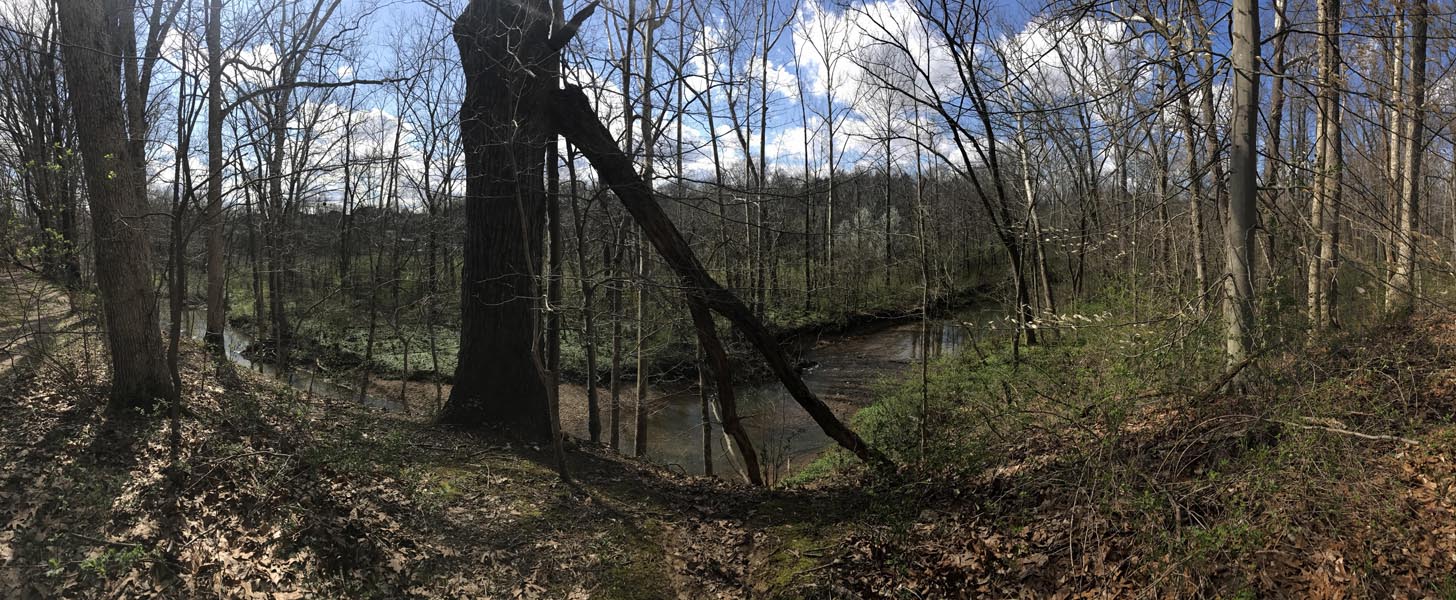
Probably the next time I show you the River Jordan, it’ll be frozen.

It’s diminutive for a river, I grant you. I prefer the previous name anyway: Spanker’s Branch. Maybe there was someone named Spanker, maybe parents spanked their kids for getting in the creek. No one knows why it had that name. But from such harmless mystery good lore can emerge. As it is we have to say: Jordan was a 19th century president who didn’t think a building should be named after him, so he said just name the creek after me and by the 1920s people were calling it the Jordan River casually, and it was formally renamed in the 1990s.

Spanker’s Branch is the better name, then.

But what’s even better is the weekend. And I hope you have a great one!