


We’re going back in time 90 years so we can see, just a bit, of what college looked like at my alma mater in 1936. Some of the great old buildings are there, some not yet so old! It’s starting to look modern, in campus and in the people. But nine decades is 20 or so generations of student churn in a college town. And we’re more interested in the people, anyway. What was life like, in a cash-strapped university, in a poor state, in the middle of the Depression? Before the war, before the G.I. Bill brought the next population boom to campus, it was a different world — but some of this is going to look familiar.
This isn’t a complete examination, just a quick flip through some of the images and names that jump out. Even still, we’ll be looking through this for the next few weeks.

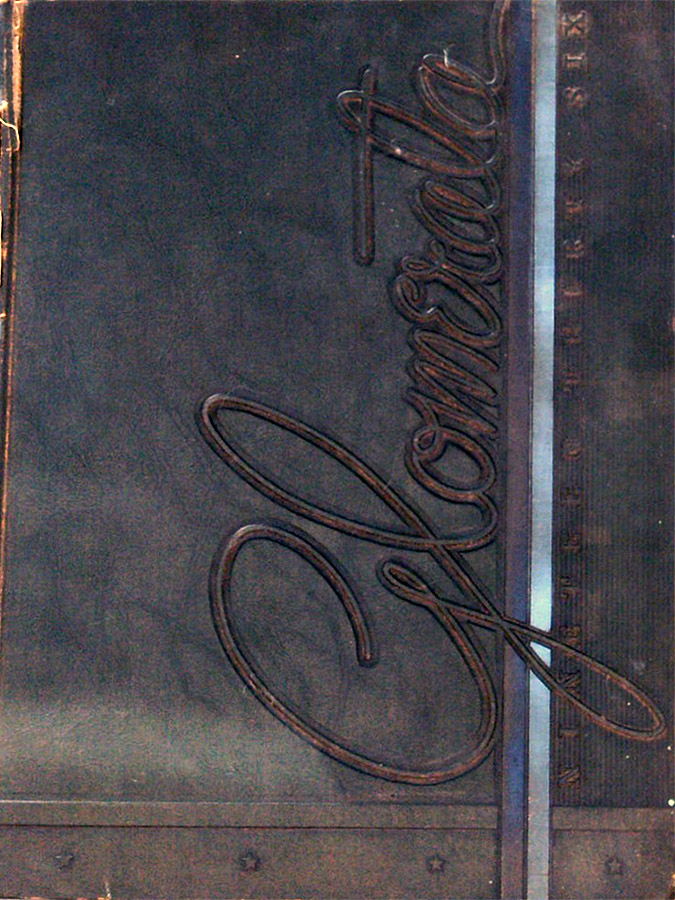
Clearly this particular book — which was unsigned and doesn’t seem to give us any context clues as to the original owner — has been through some things. I like to imagine that this is an Alabama clay treatment that someone put on the cover, just to remind readers of where most of the people inside came from.
Let’s see some of the photos from those first few pages. This yearbook was dedicated to university president, Luther Noble Duncan. (Guys you’ve already got the job.) The dedication reads:
Having labored unceasingly for the growth and progress of Auburn, Dr. Luther Noble Duncan is esteemed by the citizens of Alabama and beloved by the entire student body. It is with sincere appreciation of his services to the institution and profound admiration of his sterling character that we dedicate to him this thirty-ninth volume of the Glomerata.
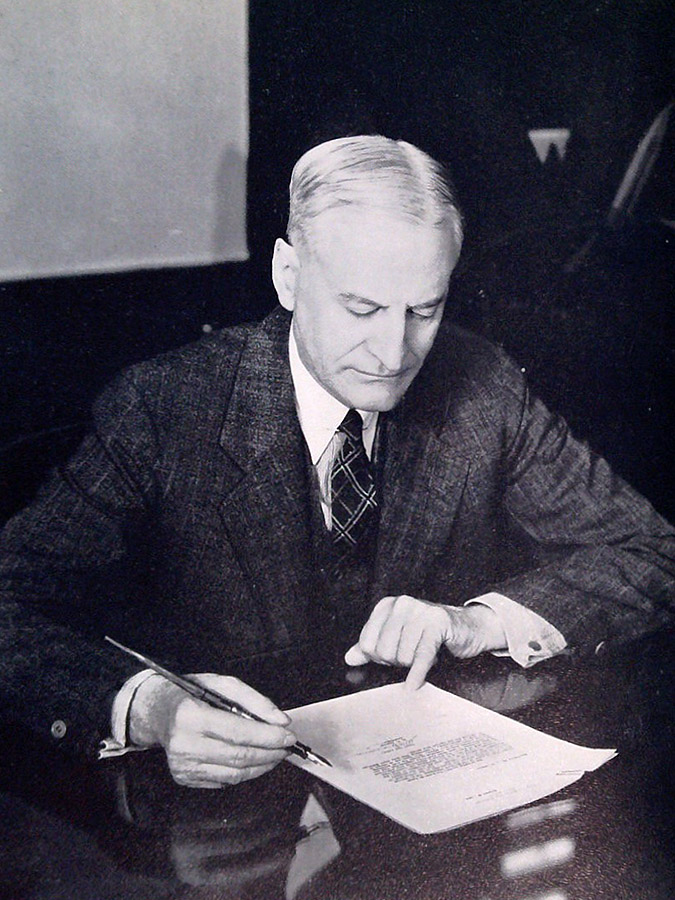
Just a few years earlier, when he was the director of the Extension system, the largest newspaper in the state called Duncan “a master of political trickery…probably without a peer, certainly without a superior, in Alabama.” The publisher of the paper sat on the university’s board of trustees. Duncan came to this job when his predecessor, a man named Bradford Knapp, resigned, citing pressures and stress. Knapp, the son of the distinguished agricultural reformer Seaman A. Knapp and president of Oklahoma A&M College, was academically qualified, but politically outgunned for this job. (And believe me when I tell you that is the everlasting theme of the place. Duncan moved over to the mansion in 1932 after the locals landed on the governor demanding he get the job. They liked his financial sense, that he knew the state and the players. And, by then, everyone knew about his abilities in the political arena. There was a lot of figurative knife-fighting involved in Duncan finally getting the job, in 1935. I’m sure there’s some thin allusion in the above dedication to all that transpired, but there were a lot of problems on campus in those tense times.
Early (in 1932), the committee made its first report to the board. They had found that the college owed $160,000 for various supplies and expenses. Approximately $300,000 had been borrowed from this operating fund and placed in the building fund in anticipation of payment on state building warrants, which never materialized. They also found $10,000 in unpaid interest on loans. The treasury was empty and the committee had been forced to borrow money to purchase stamps. The faculty and staff, who had been paid in certificates of indebtedness for the past ten months, had been informed that no one could be assured of a job after July 1, 1933. No concerted effort had been made to register students for the fall quarter that had just ended.
Because of his budgetary experience as extension director, Duncan played a crucial role on the administrative committee during the coming months. As of September 30, 1933, the end of the fiscal year, the college had paid forty-five percent of budgeted salaries. Early in 1934, the board authorized the committee to obtain all state bonds due to the college, to exchange the state building warrants for bonds, and to pay the school’s outstanding debts with these funds. By July, the faculty were receiving sixty percent of budgeted salaries. In early 1935, when the board named a president, the choice was clear. Hanson still opposed Duncan, as did one other board member, but otherwise the extension director enjoyed solid support.
There was also the political theater around something called the Teacher-Training Equalization Fund, which was, by this point, a several-years-long program that favored some institutions in the state over others for funding. This was nothing new. But it was changing. Just a few months after this yearbook came out Duncan won over the new governor, Bibb Graves, and the funds were equalized. This would be the first of many such corrections required for the university, over the next six decades or so.
He’s got a road on campus named after him, and also a building. I had an on-campus internship and an office in that building for almost two-years.
These past few years had been pretty tough on the Plains.
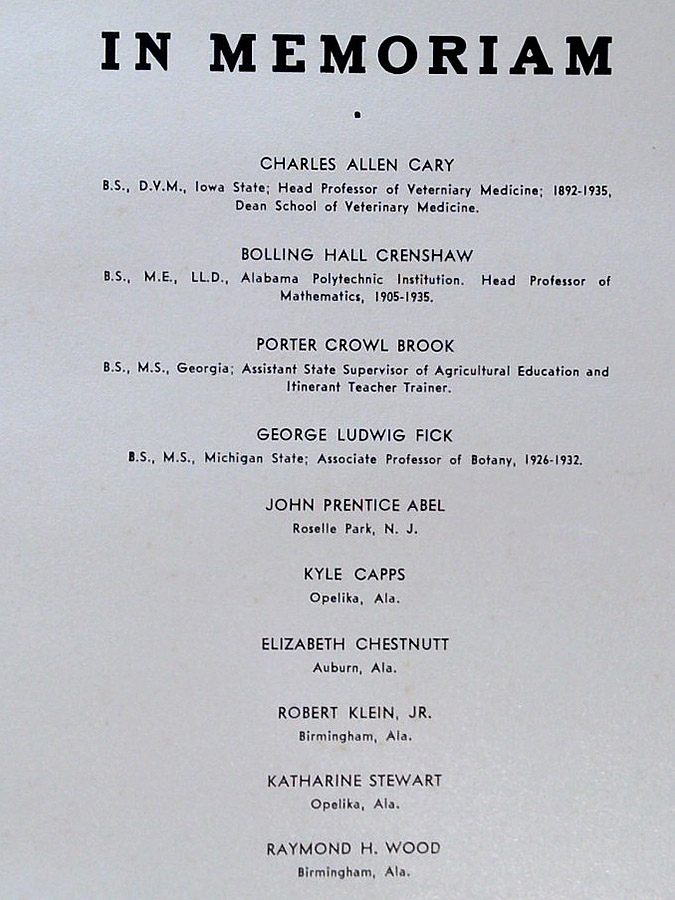
Charles Cary was the first dean of the vet school, and had been around for forever. Before he had that deanship, though, he’d also served as the first state veterinarian, and led in establishing meat and dairy inspection laws. He helped wipe out fever ticks in Alabama, pushed brucellosis and tuberculosis testing and the mass production of hog cholera serum. A few years later, in 1940, they’d name a building after him. it was the vet building for 30 years. Later, I had two biology classes there.
Bolling Hall Crenshaw was a local man, son of a judge, and taught the pluses and minuses for a long time. He was also part of a three-man executive committee that ran the university while they got their act together and finally decided to hire Duncan. His home the Crenshaw Guest House, is now a B&B — 12-foot vaulted ceilings, to golden heart pine floors, all Victorian design.
Porter Crowl Brook was a Georgia boy, the second oldest of six. He died in Montgomery at just 42. His wife survived him by 41 years.
There’s a George Ludwig Fick buried at Pine Hill. He died in 1936. His marker lists his Navy service, but nothing about the university. (Most all of the markers there do.) Also, I’m not sure about the years, since this says he left campus in 1932, but the Fick I found passed away in 1936.
They have a four-page spread of deans. The first one you meet is Marion Jacob Funchess, and he has clearly mastered the new art of the candid photograph. He has a building named after him, built in 1961. That place denies the rights and rules of physics. It houses the biological sciences department, entomology, plant pathology, agronomy and horticulture.
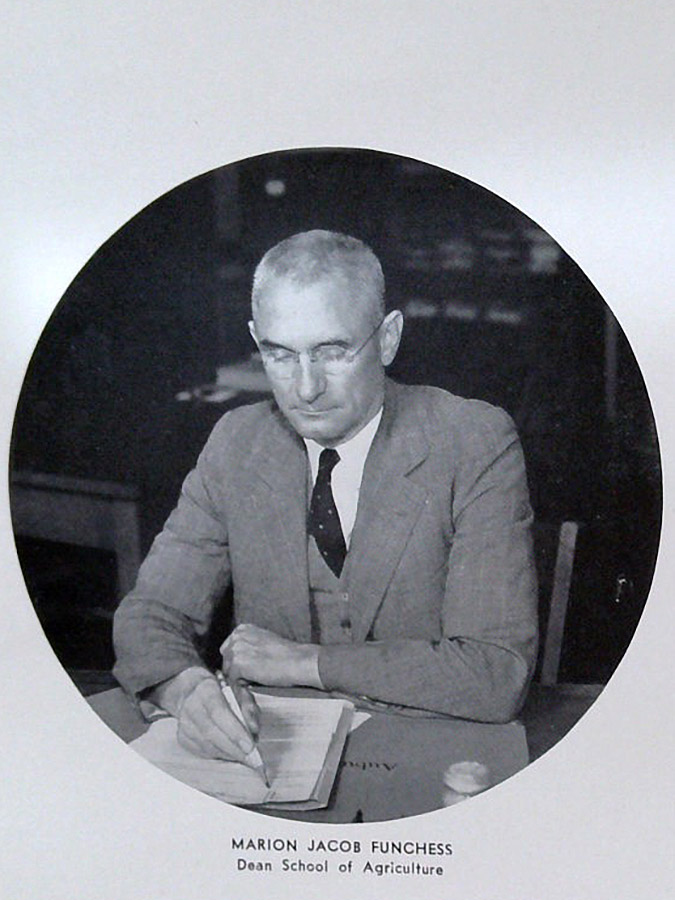
It smelled of formaldehyde and sawdust. It featured neglected taxidermied animals. I had … quite a few classes there, and so did a lot of my friends. We called it Funky Hall. It’s due to be razed sometime soon. (It is, in my estimation, on the list that need to go, but not at the top of the list. But that’s a discussion for another day.)
George Petrie, history professor, father of Auburn football, author of the Auburn creed. Man about town.
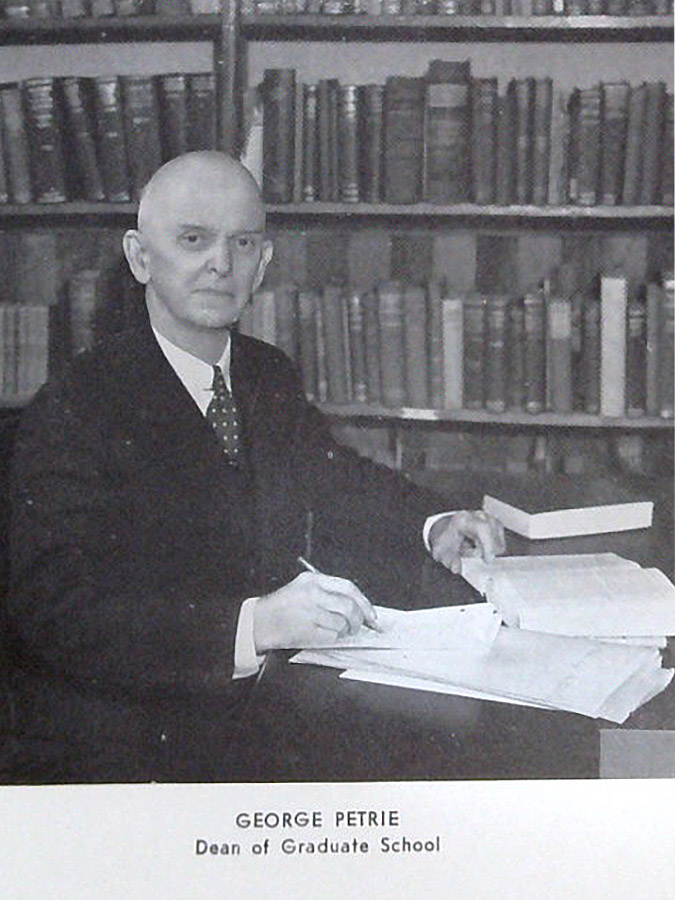
He worked on campus in varying roles from 1887 until his retirement in 1942. I wonder what happened to all of those books after that.
Petrie Hall was opened in 1939 as the athletics field house. Over the years it has had some academic uses, but has largely been administrative. Now it holds some athletics offices and storage. It’s a small building, in the shadow of the football stadium. How it has survived the march of progress I do not know, but I’m glad to see. I’m sure the name above the door has been a part of that.
John Wilmore would like you to hurry up with your little photograph, so he can get back to the important work of deaning.
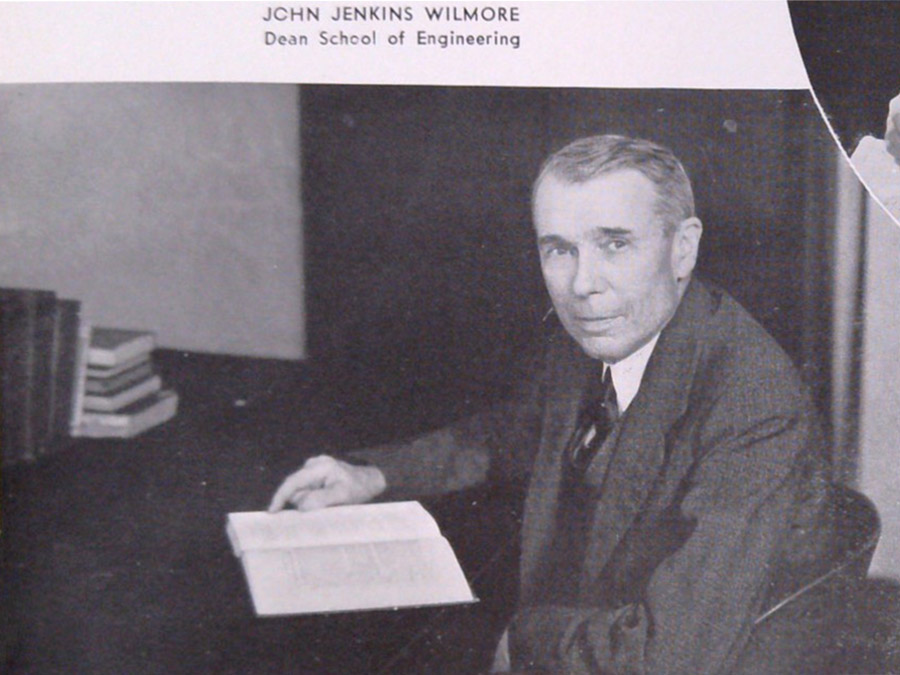
Educated at Purdue, Wilmore spent 55 years at Auburn, and was dean from 1907 until 1943, during which time the engineering program went from 20 students to around 900. It’s one of the biggest, most prized, most valuable elements of campus today. Wilmore also served on that three-person committee with Brook. The Wilmore Engineering Laboratories building, a 65,000-square-foot facility, houses the academic offices for materials engineering, and office space for all sorts of engineers.
Major Gustav H. Franke led the ROTC program. He was a star on the West Point polo team way back when. The Army lifer was an artilleryman by trade. He’d commanded the first U.S. unit to fire on German forces in World War I. So you know no one tried to pull campus pranks on this guy.
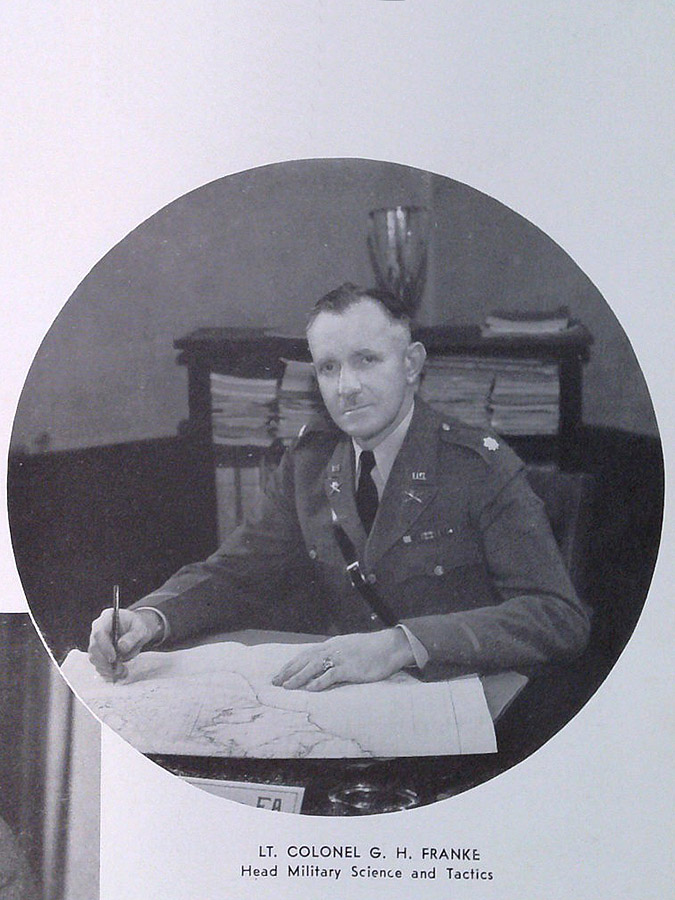
This was his last year on campus. When World War II came he found himself commanding the Field Artillery Replacement Center at Fort Bragg, and eventually artillery for the whole 6th Infantry Division. He also led the 81st Infantry Division at Fort Rucker (the modern Fort Novosel) and was largely responsible for the buildup of that installation. He would retire a major general in 1944. Both his son and grandson would later serve as army officers.
First it was a department, but it became the School of Architecture, or Architecture and Applied Arts, under Frederic Biggin’s guidance, a man so well-respected still respected well enough that they use his name for high-dollar donors. His house, a Dutch Colonial Revival that is on the historic register, has been gifted to the school for meetings and classes. A New Yorker, he was on campus from 1916 until his death in 1943. He had a daughter, and she had two children who have passed away in recent years. They all stayed in the area.
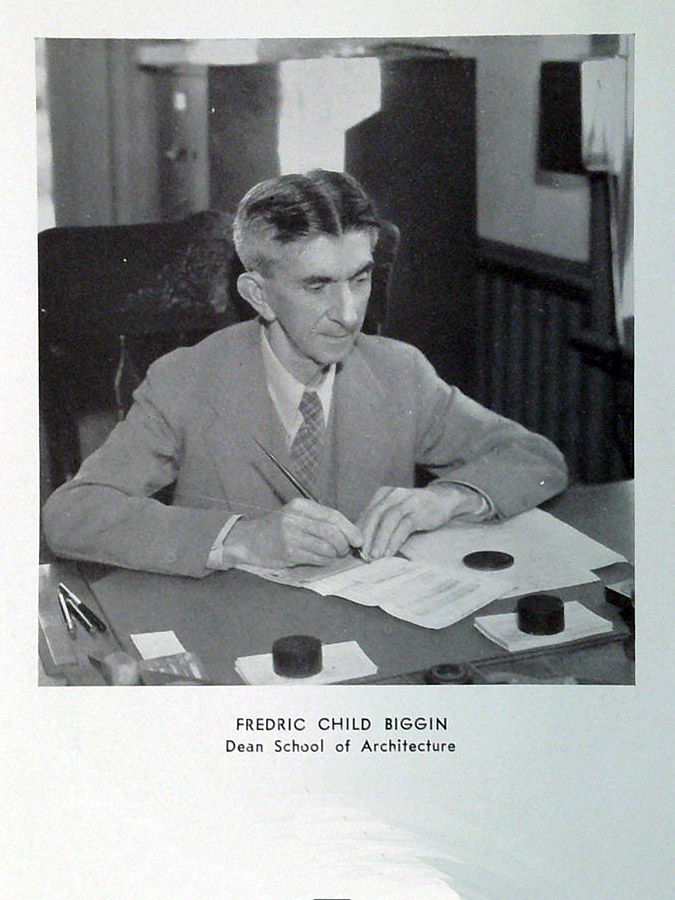
He would never see it, but there’s a building, right on the corner where town and gown meet, named in his honor. It opened in 1951 as the College of Architecture, Design and Construction, but has been home to the Department of Art and Art History for some time. The university notes that the building’s “most prominent feature is a wall of windows facing north on Magnolia Avenue to let in abundant natural light favored by architects and artists.” At one point, the story went, the wife of a university president had a bunch of tall shrubs and trees installed so she wouldn’t have to see that building when she went by.
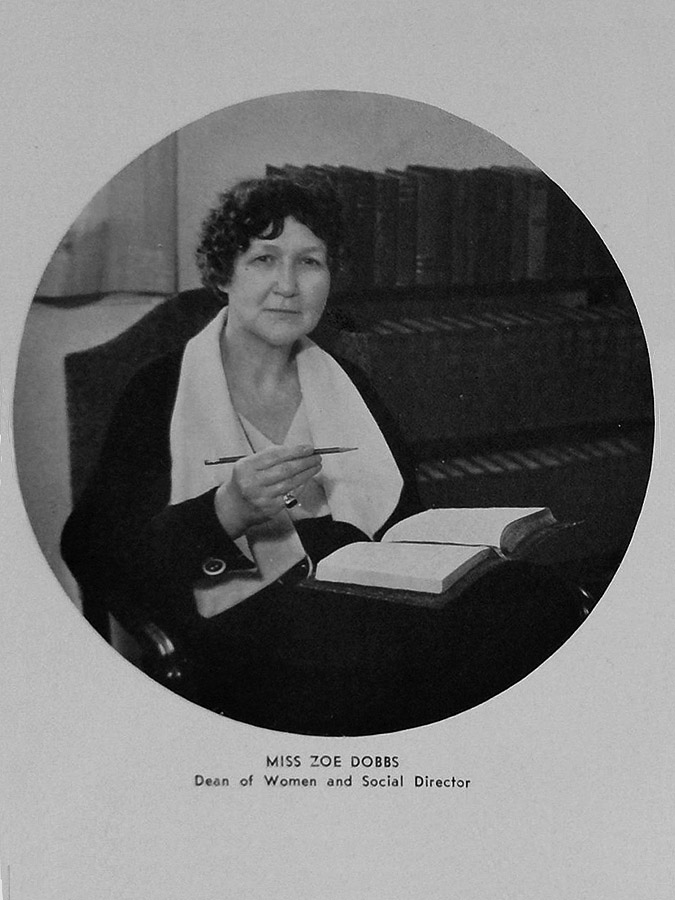
Shows what I know. Zoe is a popular name in this century, but the Greeks used it, too. I just learned that, reading up on Zoe Dobbs, who started at API as a professor of English and education in 1920. Later that decade she became the social director, and before long they named her the dean of women. She stayed on until retirement in 1952. Soon after, a dormitory was named in her honor, but its gone now. She died, and was buried in neighboring Opelika, in 1973.
Dean Isaac McAdory would like you to not notice his messy desk. He wouldn’t mind, however, if you realized his seat is right next to the radiator, and that his office is so small his plant is behind the radiator.
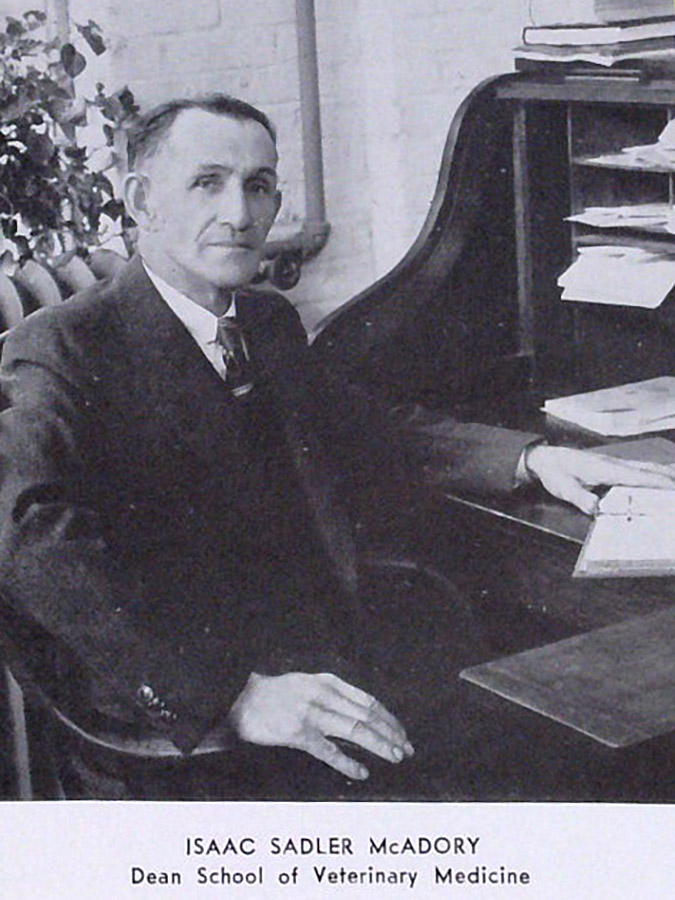
McAdory was on campus from 1904 until he passed away in 1952. In my time on campus, part of the veterinary facilities were named after him. This was notable to me, as I had also attended McAdory High School. Somewhere along the way I learned that Isaac’s middle name was Sadler. Two miles from my childhood home, and about that same distance from my school, was the historic Sadler house, pen log house done up in the Georgian style. It wasn’t until much later that I put the rest of this together, but the owner of that house was Isaac’s maternal grandfather. I wonder how much time he spent in that house. My high school, which opened in 1920, is named after his father, Isaac Wellington McAdory, who became a teacher soon after he mustered out of the Civil War.
John Scott would like you to know that he is so studious he has a special book on a special stand. He can leaf through it at anytime, and it’s got a look that suggests it was being used just enough. I wonder what that book was.
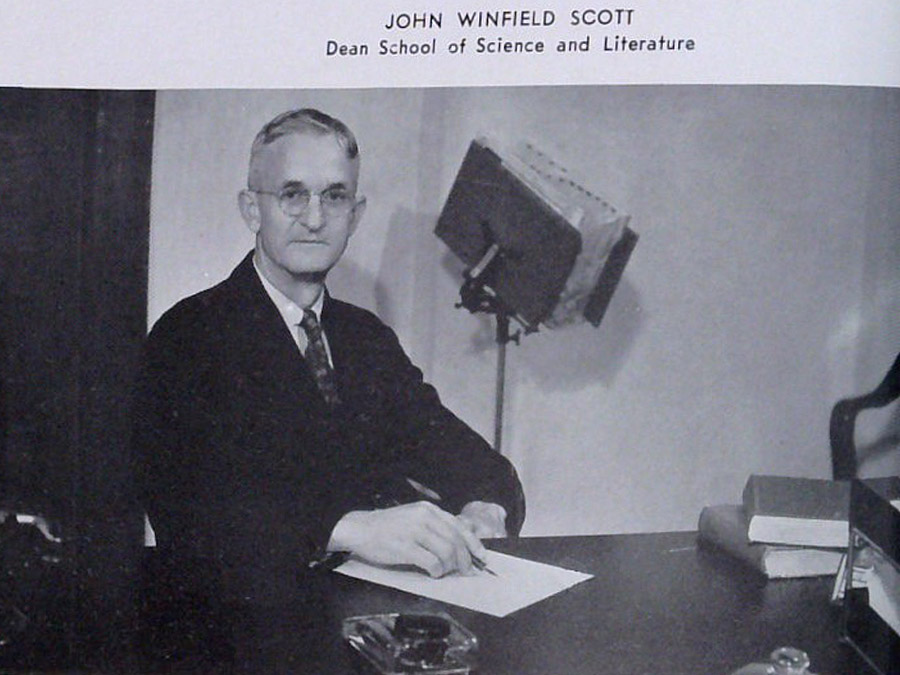
He’s about midway through his time on campus here, working through the economics department from 1927 through the mid 40s. And this is how you know university life has changed. He was the head of the economics department (which offered 35 courses) and dean of the academic faculty. In 1930 he was the dean of the School of Science and Literature, head professor of Business Administration, head professor of Economics and Sociology, and director of the Bureau of Economic Research.
That’s … a lot.
There was a great story about him in the local papers the next year.
Odd as it may appear, Dr. John W. Scott, dean of Auburn’s school of science and literature has today the experience of legitimately writing a letter to himself.
And even more unusual was the fact the letter had to be of a congratulatory nature, if he was to act in his strict line of duty as a college dean.
You see, it was this way: The name of his attractive daughter, Eleanor Lucile Scott, Auburn sophomore in science and literature, appeared on the list which came to him of students whose scholarship average for the first semester was 90 per cent or above. Miss Scott averaged 91.45 in her eight subjects.
Ten years ago when Dr. Scott came to Auburn from Oklahoma A. & M., he initiated the practice of writing personal letters of congratulations to parents of Auburn students who averaged 90 or better in their studies.
“Writing these letters to parents is one of my most pleasant duties,” said Dean Scott, “and I’m glad that Eleanor has placed me in this ’embarrassing’ position. I hope she does it again.”
Cliff Hare doesn’t know why you’re here, and thinks you should probably be over in one of the chem labs, working on your practicals.
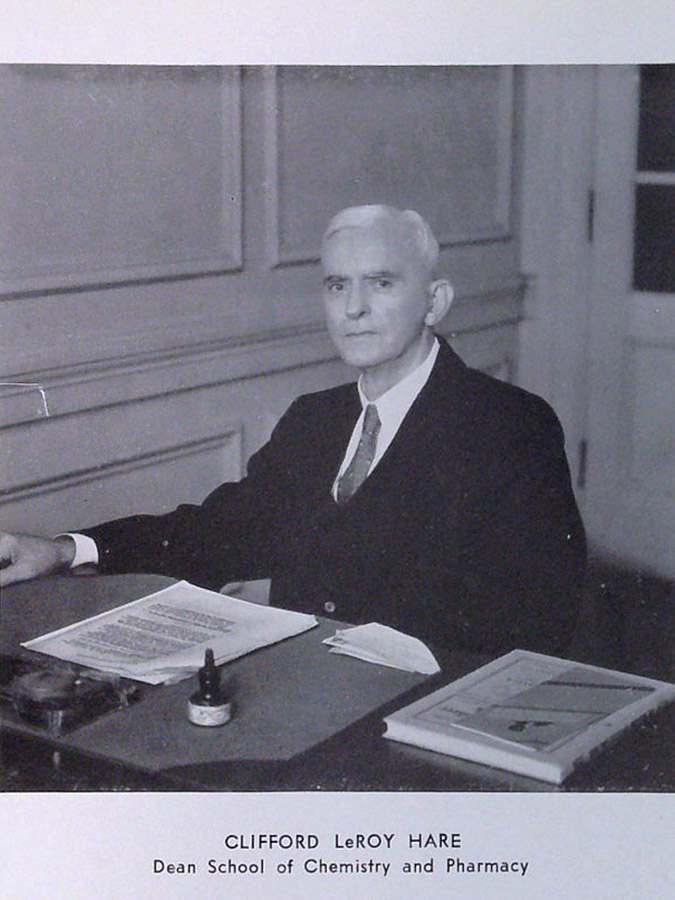
By this point Hare had been on campus for 40 years. He would stay on the faculty for another 13 years. He was on the first football team, in 1892. If you watch Auburn play a football game, you’re watching in the stadium named after him. He was also president of the Southern Conference for a time. Also, he designed the first local golf course, helped the baseball program get off the ground, ran a local bank for 34 years, served on the city council, and as interim mayor. He also helped established a local medical clinic for people in the town. People sing his praises a great deal, but he’s still probably undersold for his importance.
This is one of the few people in this list I didn’t know anything about. Dana Gatchell was a professor of foods and nutrition. She was on the faculty for more than 30 years, retiring in 1956. In the university’s collection is a scrapbook she made that included pictures of the beds of royalty and aristocrats from Europe, and her notes on the development of bed styles from the 16th through the 19th century. What a great area of study!
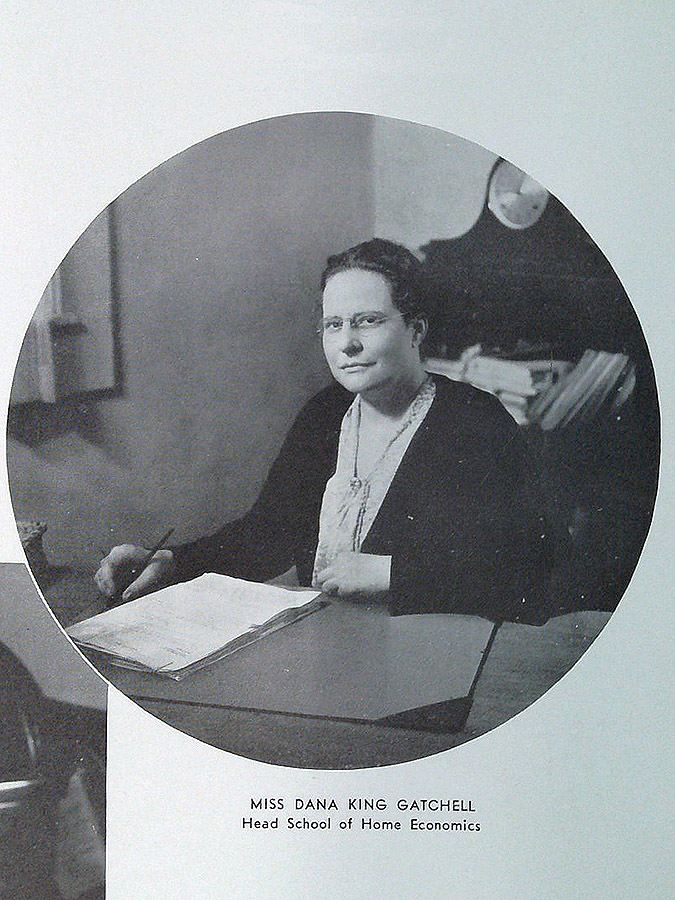
She wrote several cookbooks, and collected them as well. She also wrote books titled Handbook of Menu Planning, Know Your Table Linen and Laces, and Know Your Tableware. She passed away in 1960.
You have to have a certain kind of confidence and swagger to make your way through this modern world with a name like Zebulon. You take one look at this man, and you know he had it in spades.
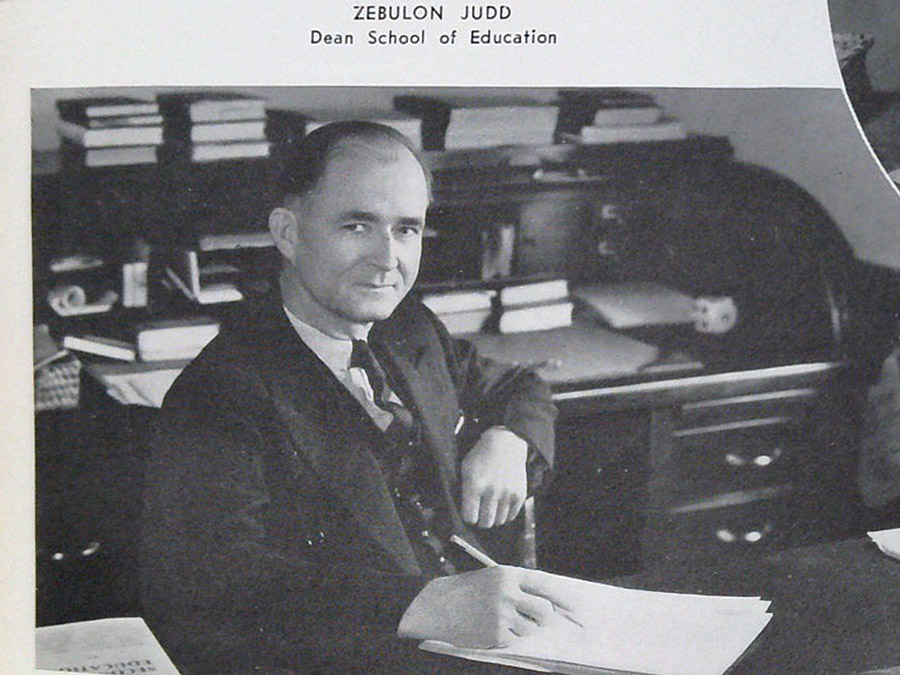
Judd was the school of education’s first dean. He was there for 40 years. The original purpose of the education program was to offer courses to people studying agricultural education. He died in 1960, at 83.
After the deans come the class photos. And at the front of each section is a photo of the snappily dressed class officers. Let’s wrap this post up by finding out a little about these seniors.
John Rush is the class president, and the guy on the far right, here. He was from Mobile, and majored in aeronautical engineering. He became a naval aviator. He died far too young, just before his 27th birthday, in June of 1941. He was conducting a test flight of the Curtiss SNC-1 Falcon when he got caught in a squall off Pensacola. He and his co-pilot were killed. Rush was buried at Arlington.
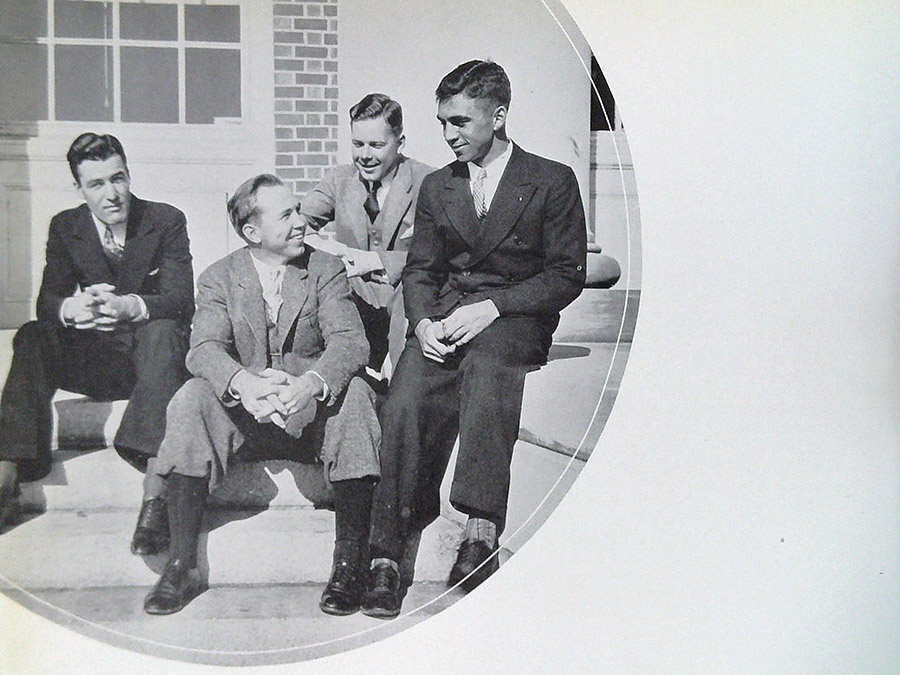
The light-haired guy sitting in the middle is William Fredrick Black. He was from Macon, Georgia and he, too, was studying aeronautical engineering. He was the class vice president. He played football in high school, and football and basketball in college. After he graduated he did six months at the naval base in Pensacola and was moved over to the reserves in 1937. He became a state trooper in Georgia soon after that, one of the first in that state, in fact. He would also be the first Georgia trooper killed in the line of duty, at the end of 1940, when he was just 29 years old. He and his partner stopped a car in north Georgia. Driving that car, which turned out to be stolen, was a man who’d already done three stints in prison. He’d broken out of a Oklahoma jail while awaiting trial on a robbery charge. Black was shot three times and died on his way to the hospital. The shooter was also wounded, but ran into the woods and led hundreds of law enforcement officers on a five-day manhunt. He was executed in 1943. Black was married to Juanita, who never remarried but focused on social work and service. She worked with the WPA, training women to sew parachutes and military uniforms. She apparently knew generals George Patton and Omar Bradley.
In the back is John Prentice Abel, and if that name seems familiar you were paying careful attention earlier. He was a senior from Roselle Park, N.J., studying mechanical engineering. He was the class historian, and he also appears on the In Memoriam page that we saw above. Abel died two months before his 21st birthday, just a few months before this book was released. He’d been riding in a car in Georgia and that car collided with a truck. It was December, I assume he was traveling home for the winter break.
That square-jawed man on the far left is James Moreman, a business student from Waverly, and secretary of the senior class. After graduation he went to work for General Motors in Birmingham. Like a lot of men his age, he found himself called to active duty. He was a captain in the army by 1943, and had been at Fort Bragg, Fort Sill, and Camp Clark, in Texas. In 1944 he was a major, and sent to Europe. The newspaper clippings tell us he was in the ETO for 18 months before returning home in September of 1945. It seems he and his young family bounced around the state a little bit before settling in the Birmingham area around 1950 or so. He was the commanding officer of an army induction station there until about 1951. He was active in the Civitan Club. Moreman worked as an accountant and controller for a truck leasing company. In 1975 James Moreman died, at 60, in Huntsville, survived by his wife and three adult daughters, a son, and six grandchildren.
Next week, we’ll take a look at a few of their classmates.
All of this will wind up in the Glomerata section (eventually). You can see others, here. Or maybe you’d like to click through to see all the covers. The university hosts their collection here.

