We took the Glacier Express, the world’s slowest express train, and enjoyed an afternoon in the Swiss Alps. Trains have been running here since 1889, the Glacier Express started in 1930, but the first panoramic trains, like the ones we enjoyed, have only been on these rails since 1993. The modern cars came in between 2006 and 2009, and they have all recently received a facelift. These are comfortable rides, and they offer three- and four-course meals. (The food was quite tasty …)
Otherwise, you sit back and enjoy the scenery. There are headphones with music and, from time to time, a narration with local points of interest and historical notes. We started in Chur, Switzerland’s oldest town. We traveled through the landscapes brought on by the last Ice Age landslides, and the “Swiss Grand Canyon,” past the oldest Benedictine abbey in the country, through valleys with towns that date back to the 11th and 12th centuries, near UNSECO World Heritage sites and, finally, to Zermatt and the cloud-shrouded Matterhorn, which, on this day, was still able to hide despite topping out at well over 14,000 feet.
But why read about all that, when you can see a bit of video from the train window.
Here’s our train …
And a few photos for you to enjoy. There are a few words down below, so scroll slowly, or you might miss a pun.
Here was dessert. Locally grown berries. Fresh and tasty!
We paralleled this rive a great deal of the trip. The closer you get to it’s source, the richer and whiter the water becomes. It’s full of nutrients and minerals and, eventually, it is very drinkable. But too close to the source, and it’ll give you an upset tummy. No matter where you are in Switzerland, though, the water looks beautiful. And chilly.
Panoramic train windows.
And speaking of panoramas, here’s one now. As with every panorama, click to see the larger version in a new tab.
This is Oberalppass and, at 6,669 feet, the highest point of the train’s trip.
I get one good joke a day. And this is where I used it.
There was a place near Oberalppass where they let us off the train for a few moments. Some of the scenic shots in this part of the post are from there. The Yankee got back on the train before I did, and so I took pictures of the train, too.
Here’s our river again. Notice how the water is getting white? We’re getting closer to the runoff source.
And here we are in Zermatt, a car-free village you can walk through in a few minutes. It’s a charming place. And at the other end of the valley, behind these clouds, you would find the Matterhorn.
We didn’t get to see it. Oh no! We’ll have to come back! Shoot!
Shutter error. Looked cool. I’ve added it here.
We had dinner at a little Italian joint, Casa Mia, next to the train station while waiting for our return train. We ordered pizza. This is the Pugliese, featuring tomatoes, mozzarella, coppa ham, burrata, dried tomatoes. So very tasty. That burrata was amazing …
And here are a few photos from our train out of Zermatt. Just a regular-old train, no panoramic windows, but amazing views. And here I’m able to share a bit more of the gorge-style landscapes.
Also, we had our own train car, which was a great way to travel.
We had to make a connection, but our second train was late in arriving, which shifted our schedule back by about an hour. It was the only train problem we had in Switzerland, an event I noted with this extra photo from our stop between here and there.
And we have two more days of Switzerland adventures to get through. As great as this one was, the one I’ll show you tomorrow might have been even better. So make sure you come back for that. Until then, “Hopp Schwiiz.”
For this Tuesday post we’re looking back at our trip two weeks ago today. We’re doing this to catch up, but also to make up for the brief break I took from the site. So, sit back, enjoy the many photos (and the charming little video!) that tells the tale of this recent, amazing, adventure …
We set out on a tour for The Jungfrau, one of the main summits of the Bernese Alps. It’s part of a massive wall of mountains, and a distinctive sight in the Alps. First summited in 1811, it was not until 1865 that a direct route up the northern side of the mountain was opened.
We’re going up there.
The construction of the Jungfrau Railway, in the early 20th century, made the area one of the most-visited places in the Alps. It is now part of an area designated a World Heritage Site in 2001.
Here’s a better look from the town below.
We took the hardest route of all: the bus route, which led us to a ski lift, and also that train mentioned above.
Oh, and they call this …
The proper summit is 13,642 feet. We stopped just short of that, which is probably for the best. I fell just before taking this photo, which was in a gift shop.
And here’s my lovely bride, realizing she’s stuck with a faller.
But can we go outside for a moment? Remember those lovely exterior shots at the beginning of the post? The ones with the beautiful mountain behind us? If you turned around the other direction, you saw this. Think about those views.
So we’re on the move here, let’s look at some other mountains, or hills, or Alpine speed bumps.
It wasn’t just me, struck by the novelty of the locale features, which is reassuring.
Here we are on the ski lift going up on the next step of the journey.
We’re just flying over these houses, and so you don’t know anything, but that doesn’t seem like a bad lifestyle from above, does it?
Putting aside the pastoral living, we’re really here for the mountains.
You’ll have to forgive me, but I don’t see mountains every day, so I really played up the tourist bit.
And, yes, we’re going well above the tree line, and into the snow.
Here we are, on foot, approaching the tourism summit of Jungfrau. For a few moments while we were standing there we were experiencing a white out. (Somehow those are more fun on the last day of May? Again, the novelty of tourism …)
I’m not sure if she was prepared for snow.
But pretty much the entire time we were on the mountain, we enjoyed the snow. Farther down, on that ski lift, it was just rain. In the valley where we started this post, it was sunny and a mild spring day, all day.
This other prominent point of the mountain in the background isn’t far away, but in the clouds and fog and snow, it seems only barely there. Doesn’t help that there are actual snowflakes in our eyes.
This is one of the two observation points that were available to us near the top. Lots of people. Lots of photographs. A lot of people doing video chats with people back home. No one, but us, doing this.
(They were all impressed by us.)
At the other observation point, we claim this mountain for Switzerland! (Our presence, like the flag, was a big plus.)
Let’s go inside the mountain.
They call this part the Alpine Experience, and this giant snow globe is going to grow on you.
Had it not been for other people interested in seeing the thing I would have stood there until I shot every moving part. But sometimes tourists get in the way of a full, proper, tourist experience.
We walked down an ice tunnel.
Everything here is ice, except the lights and the handrail. Very James Bond.
I don’t know about you, but I seldom get to walk around in ice tunnels, so this was fun. Also, the acoustics were great. You’ll have to take my word for it.
There are several ice carvings through the area. Here’s just one.
The romantic story is that it was the nuns of the Interlaken convent (the town we started in at the beginning) who gave the mountain its name. They owned a lot of the pasture land at the foot of the glacier and the mountains. The rock faces seemed inaccessible and the nuns thought it jungfraulich, untouched and virginal. The signs say that’s not actually the case. The real story just sounds like a more natural evolution of language.
Welcome to the highest-altitude karst cave in Europe, at 11,423 feet.
The unsorted sediments seem to have arrived here by glacial displacement, or water. Dating has been a problem for scientists, but the research suggests we’re looking at mid-Pleistocene age accumulation. So we’re talking after the earliest documented human clothes, but earlier than human mastery of fire. This cave is inactive today, because the permafrost restricts cave-forming processes.
But if you’re not here for geology, you must be here for the chocolate!
That wasn’t the point of the day, but a nice benefit. We didn’t buy this bag; we just ate it right there in front of the cash register.
we actually enjoyed a perfectly healthy cucumber sandwich in the self-serve cafeteria, looking out to the mountain.
Also, if you go up this high, you will feel it. Drink a lot of water, our guide said. You’ll thank me, he said. Altitude headaches are real, he said.
He was right about that last one, at the very least. We’re at 2.25 miles above sea level there. In Zurich our hotel is at 1,330 feet. Our house is just over half that high. We were up there. It was great!
And Jungfrau is just one part of our amazing Switzerland adventures. Come back tomorrow. There’s going to be something that’s, perhaps, even more impressive!
This was written for a Friday, two weeks ago. That’s the way of it around here for a bit as we go over our amazing travels. So, if you’d be so kind as to cast your mind back two weeks (and also 78 years ago) …
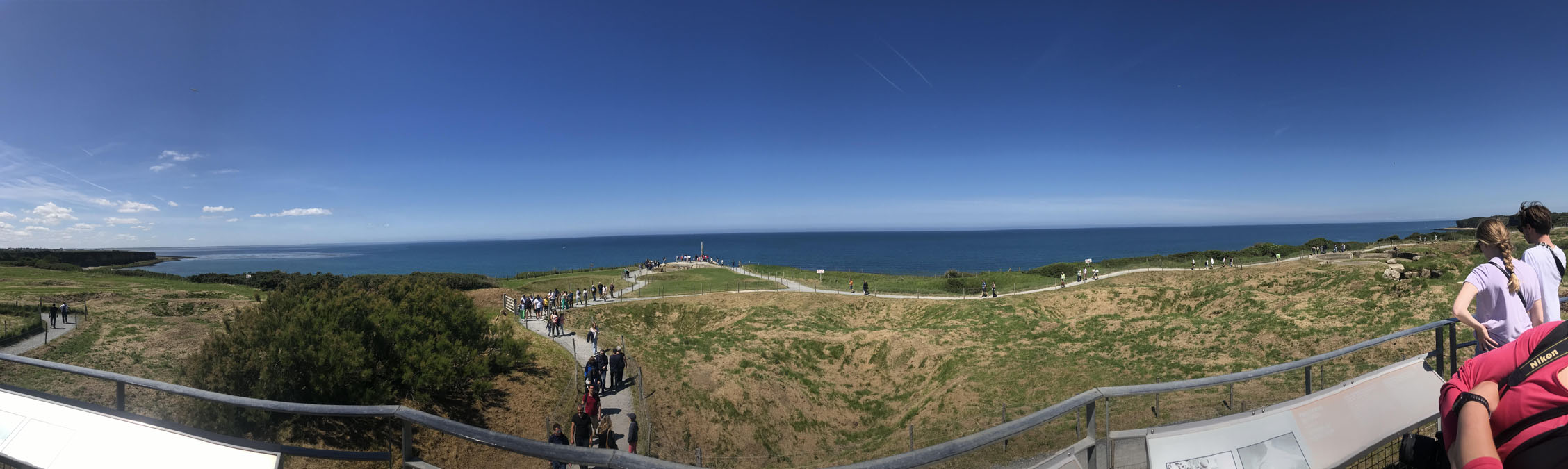
Like many panoramas, this one lives at the intersection between beautiful and enlightening and distorting. Like all panoramas on this site, if you click it, you can see the larger version. We were there two weeks ago.
We caught a morning train out of Paris to head west to Bayeux.
And in Bayeux we rented e-bikes to ride all over the beautiful countryside of Normandy. It is beautiful. We rode all over the countryside. And not all of it on roads. The Yankee suggested Normandy, and I said I wanted to go here, if we could, and after a lot of pedaling, this was our first stop for the day. (Note that upright stone just on the left margin.
If you stood at that stone and look left, you would see Utah Beach just beyond that point.
And if you stood at that sone and looked to your right, beyond the other point, you would see Omaha Beach.
And if you stood at that stone memorial, you’d be wear Ronald Reagan delivered one of the truly great speeches of his presidency.
Peggy Noonan had found his voice by then, and it didn’t hurt that the topic was such a dramatic moment, and the audience included some of the heroes he was talking about.
I remember reading about this anniversary, the 40th, in the second grade, before any of this made any sense to me. I remember a quote from one of the Rangers who was at that event. They’d taken them to the shore line and they looked up the cliff face in wonder. How in the world did we do that? That quote is now 38 years old, and as much as anything, I owe my awe to the moment to that awe of the men who did it.
The guns were located so that they could cover both Utah and Omaha. They could do terrible damage to the troops coming ashore, or to the vessels waiting off the coast. So they sent in the Army Rangers.
General Dwight D. Eisenhower and his staff planning Operation OVERLORD assigned the Rangers of the 2d and 5th Ranger Battalions, under the direction of Lieutenant Colonel James E. Rudder and organized into the Provisional Ranger Group, the mission of destroying the enemy positions on the cliff top. Unbeknownst to Allied planners, the Germans failed to believe that U.S. military command would consider the cliff top accessible by sea. The Americans, however, considered it an accessible assault point and reasoned that with a well-trained force, soldiers could land on the narrow beaches below at low tide and ascend the cliffs with the assistance of ropes and ladders. When Lieutenant General Omar N. Bradley told Rudder of the assignment, the Ranger officer could not believe what he had heard, but he understood the importance of the mission at hand. In his memoir, A Soldier’s Story, Bradley wrote, “No soldier in my command has ever been wished a more difficult task than that which befell the thirty-four-year-old Commander of this Provisional Ranger Force.”
The original ornate plans were ruined by rough seas, which put the entire Pointe du Hoc timetable well behind schedule. They were forced to improvise.
The delay gave the Germans enough time to recuperate, reposition their defenses, and lay heavy gunfire on the incoming Rangers from companies D, E, and F. The Rangers, no longer able to follow Rudder’s original plan, were now instructed to land all companies to the east of Pointe du Hoc on a strip of beach about 500 yards long and thirty yards wide. They came under heavy fire from the Germans while coming ashore. As the soldiers at the front exited the landing craft, the Rangers toward the rear laid down covering fire as their comrades ran to shore and took shelter in a small cave at the base of the cliff or in craters along the narrow beach.
[…]
The Rangers experienced much difficulty climbing up the cliffs that day. Many of the ropes that caught hold of the cliffs that morning were completely covered by enemy fire, making the number available for climbing severely limited. The wet ropes were slippery and soldiers were weighed down by damp uniforms and mud clinging to their clothes, boots and equipment. German bullets and “potato masher” grenades rained down from above. Nevertheless, the Rangers climbed to the top of Pointe du Hoc while under enemy fire. Several German soldiers were killed and others driven off from the cliff edges when Rangers opened fire on them with Browning Automatic Rifles (BARs).
The guns they were sent to capture, their primary objective, weren’t there. The Germans had moved them back from what they’d thought was an impregnable position. A two-man Ranger patrol later found five of the six pieces of heavy artillery and they were subsequently.
After scaling the 110-foot cliff face against brutal German fire, gaining the top and then fighting the enemy for two dys fewer than 75 of the original 225 who came ashore at Pointe du Hoc on D-Day were fit for duty. It’s a testament to bravery and grit, and courage and honor. We were fortunate to have been able to visit it for a brief time.
From there we rode our rental bikes to the Normandy American Cemetery. We weaved through traffic, passing gobs of cars (it was oh so satisfying) stuck in traffic in time to see the evening’s flag lowering.
The World War II cemetery in Colleville-sur-Met, Normandy, France covers 172.5 acres and contains 9,388 burials. In the gardens are the engraved names of 1,557 servicemen declared missing in action in Normandy.
In that building you’ll see massive maps describing the planning and the D-Day assault itself, and also the push all the way to the Elbe River.
None of this was a certainty when D-Day began. And it took about two months of hard, deadly fighting, before the Allies could claim Normandy as under their control. Great losses were absorbed and delivered to get off that beachhead.
On the cemetery’s chapel there is a carving in the marble of part of John 10:28, “I give unto them eternal life and they shall never perish.”
The cemetery looks over a bluff onto Omaha Beach. There are 304 unknown soldiers at rest in the grounds of the cemetery.
It also contains the graves of 45 pairs of brothers (30 are side-by-side), a father and son, an uncle and nephew, two pairs of cousins, four chaplains, four civilians, three generals and three Medal of Honor recipients.
We were about 30 miles into our lovely afternoon bike ride, and we were starting to eye the clock. The bike shop we rented from closed at 7, and our train was coming at about 8:30. So we had to race back. (Nice bikes, would rent again. Would check to make sure my back brake worked before I set out next time, though. I had to feather off the front brake for the entire day!) We made it just in time, which was the shocking theme for the whole day. Just caught the morning train. Arrived with our bikes ready, got lost twice and still made it to the cemetery just in time to see the flags lowered. Lingered around that hallowed place a while, giving us just enough time to get back to the bike shop, which left us enough time to get a bite to eat at a place next to the train station. Which put us safely on the train.
It was an important day in important places. I’m glad we did it, and that it all worked out as it did, which was to say, perfectly.
She planned another great trip, and we’re just getting started.
We still have two days in Paris, where our adventures will continue.
This was written for a Tuesday. Not today, but two weeks ago. And that’s going to be the way of it around here for the next few weeks. But it’ll be worth it. All of this covers two weeks of travels and, hopefully, makes up for the two-week break I took on the site. So cast your mind back two weeks …
We stopped to pick up a quick sandwich after a morning of finalizing packing, and running an errand and before the day’s treat, and this was the art next door.
Everything can’t be art, because if everything is art then nothing is, really, art. Art, in a simple form for a simple way of thinking about it, like mine, should be transportive. That could take you to another place, to the artist’s way of thinking, or just at a slight remove from your own place. Everything can’t be art, but art can be … distractive.
But not everything that distracts is art. Just because you used something evocative of modern art techniques on the side of an oil change place doesn’t make it art. That you put eyes on it probably does. That it was commissioned seals the deal.
Anyway, that was at lunch, a hasty chicken sandwich on the go in Indianapolis, as we were actually on our way to see some post-impressionism from Vincent van Gogh:
Step into a digital world of art at THE LUME Indianapolis and explore the combination of great art and cutting-edge technology at its finest with floor to ceiling projections of some of the most famous paintings in the world. A must-see cultural experience created by Australian-based Grande Experiences; the first year’s show features the paintings of Vincent van Gogh as well as featurettes inspired by the work of Van Gogh.
Nearly 150 state-of-the-art digital projectors transform two-dimensional paintings into a three-dimensional world that guests can explore while walking through 30,000 square feet of immersive galleries. THE LUME Indianapolis has 60 minutes of digital content that runs continuously and simultaneously in all the digital galleries.
This is not a movie with a start and end, or something you would sit to watch from one viewpoint, but rather a constant loop of beauty that is designed to be a walking experience, seeing the art up close and all around you. Guests should wander throughout the space, taking in the experience from every angle.
We’d put this off, because of Covid, but we had time on this particular Tuesday before we had to get to the airport and the exhibition was closing at the end of the month, so this timing worked out just right. And seeing this was absolutely worth the experience.
The music there is Le Carnaval des Animaux (or The Carnival of the Animals) by the French composer Camille Saint-Saëns. It’s a 14-movement composition, and he wrote it as a joke, forbidding public performances during his lifetime out of fear that it would harm his reputation as a serious composer. Here, it got used for its whimsy.
So while you contemplate the adaptation of van Gogh’s famous oil-on-canvas The Starry Night, I must tell you I wasn’t really sure what to expect from the exhibit. I’d seen one little bit of text and maybe one image and thought we were just going to walk through Starry Night for a while, which would have been perfectly fine. He painted that in June 1889, inspired by the pre-dawn view from his window at the the asylum at Saint-Rémy-de-Provence. (The village in the painting’s foreground is imaginary.)
I have an original, one-of-a-kind, reproduction of Starry Night in my home office. I just have to turn my head a bit to the right to see it. At once evocative of the van Gogh masterpiece, and altogether different. It really is lovely.
He’d admitted himself into the asylum the month before, after his December 1888 breakdown and the whole ear thing that people want to remember. That part of his life comes up a fair amount from the exhibit, but that’s not the whole man, nor the whole of what we saw.
Wheatfield with Crows is often thought to be van Gogh’s last painting, but the museum named after him in the Netherlands says that’s a myth. Nevertheless, you get a sense of more of van Gogh’s unsteadiness in the final year of his life — and the music here helps convey that. He said the fields below the stormy skies expressed “sadness, extreme loneliness,” but the countryside was meant to be “healthy and fortifying.”
It is dark in the exhibit. There’s a gunshot, or some such loud sound, and the frozen oil on canvas crows fly away and disappear, because they are digital. And Chloe Hanslip, meanwhile, is sawing away at Benjamin Godard’s Violin Concerto No. 2. It gives it a certain edge. But when those crows jumped, that was startling.
This isn’t just a light show projected on the walls. There’s stuff happening on the floors, too. At times you’re walking in, and on, van Gogh’s paintings and sketches.
Many of van Gogh’s early works showed Dutch landscapes and his native culture. Windmills show up a fair amount in all of that, and also in much of his work from Paris. He could see windmills from his apartment there.
Most of his windmills are displayed in museums around the world today. (An important one was lost in a fire in the 1960s.) Who doesn’t like windmills?
And who doesn’t love Bach’s Cello Suite No. 1 in G Major?
We had that in our wedding. My lovely bride has it as one of her ringtones.
There is also an interactive component to the exhibit. You can zoom in to study brushstrokes using a frustrating technology that tracks your hand motions, and you can take pictures and apply a postimpressionist filter. (This concept would have been a wonderfully novel trick before Instagram, of course. It just feels normal, now, though.) We’re all painters! And subjects …
Interspersed with the recreations of van Gogh’s art there were plenty of other digital elements, including some context about his time in various other parts of Europe, and things he’d written. I don’t know if I’ve ever identified with a quote as readily as this one. It is the English translation of a passage from a letter van Gogh wrote, in 1885, to Anthon van Rappard who was a friend and mentor. They were critiquing each other’s work, discussing their progress, and their contemporaries, and the regular stuff of living a life. And then, eventually …
That’s my process for … most everything … in that one sentence. Anyone who has spent more than 90 seconds on this site, or probably just around me, could recognize it.
The work in question, painting the peasants, is such laborious work that the extremely weak would never even embark on it. And I have at least embarked on it and have laid certain foundations, which isn’t exactly the easiest part of the job! And I’ve grasped some solid and useful things in drawing and in painting, more firmly than you think, my dear friend. But I keep on making what I can’t do yet in order to learn to be able to do it.
The artists who worked on the creation of this traveling installation were obviously having a great time. You didn’t have to bring interpretive weather into a master’s work to see that, but it doesn’t necessarily hurt, either. And here’s more of Hanslip playing Godard.
For whatever reason, I’ve never thought much of still life. Kitchen table art just seems like, well, those plastic tablecloths on so many of the kitchen tables of your youth. But this, perhaps because it was on more than one plane, and oversized, is really captivating. I stood there staring at the white in the apples at my feet, but I was transfixed by the reproductions of the cracks in the oil.
That was late in the afternoon. The exhibit seemed to close a bit early. Everyone knew it but us, and so they all left. We had maybe 20 minutes alone with the whole thing. In a way that’s easy to feel and difficult to describe, it seemed like a big gift: a private moment looking at the brilliant work of people inspired by a master.
It wasn’t all digital. They also had an actual van Gogh on display, this is Landscape at Saint-Rémy, and I hope this does it a bit of justice.
As of this writing, it is in 13 U.S. cities and seven more in Europe and a few other places besides. If you can see this immersive exhibit, you should definitely make the effort.
After that wonderful experience, we had another one, at the airport. Two airports, in fact!
But more on that tomorrow.
site / Thursday / Twitter / video — Comments Off on To make up for previous long posts, this one is just 200 words 19 May 22
I’ve been trying for three days to get the next bike ride in. So, needing the content and having been cheated out of bike photographs, I stood on the porch, and in the rain and in the driveway, and did …
… that.
Not as good as a bike ride. But the grass is nice and green!
I also updated the images on the front page. You’ll want to check those out; there are a dozen amazing new shots to enjoy. (See all 12! Then let them recycle and count each one, to make sure you’ve seen all 12!)
Otherwise, I’m just explaining things to the cats.
“Don’t worry, Poseidon, that’s just electrons coming to the ground, heating the air to about 50,000° Farhenheit, then cooling, leaving a resonating partial vacuum behind. Air nearby expands and shrinks, vibrating, echoing and reverberating, making the sound we call thunder.” pic.twitter.com/SL72idEu9s
I should have shared the weather radio one, too. But that would have just read like crazy talk.
More tomorrow. Until then, did you know that Phoebe and Poseidon have an Instagram account? Phoebe and Poe have an Instagram account. And don’t forget my Instagram. Leep up with me on Twitter, too.