music


31
Jul 26

Fastest July ever

Happy weekend! I’m making it a long one. There was work, a little, but then my lovely bride and I decided to sit down and read books. First we read inside. Later, we read in the backyard. We know how to party.

The electricians came back to finish the install of the generator. Took them part of a third day to get it done, but at least this time it wasn’t 108 degrees outside. They’ve completed their tasks. Nice guys, unfortunately their shop is a long way away, or I’d call them our local electricians. Maybe they still will be.

And so we have a generator. The local inspector has to come out and inspect all of the gas and the electrical work, and hopefully that will be painless. Our electricians seemed to know what they were doing. The various gas people who’d come out seemed to know what they were doing. I’m sure it’ll all look good.

This is how it works. If the power goes out, the system realizes it, and the generator fires up 10 seconds later. When the power comes back on, the generator set up realizes that, and turns itself off. Our job is to keep the air vents cleared, schedule annual maintenance, and, if the generator has to run for long stretches of time, check the oil.

Since we’ve been in the house the power has gone out three times. Once for about three hours, once for slightly longer. The first time we weren’t home, so I don’t know those details. Always in the back of my mind, though, this is the first time in my life that I’ve not lived on a priority grid — near a hospital or nursing home — and it could take a while to have the power restored if there’s a widespread outage. The neighbors talk about a big storm that came through and famously left them without power for a week. And that’s why we, and the neighbors, both have generators now.

Also, we got a shutter fixed today. Somehow some wind got in behind one, bent it over from the top down, and pulled the two top screws out of the siding. It just dangled there for a few days. It’s too far to reach via ladder alone. Also that roof is steep. Also, once in a while I get the impression that I am not as young and as bulletproof as I used to be. Also, that angle.

Anyway, a guy shimmied up the ladder, pulled out the old one, put up our new one (both are plastic, and look roughly identical) and held up a pleasant conversation the whole time — like he’d done this all before.
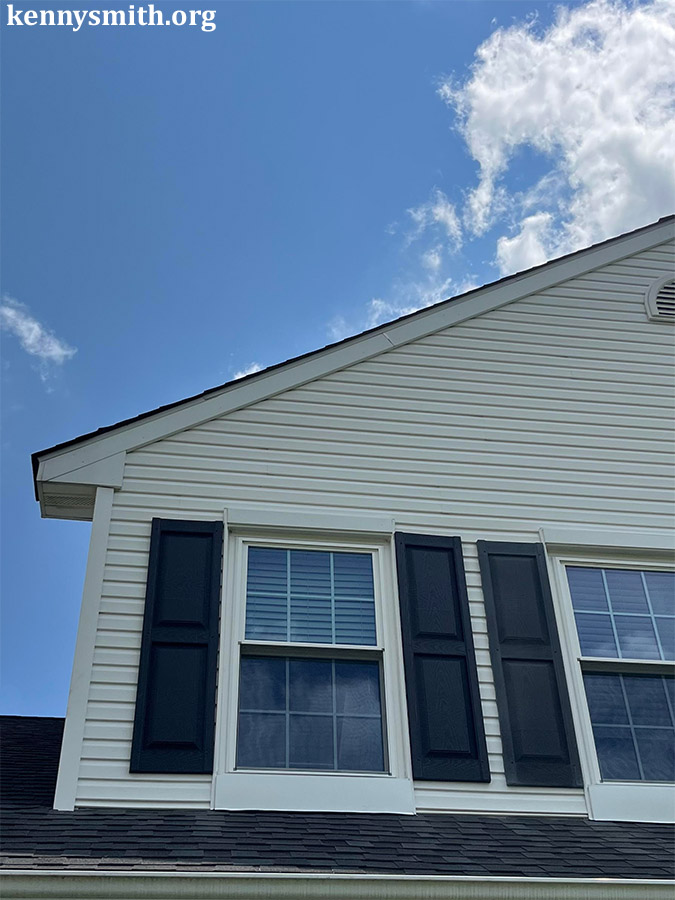
I promised to catch him if he fell. He promised to not mess up the gutter. He held up my end of the bargain and decided it wasn’t worth testing whether I meant it. (I meant it.)

Thing is, those shutters, pretty standard aesthetic pieces, come in packages of two. So now we have one extra shutter. Hopefully we won’t need it anytime soon. I put it in the store-it-and-forget-it section.

At the concert last weekend, Train did a curious little medley, the theme of which, if any, escaped me. But the crowd enjoyed themselves an awful lot with it.


It’s a party band vibe. A lot of crowd pleasing things, and tons of those local references that make the crowd scream. A lot of energy throughout.

The demographics here make no sense, and that’s probably the best part about it. For every person my age we saw at the show there was one person much older, and three people in their 20s. Age is just a number at a rock ‘n’ roll show. Maybe the demographics never should have mattered.

We continue on with Rick Atkinson’s Fate of the Day, the second in his Revolutionary War trilogy. Sometimes, even writers who have won two Pulitzer Prizers, and/or the editors who edit them, can get punchy.
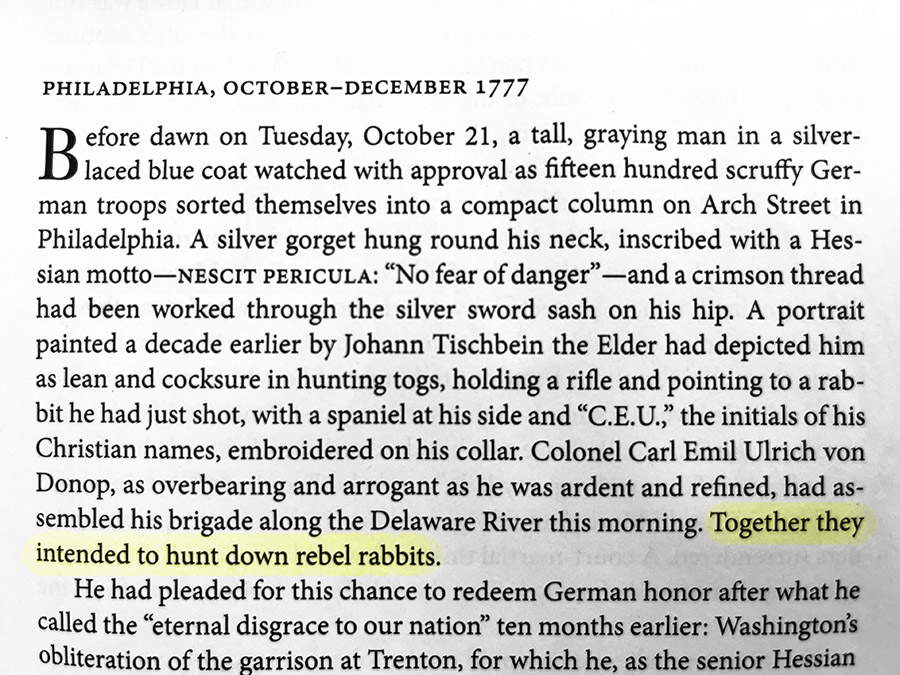
This is, so far, the only Looney Tunes reference I’ve read.

Col. Donlop was killed at the Battle of Red Bank. It was a poorly conceived assault by the German officer and his British commanders. The Hessians were trying to avenge a previous slight. They thought they had the element of surprise. They did not have the proper tools for a fort siege. They never had the initiative and, ultimately, the battle becomes a big morale win for the Americans.

Some of our colleagues are working at that site even now. Just a few years ago archeologists found the remains of 15 Hessian soldiers there, and the project has become a public and educational dig. Dr. Janofsky is the real sort of archeologist you’d want to meet. The kind that can bring history to life for people who thought they were uninterested. I had the chance to see her speak earlier this year. She’s incredibly passionate about the work and of course steeped in the time she’s studying, but a part of a program that’s using the most modern techniques (isotopic testing of remains!) to further the research. Between the discovery in 2022 and 2024 the researchers have held a few “public dig days” and almost 400 community members have taken part.

Read Atkinson’s book. (If you know how to party like I know how to party, this will be a great start to August for you.

30
Jul 26

This is no time to ask for more time

I spent the day reading and playing with cats. These were excellent choices. If this day came around again, I would do much the same thing. I’d just also do other things. There are always a lot of things I could do, a lot of things I want to do. You just can’t fit them all into every day. I’m never sure how to remedy that, but I’d like to figure it out. I’d like to figure out how to do all of the things I want to do, to the degree and extent I’d like to do them, so that each day has all of those things, nothing was overlooked, and there’s nothing to regret.

Or, how do you put 10 pounds of your interests in just two hands?

Also, how have I not figured out the solution to this dilemma by this point?

At the show last weekend, they brought Ed Robertson back on the stage to do a medley. Train played their shockingly ancient breakthrough hit “Meet Virginia,” and Robertson has been coming out for a little “Country Roads” ad lib. I expect he’s been doing the Canadian bit throughout. But Pat Monahan has a topical lyric in here.


I can’t not hear Country Roads anymore without thinking that we need some profound exploration and explanation about why it has such a growing, lasting resonance.

That’s a weird thing to think about at a rock ‘n’ roll show.

My lovely bride went out for a run. I went for a ride. I did a part of what we call the marsh ride, turning left before you get to the marshes. So it’s the non-marsh ride. It was one of those rides where I set out just to move my legs a little bit, having gotten started too late in the day. When it came down to it, I was riding well on the flat portions. Every time I looked down at my bike computer I was impressed by the speedometer. I was riding fairly poorly on the little hills. No need to look down to realize that. Some things you sense in more ways than one, and you do not need an LCD screen to convince you.

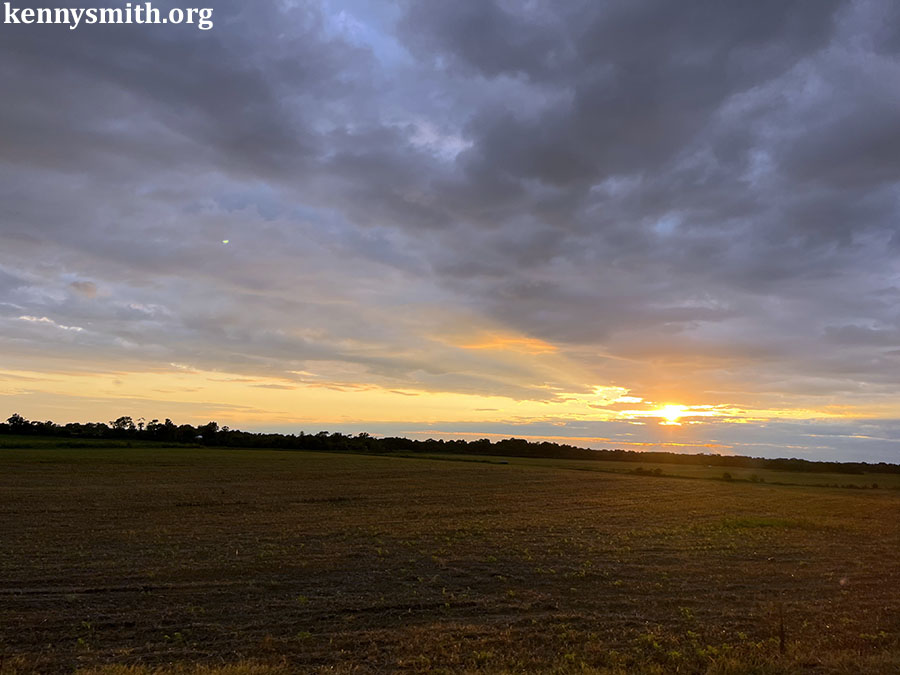
Anyway, cut over from one road to the other on some quite side roads, which was my plan, and then spent the next four miles wondering if I had enough daylight to add on a few more miles. I did not. One must be near home before dark if one did not bring along headlights. And one must never be late for dinner. This was what I saw over my shoulder at 7:55 p.m.

It was a nice little 17 mile ride, just enough to make me feel like I’d had a nice little bike ride.

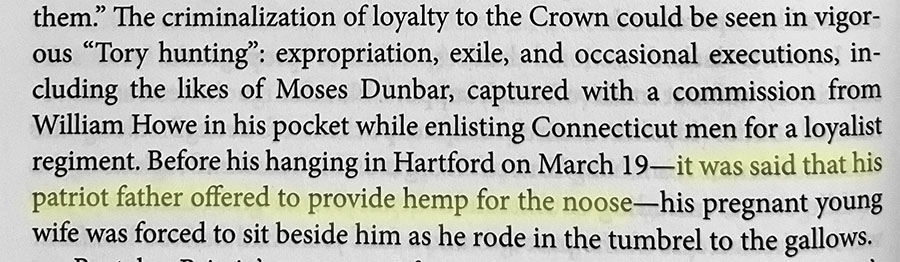
We continue on with Rick Atkinson’s Fate of the Day, the second in his Revolutionary War trilogy. This is one of those little supposed anecdotes that hits on all of the themes I’ve been thinking about the last few days.

The question is whether you believe that. The anecdote here feels as much like wartime propaganda as something that really happened. But let’s assume that Moses Dunbar’s dad made that offer. He was the second of 16 children. His dad, John III, had fought for the British in the French and Indian war, but was supplying rebel forces during the revolution. They disagreed on politics, but also religion. As a young adult, and freshly married, Moses joined the Church of England. This was a problem for John, a strict Congregationalist. And of course that little passage omits other details. Moses had been arrested once before, and released. He’d thought about fleeing. He enlisted. He was captured, escaped, and was re-captured. The emotions of those times were running high. Connecticut’s Nathan Hale, a 21-year-old Continental officer was hanged just six months prior in New York, and people in Connecticut were surely thinking of that.

Moses Dunbar was eventually hanged in front of a large crowd of onlookers. He was apparently the only person to be convicted as a traitor and executed in Connecticut. Rumors were that his remains were later moved by his family, and there is another marker in another cemetery, but apparently this is still something of a mystery. He was buried, initially at least, at the Ancient Burying Ground in Hartford, where the founder of the Nutmeg State, one congressman and four governors are also interred. You can read a bit more about Moses, including his last letter to his children, here.

You should also read Atkinson’s book. It offers some great insights into the times.


29
Jul 26

I had to log into Canvas today, and more fun things

Today I started doing some back end coursework. Building Canvas shells and preparing the reorganization of things. I started some light reading. The usual, and terribly exciting stuff. But, ya know, it has to get done. And done it gets. So much so that I may do less tomorrow. Is day three too early to take a break? It’s probably too early to take a break.

I’m taking a break.

I shot this photograph, which is nothing special, while doing the weekly garbage can chore, and promptly forgot about it. I remembered it. I edited, uploaded it, and promptly forgot about it again. So here it is, a nothing special snapshot from the wee hours of Monday morning.

The clouds had more patience than me and waited me out. Then nothing happened and I went inside, which is why it is nothing special, and probably why I forgot it, twice. But it’s here, I’m here, the site is here, you’re here, and so on.

The headliner at the weekend concert was Train, which is doing one of those “celebrating 25 years of a hit” tours. So many people are doing these now it no longer seems novel. It seems impractical. It seems a problem. The problem is that so many acts I like are doing them.

Anyway, at one point they launched into a planned bit of spontaneity and played Jack and Diane. Matt Nathanson came out for the back half of the song.


And, now, allow me to point you to something that will change your opinion about that song, and give you, finally, the correct opinion about Mellencamp. It was funny, when this happened, listening to the people who knew him, his father, his sons, and their opinions of him from first-hand experience, and watching all the right people fawn and fan over the whole event, and watching the students saying, “Who?”

I have two more concert clips to round out the week. Tomorrow’s video is something you’ve never heard before, guaranteed. Friday’s video is something I’ve, somehow, never seen live before.

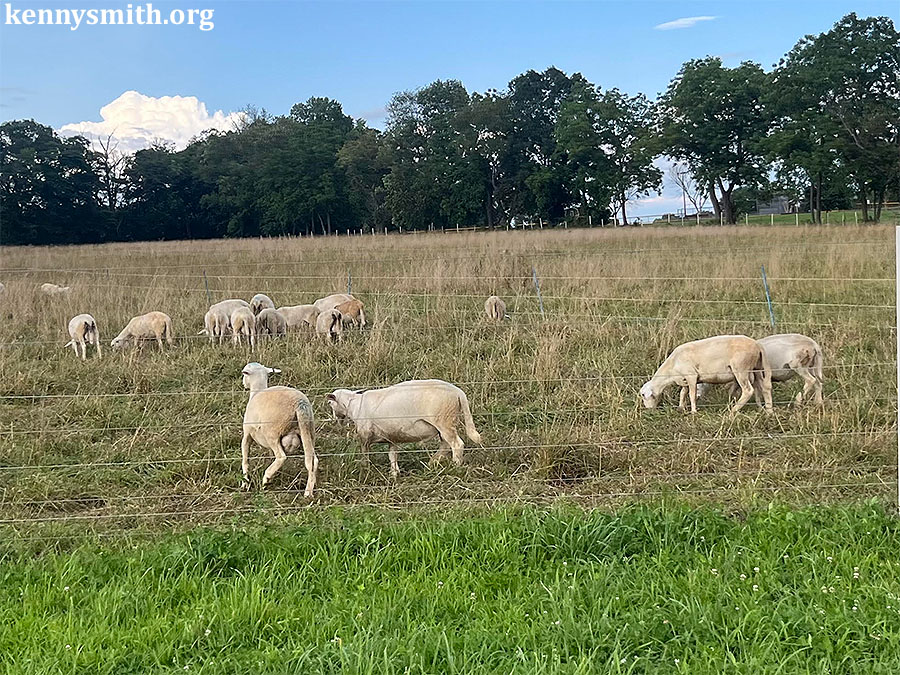
I had a nice little ride this evening. I set out for my time trial 25-mile loop, but it was slow. I didn’t really know that when I passed the sheep, but that’s only because I see them in the first five miles or so.

Soon after, though, the numbers looked low, so I decided to do a bit extra. On the long straight road that usually gives me a good tailwind before the final segment I had a crosswind, and instead of turning for the last seven miles home I went down to the next turn, 1.5 miles down the road, hooked a right at the little white house on the corner and then pushed on through some woods, a few warehouses, over some railroad tracks, a few more warehouses, and then finally took another right, to pass by some other warehouses, and finally the bridge over the water at a place where you sit five feet below sea level, and then into a four-stop sign town that dates back to the 17th century.

Turning left at one of those stop signs sends me through one final neighborhood and then four miles of pastureland, and then home. It was a lovely evening for a ride, a lovely ride, felt good and, yet it was somehow slower than I expected. Who knows why these things are the way they are.

We continue on with Rick Atkinson’s Fate of the Day, the second in his Revolutionary War trilogy. Terrific book and today I am again marveling at his source material.

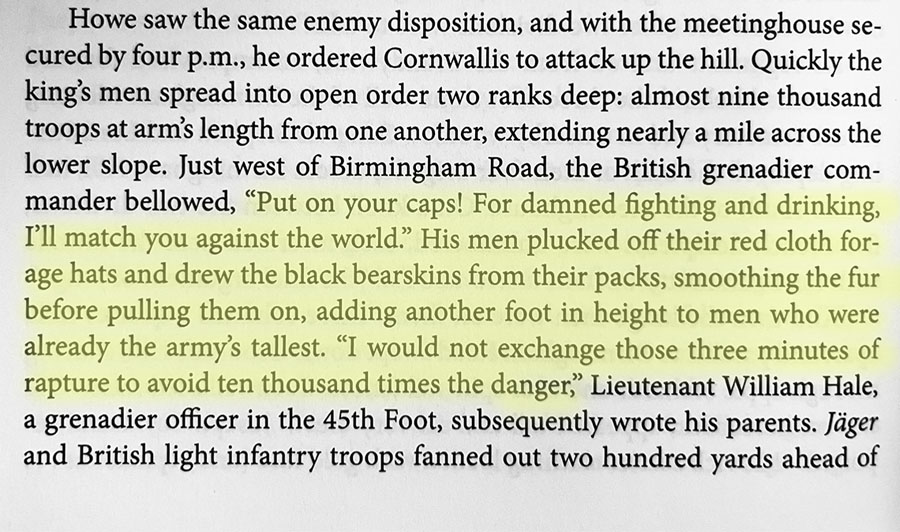
This was just prior to the Battle of Brandywine. The 45th Foot returned to England the following year, 1778, its strength barely 100 officers and men by the time they got home. We know Lt. William Hale survived Brandywine, participated in the occupation of Philadelphia and beyond. By August 1778 he knew he was going home, his regiment in tatters. Less than 100 officers and men from their muster rolls survived their battles and the subsequent trip home. A 1914 text gives us the context clues that he survived until at least 1780. The author of that history, a Captain W. H. Wilkin of the same regiment, writes that Hale “was not a man of note,” and that his letters home “describe the war from the point of view of a British subaltern.” Wilkin, nevertheless, gives Hale’s correspondence a full chapter which is rich in context and granular reporting of some of the battles in which he participated. Hale was 22 and fighting in America, retired from the service a captain in 1781, married in
1783, and died in Devonshire in 1789. There are other Hales, contemporaneous American soldiers, the lieutenant’s father, an admiral in the British navy, and a few other Williams in subsequent generations. So that might be all I can dig up about the grenadier today.

Hale’s line about his esprit de corps has, of course, been used in still other books as well. How could it not? While I’ve not read those others, I can say that Atkinson is delivering another great work. If you like history of the period and you’ve somehow missed this best seller, go get it. Or get the first book, then this one. Catch up and read along!


28
Jul 26

Back to work, a little, sorta

I made the mistake of thinking ahead today, and now my head hurts. But sometimes you must do that — thinking ahead, I mean, not self-induced cephalgia — so that’s what I did today. I printed out calendars, September through December. I did this three times. And this is the start of my fall semester. The work begins anew, with a smile, and no pay until September, etc. This work will continue until mid-December, which will roll immediately into the spring term. The second thing I did was to look at all of the academic calendars. Classes begin this day, Thanksgiving is that day, finals will occur on those days. The next five months are defined.

I accidentally glanced at the spring calendar, then quickly distracted myself by figuring out my weekly schedule and office hours for the term. That took three Post-it notes. Now they’re just hanging on the corner of my monitor. Taunting me.

There’s a lot of preparation to do in the next month. But not as much as in some other semesters. One class I must convert from an online class to an in-person format. That’s going to be a task, with some things coming out, some things need to go in the newly vacant spaces, plus there’s the simple trick of doing a class twice a week as opposed to via email.

To build momentum, I’ll start somewhere else. Two classes must be converted from twice-a-week to once-a-week. One of them is get an structural overhaul. The other, just needs to be redone to accommodate the new term. Maybe some more theories. Seemed light last semester. That means more studying on my part, which is fine, great even.

And this, friends, is how I will fill a month-and-change of work. Hence the headache. But I’ll be pacing myself. There’s time for that.

The feature act we saw this weekend was Barenaked Ladies. I hadn’t realized it, but we’ve now established a little tradition of seeing them every summer. We went from my lovely bride, a few years ago, having never seen them to now having an annual appointment. I think this is her fifth time seeing them. And that means she has seen five of Jim Creeggan’s upright bass solos. Here’s one now.


Ed Robertson did a freestyle rap. They did the medley that started with “Pink Pony Club” and ended with “Highway to Hell” and included stuff like “Texas Hold ‘Em,” “The Gambler,” and “Hot to Go” in between. They played the hits. I still miss Steve Page. I suppose I forever will.

When BNL are the headliner I still think, Maybe this is the tour, maybe this is the night they bring it all back together.

I try not to think about how he’s been out of the band for longer than I knew him in the band.

It’s been, what, eight years now since they had the Hall of Fame reunion?

Time really has sped up. If the full band ever has the appetite to get back together I hope it slows down so I can see several of those shows. I would go to see several of those shows.

We’re glancing at Rick Atkinson’s Fate of the Day, the second in his Revolutionary War trilogy, which I am enjoying reading a great deal. If you like history of the period and you’ve somehow missed this best seller, go get it. Or get the first book, then this one. Atkinson is aces, as ever.

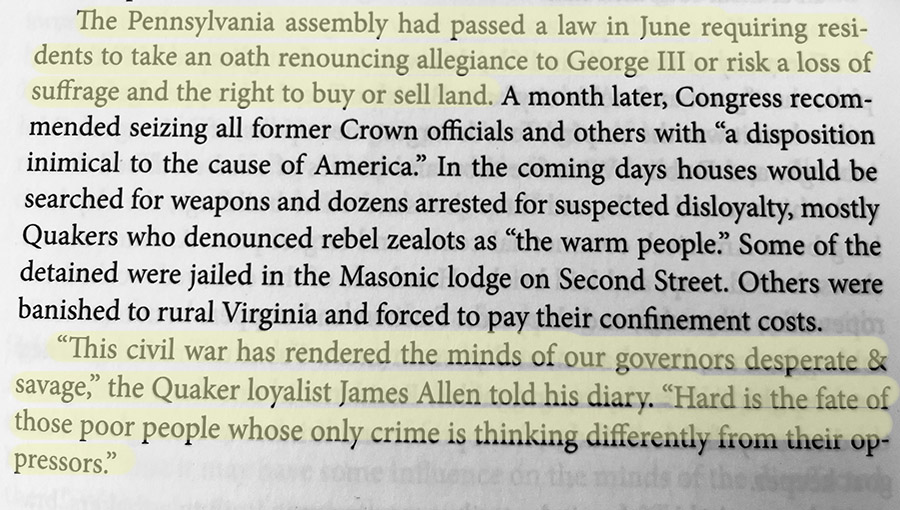
This is something I’ve always wondered about, ever since some history or social studies class began to teach us about the American Revolution in whatever grade that really began, I’ve always had questions about how one group of people came to find themselves in a position to upset the paradigm (I knew big words as a kid) and the ability to explain their will to others, and win the day. While doing all that, of course, you have to build resources, prepare and fight elements of the best army and navy in the world, and so on.

Representation got them into meetings, and local “committees,” general hooliganism, brute force, and some policy that they managed to institutionalize led to enforcing the new rules of the road (before they were laws of the land). If you were on the fence you got persuaded, or you went to Canada, the islands, or back to Europe. Persuasion came in many forms, not all of it terribly polite. But that’s revolution for you.

Which is, I guess, to say that I would have been terrible in the moment.

Who gave you the right? What are the rights? What are your rights? What are my rights? Who said you could speak for all of us? What if we don’t agree? No king, sure, but there’s a lot of you and you suddenly have a lot of rules and I could see a time, in another 250 years, when it is truly burdensome and sure they’ll have powers baked in by representation and precedent but, you, here, now, who gave you the right?

They might only thought up the idea of tarring and feathering people when they came across someone like that.

Here’s James Allen’s diary that Atkinson is quoting. And therein is yet another way for us to realize and recall that people had their positions for unique and, sometimes, changing reasons. The Allens were a prominent Pennsylvania family. They were loyalists but, as James Allen said once when talking his way out of a bit of trouble, didn’t actively work against it. At various moments people on both sides took a for-us-or-against-us approach, the most basic history can do that, too, but that didn’t always apply to everyone in those years, for all sorts of reasons like laws and history and fear and risk and religion and class and a feeling of what is just or what is at stake and on and on. We never think on that enough. Hard is the fate, indeed.


27
Jul 26

All I can hear now is Aerle Taree: ‘a game of horseshoes’

We went to a pool party, Saturday. Perfect day to spend in someone’s backyard. Just a lovely day. Very nice people. Let me count … about two dozen people. Kids in the pool, burgers on the grill, enough tables to circulate through to drop in on different conversations. Perfect weather. Someone there will have a big birthday next week, so it was one part that and one part getting all of these different people together.

Played a little cornhole, downplaying the skills, lest anyone become awed by my grasp of geometry and physics. At one point, for phone, I was just knocking other bags out of the air with my bags. And then a score was announced and, well, I can’t lose the game. So I started dropping them directly down the hole, which wasn’t as impressive as it could be, but was held in higher regard than it should be.

I resisted the urge to throw up my hands and yell, “I grew up playing HORSESHOES!”

Because I did, and that game gives you life lessons.

Also Jarts, which gives you other lessons, important lessons about parabolic arcs, escape vectors, eye protection, how to pop your hips and turn from a backpedal into a sprint if it really goes bad, and so on.

One of the kids was working on swimming lengths of the pool entirely underwater. We’ve all done that. I still do that. I might do that the next time I get in the pool. The swim was powerful, fast, ferocious. Three widths of the pool were completed by natural athleticism, fitness and youth. I explained lactic acid buildup, fluidity, efficiency, and wall propulsion. Suddenly, five widths became the standard. I think I felt more accomplished for explaining it than the swimmer did for swimming it. This is what it means to coach others: to see the success of others, to manifest an excitement of achievement that belongs solely to them because, if you did not, it’d just look weird when the thing was done to a level you knew possible.

Another, younger, kid I taught how to use a snorkel. I’m not sure if we progressed well into using it as a submerged breathing tool, but he did delight in blowing water out of the top of the thing. This is always what it means to coach others: to enjoy seeing the delights of others as your success.

Ask someone who played any sort of youth sport about something a coach and a team and their sport taught them that wasn’t about the game itself. That’s what it really means to coach others. I’ve never coached a sport, but I had those coaches. It’s invaluable. I coached college students on student media for 15 years — they won a bunch of awards and a lot of them have gone on to satisfying and important work in the media and someone of them just enjoyed their time their for their own reasons. And I think about that aspect of what a mentor or a coach can be when I think about that work. In this case, what is the confidence that grows in seeing yourself improving a skill by 67 percent based on just one conversation? What joy can you provide yourself by seeing how far you can discharge water out of a silly looking bent plastic tube?

Which is to say it was a nice pool party for me, and, also, I won at Cornhole.

We went to a rock ‘n’ roll show last night. Matt Nathanson was the opener. Still doing his breathy-graveling, coffee shop singer-songwriter thing. He was a 15-year-overnight success in 2008. He’s done now something like a dozen studio albums, two live albums, a bunch of EPs. He’s got a great stage presence. Its not every opener that you’re determined to get there on time for, or that everyone around you will shut up for, but we should, and Nathanson is one of them.

  
It was a night of three acts. More featuring Matt Nathanson later in the week. I’ll have another, different clip tomorrow.

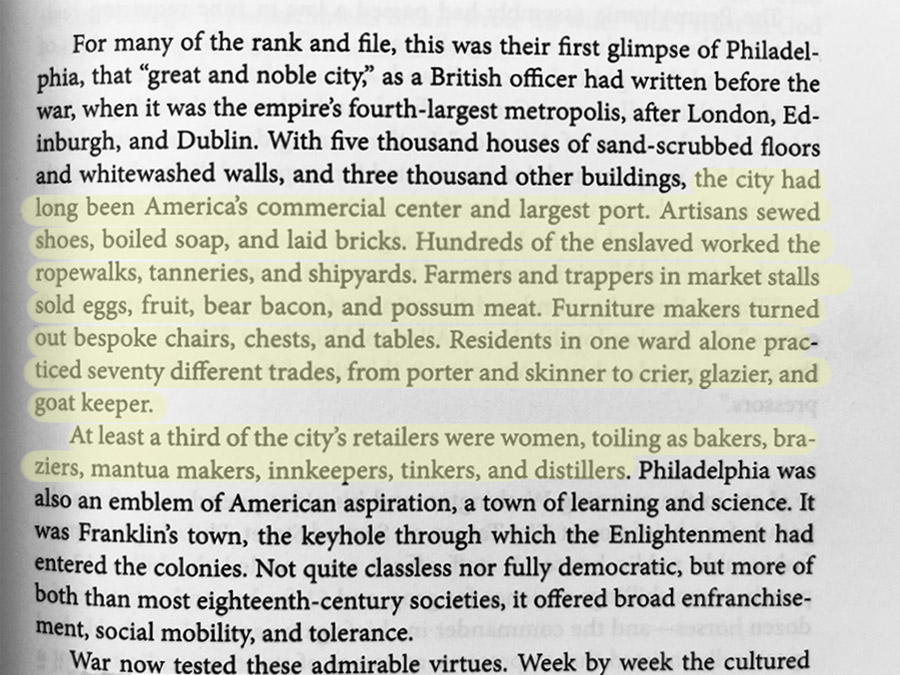
Back to Rick Atkinson’s Fate of the Day, the second in his Revolutionary War trilogy. (This is not a book club, but if you pick this up and read along we can pretend. Either way, you should consider the book, it is a great, terrific, and informative read.) One of the things that I always appreciate about Atkinson’s work is how he uses these lists as a sort of a daily street-level census of things. The more texture like this you give a story, the more I’m inclined to lean into it. Atkinson always seems to do that in these descriptive ways that never seem too onerous, never lose the thread of where his story is going, and yet gives you real flashes of this moment that we can’t physically inhabit.

Obviously I’m not prepared to fact-check him on this. Possum meat? Few of us are. But he’s a well regarded popular historian and I’m sure this has all been carefully examined to the extent possible. I have no reason to think otherwise, but I often think: how long does it take him, or the people that wind up in the acknowledgments of the book, to pull enough color together so that it can go into this one paragraph? Just the assemblage of information, let alone whatever time it took to write it, re-write it, edit it, re-work it again. And it’s merely a part of his style.

And one more reason I’m enjoying the book and suggesting it to others.