


We hop, one final time, into the time machine to head to 1936 to visit The Glomerata, the yearbook from my alma mater. In all of our installments we’ve skimmed over some of the student leaders, the athletics, some of their activities and so on. This hasn’t been a complete survey, of course, but it has been fun.
(See them all! Part one is here. Part two is here. Part three is here. Part four is right here. Part five is here. Part six is here. Part seven is here.)

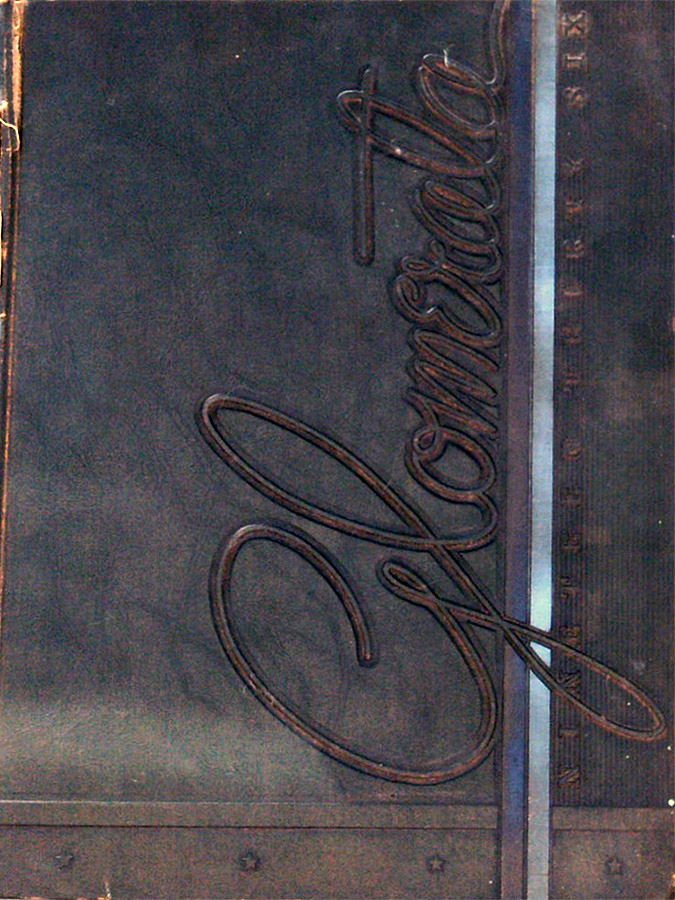
Before we dive in, here’s the cover of the 1936 Glom.
Because it is from the 1930s, this is a very male-centric book. Auburn, Alabama Polytechnic Institute, was co-ed, but the percentages were hardly equal and all that that implies is reflected in the contents here. Last week we saw some of the women about campus, and this week we’re going to see the house mothers. All the good that these students would undertake is surely to the credit, and due to the hard work, of Mrs. Sledge, Mrs. Bissett, Mrs. Haley, Mrs. Andrews, Mrs. Reid, Mrs. White, Mrs. Wright, Mrs. Walker, Mrs. Mullikin, Mrs. Cox, and Mrs. McLendon.
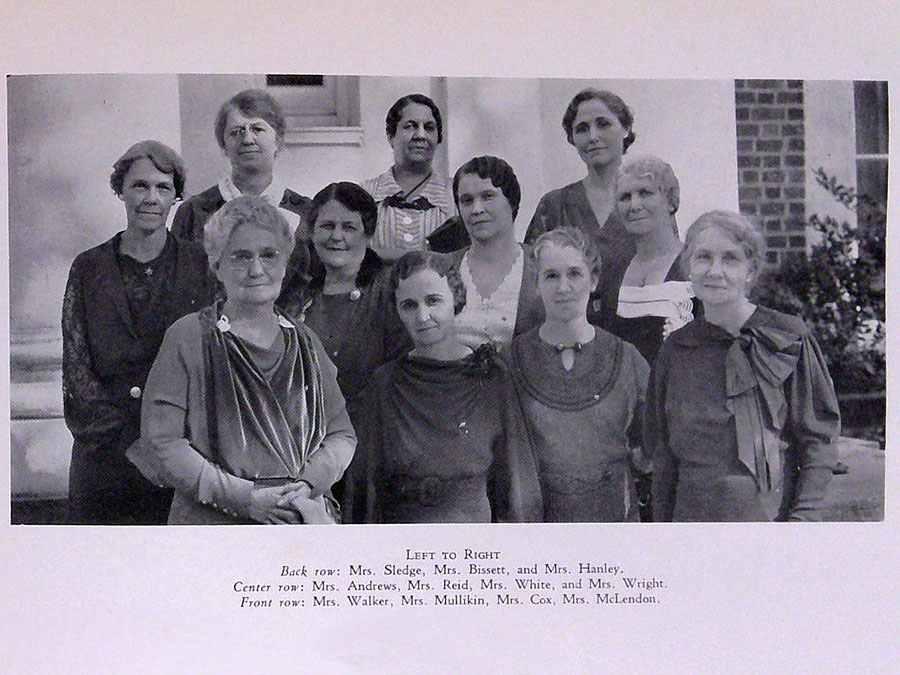
Usually these women are in some way affiliated with the university, or otherwise pillars of the local community. Who knows how many dishes they cleaned, broken hearts they mended, and whatever else that fell to them. And in whatever ways the students of this cohort came up short, well, we can’t blame Mrs. Sledge, Mrs. Bissett, Mrs. Haley, Mrs. Andrews, Mrs. Reid, Mrs. White, Mrs. Wright, Mrs. Walker, Mrs. Mullikin, Mrs. Cox, and Mrs. McLendon. I’m sure they were all lovely human beings with this close-cropped, fried hair, and life-experience that aged them before their time, but they’re hardly miracle workers.
Here’s the ag club. Decades hence I studied in the College of Agriculture there. Had I been around during this time, I’d probably be in this photograph.
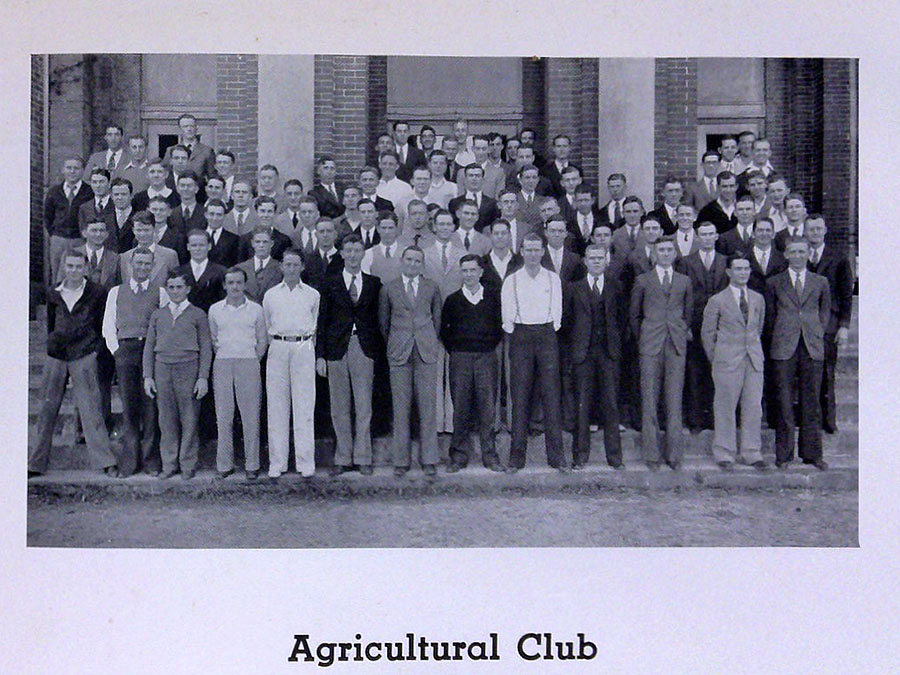
They had two sets of officers, one for the fall and one for the spring. The president in the fall was a senior, Henry Calvin, “Red” Arant, a senior from rural McKenzie. He would become a county extension agent, but died young, at just 34, after a long illness. He’d worked in county offices around the state, helping the farmers and their communities. He was survived by a wife and three daughters. He was living in nearby Dadeville at the time. He was buried in Auburn. Herbert Harris was the other president. He was a senior from Garden City, a town with 528 people that didn’t even show up on the census until 1950. The problems with have with Harris are that seemingly every time he appears in the yearbook his name is spelled differently. Herbert. Hurbert. Hubert. Also, at least two of those names are remarkably common for early 20th century boys. And there’s one more big problem: my best lead is a pair of twins. Herbert, and Hubert. There was a Hubert Harris that became an instructor of horticulture at Auburn in 1936 and stuck around for a long time. He made it to 90, died in 1997 and is buried in Auburn. His brother, Herbert, died at 51. I’d rather not speculate too much.
One of the vice presidents was a man named Klien Boyd Ellis, a senior from Jasper, Alabama. He married a girl from his hometown. At some point, they moved to Wyoming. They died in the 1990s and are buried there.
Wheeler H. Alsabrook was one of the treasurers. He would graduate the next year. He and his wife, Jennie, had two sons, one which they named him after dad. Wheeler Sr. died in 1968, just 56 years old. His son, Wheeler Jr. was apparently a green beret. Jr. had his CIB, jump wings, a pathfinder badge, a bronze star and more. He did three tours in Vietnam, took a battlefield commission, and also participated in Desert Storm. He retired a colonel. I’m sure his parents were some kind of proud. There’s a Wheeler III out there today.
The spring semester treasurer was Thomas Earl Deloach. He earned a master’s degree, taught vocational agriculture for 34 years — influencing who knows how many young people, and was a Methodist minister. He died at 82, in 1990, survived by his wife of 42 years, and three children.
The club had two reporters, and in the fall that very serious job fell to Mabry Huggins, a junior from McKenzie. The eighth of 20 children, he left school early to become an assistant county agent and work in 4-H in south Alabama. He stayed on with the Extension system for decades, another critical component in rural life are those hubs of information at the Extension agency and the men and women that keep them open. At school he’d been editor of The Alabama Farmer (which I think I have in storage) and quite the popular lad. The plan was to return to school the next year to finish up. Hopefully he was able to see that through. At any rate, got married in 1938, a union that lasted until his death in 2002. He was survived by his wife and daughter.
Wilbur Kelley was the other reporter for the agriculture club. He, too, would become a county agent. He got married sometime before 1943. He also enlisted in the U.S. Army in 1943, and was assigned as a dairy and meat inspector in the Chicago Quartermaster Corps. His first son, Wilbur Jr. was born while he was there. So important was his work with Extension that, after the war, when he received a promotion to director of the Black Belt Experiment Station at Marion Junction in 1951, that news found its way into nine different papers across the state. His concentration was in pasture research and developing an off-season breeding program for cattle, but it was all cut far too short. He died in December of 1956, just 44 years old. He was survived by his wife and four children. He helped changed the production industry, developing a cattle-row crop economy in the economically challenged Black Belt. The Selma newspaper article covering his funeral lists a Who’s Who of mourners.
Some of those other men went on to great careers, too. I just hope they were longer.
The final section of The Glom is the advertiser section. This is one of two with any real art. If you’ve not heard the expression, a latch string is simply string on a latch. You can leave it hanging outside the door to permit the raising of the latch from the outside or you can pull the latchstring inside, to prevent unwanted visitors. Loveman’s is saying the door is open for you.
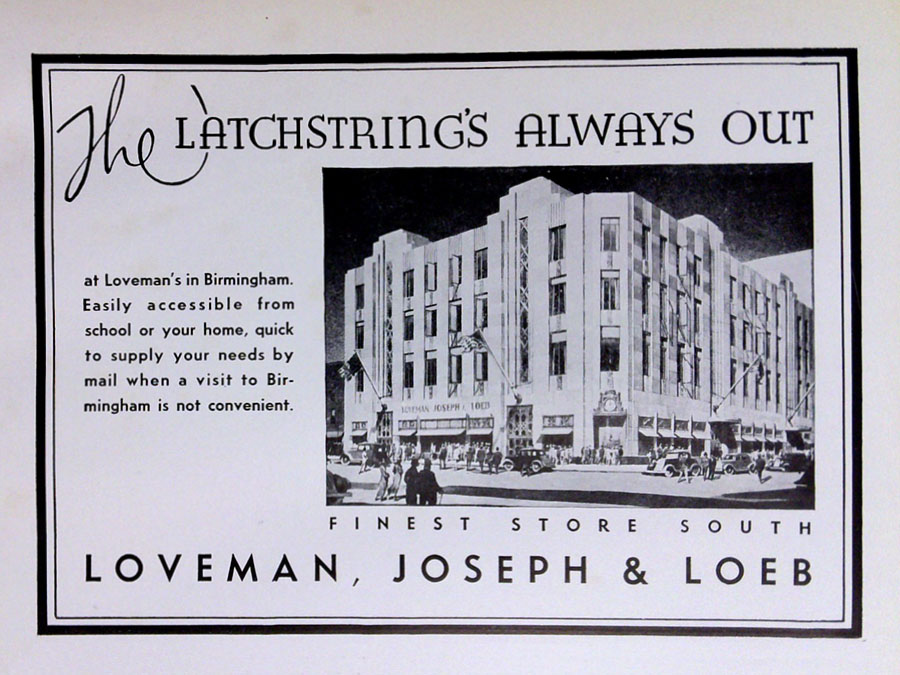
Loveman’s was a department store chain, they used this name to distinguish from competitors in Tennessee. The store dated back to 1887 in Birmingham, but soon Adolph Lovemand was joined by Moses Joseph. Soon after came Emil Loeb. Within 20 years Loveman’s was known as the largest department store south of the Ohio River. There was a big fire in 1934, destroying most of the store, but they rebuilt on the same spot. The new department store was one of the first in the nation to have air conditioning. It was the first in the state to have an escalator. They shut down in 1980. The building is still there, home of the McWane Science Center.
Here’s the building, from the same perspective, from September of this year.
Most of the rest of the ads look like this.
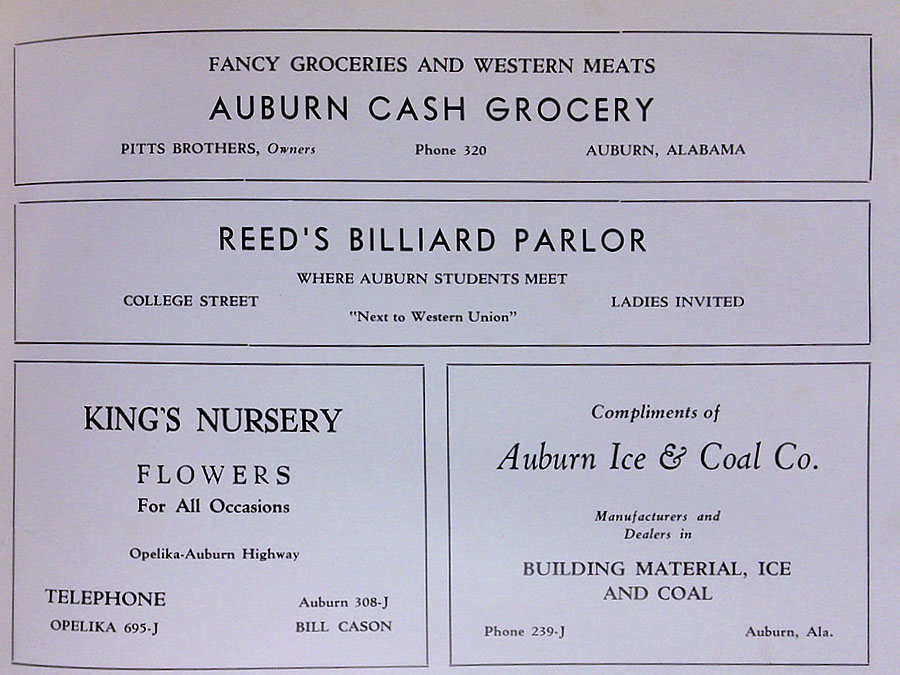
But, small college town, blue collar rail town next door, the big city two hours away, none of these things used their addresses. The merchants just assumed you knew where they were, that you could find them, that their place of business stood out.
And look at those phone numbers!
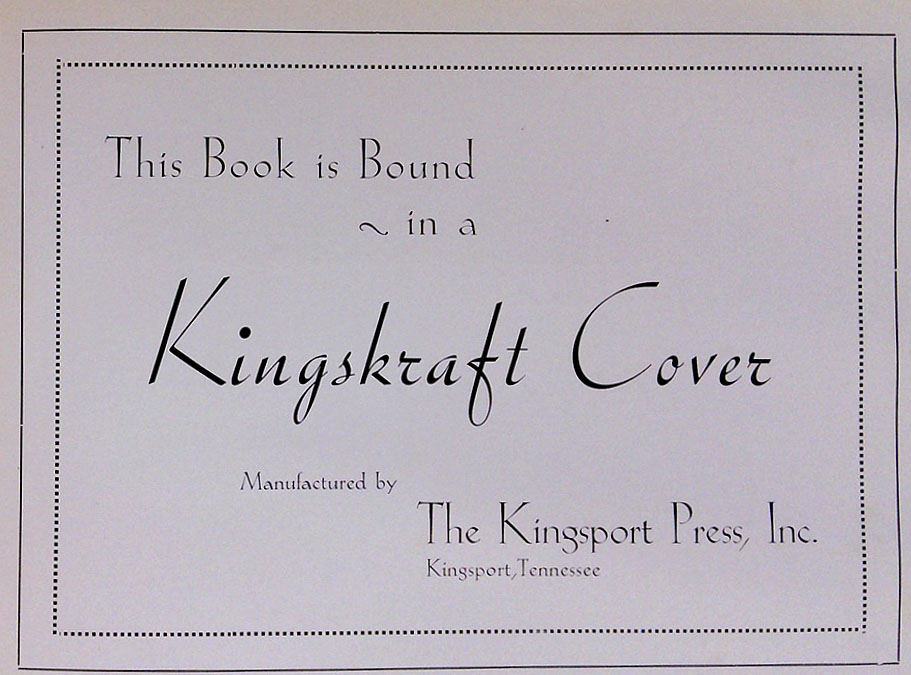
At the very end are ads for the book makers. The Kingsport Press was a big deal for half a century. They were hitting their stride by the 1930s, acquisitions started in the 1960s. By the oughts, the book industry had changed enough that they shut down the facility. The buildings are still in use today, however.
So this book was written by students, and many of the photographs taken by students. A professional photographer from Columbus, Georgia also got a credit here. They must have put this on floppy disks and drove it to Nashville, where the publisher was located, because the high speed internet connections of the 1930s weren’t that great. Also, floppy disks didn’t exist, of course.

So they drove up their work to Nashville, to the publisher, who put all of this together. They were eventually bound by that other shop, in northeastern Tennessee, and then brought back down to campus for distribution. Who knows where this particular book was for the next few generations — there’s no name in this one, so I don’t know which student picked it up — but its been with me for almost 18 years now. With the exception of the binding on the headcap hinge, it’s in great shape, so good on the old Kingsport Press.
All of this will wind up in the Glomerata section (eventually). You can see others, here. Or maybe you’d like to click through to see all the covers. The university hosts their collection here.

