


We went to a pool party, Saturday. Perfect day to spend in someone’s backyard. Just a lovely day. Very nice people. Let me count … about two dozen people. Kids in the pool, burgers on the grill, enough tables to circulate through to drop in on different conversations. Perfect weather. Someone there will have a big birthday next week, so it was one part that and one part getting all of these different people together.
Played a little cornhole, downplaying the skills, lest anyone become awed by my grasp of geometry and physics. At one point, for phone, I was just knocking other bags out of the air with my bags. And then a score was announced and, well, I can’t lose the game. So I started dropping them directly down the hole, which wasn’t as impressive as it could be, but was held in higher regard than it should be.
I resisted the urge to throw up my hands and yell, “I grew up playing HORSESHOES!”
Because I did, and that game gives you life lessons.
Also Jarts, which gives you other lessons, important lessons about parabolic arcs, escape vectors, eye protection, how to pop your hips and turn from a backpedal into a sprint if it really goes bad, and so on.
One of the kids was working on swimming lengths of the pool entirely underwater. We’ve all done that. I still do that. I might do that the next time I get in the pool. The swim was powerful, fast, ferocious. Three widths of the pool were completed by natural athleticism, fitness and youth. I explained lactic acid buildup, fluidity, efficiency, and wall propulsion. Suddenly, five widths became the standard. I think I felt more accomplished for explaining it than the swimmer did for swimming it. This is what it means to coach others: to see the success of others, to manifest an excitement of achievement that belongs solely to them because, if you did not, it’d just look weird when the thing was done to a level you knew possible.
Another, younger, kid I taught how to use a snorkel. I’m not sure if we progressed well into using it as a submerged breathing tool, but he did delight in blowing water out of the top of the thing. This is always what it means to coach others: to enjoy seeing the delights of others as your success.
Ask someone who played any sort of youth sport about something a coach and a team and their sport taught them that wasn’t about the game itself. That’s what it really means to coach others. I’ve never coached a sport, but I had those coaches. It’s invaluable. I coached college students on student media for 15 years — they won a bunch of awards and a lot of them have gone on to satisfying and important work in the media and someone of them just enjoyed their time their for their own reasons. And I think about that aspect of what a mentor or a coach can be when I think about that work. In this case, what is the confidence that grows in seeing yourself improving a skill by 67 percent based on just one conversation? What joy can you provide yourself by seeing how far you can discharge water out of a silly looking bent plastic tube?
Which is to say it was a nice pool party for me, and, also, I won at Cornhole.

We went to a rock ‘n’ roll show last night. Matt Nathanson was the opener. Still doing his breathy-graveling, coffee shop singer-songwriter thing. He was a 15-year-overnight success in 2008. He’s done now something like a dozen studio albums, two live albums, a bunch of EPs. He’s got a great stage presence. Its not every opener that you’re determined to get there on time for, or that everyone around you will shut up for, but we should, and Nathanson is one of them.
It was a night of three acts. More featuring Matt Nathanson later in the week. I’ll have another, different clip tomorrow.

Back to Rick Atkinson’s Fate of the Day, the second in his Revolutionary War trilogy. (This is not a book club, but if you pick this up and read along we can pretend. Either way, you should consider the book, it is a great, terrific, and informative read.) One of the things that I always appreciate about Atkinson’s work is how he uses these lists as a sort of a daily street-level census of things. The more texture like this you give a story, the more I’m inclined to lean into it. Atkinson always seems to do that in these descriptive ways that never seem too onerous, never lose the thread of where his story is going, and yet gives you real flashes of this moment that we can’t physically inhabit.
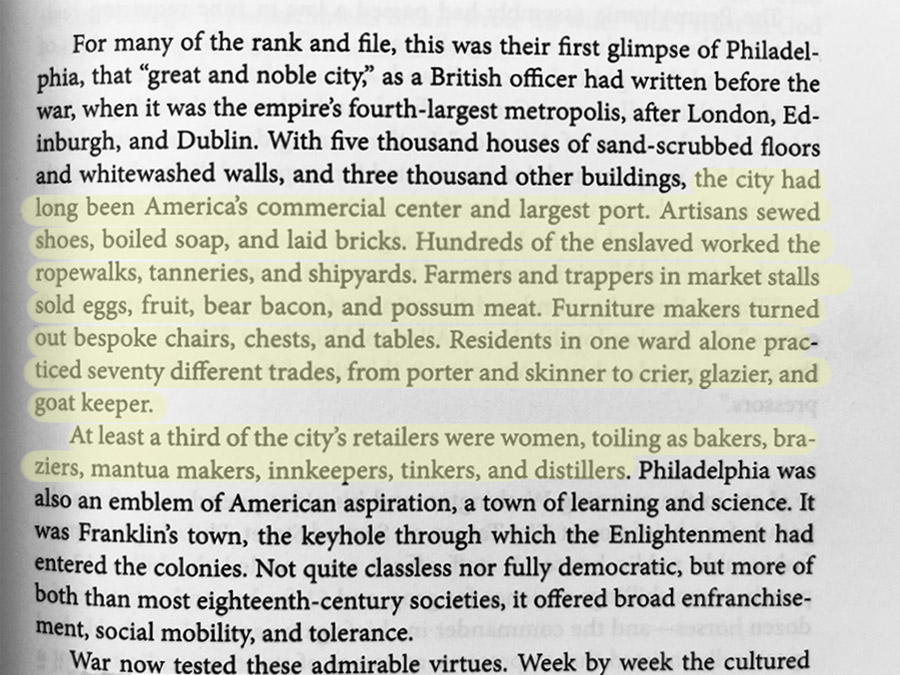
Obviously I’m not prepared to fact-check him on this. Possum meat? Few of us are. But he’s a well regarded popular historian and I’m sure this has all been carefully examined to the extent possible. I have no reason to think otherwise, but I often think: how long does it take him, or the people that wind up in the acknowledgments of the book, to pull enough color together so that it can go into this one paragraph? Just the assemblage of information, let alone whatever time it took to write it, re-write it, edit it, re-work it again. And it’s merely a part of his style.
And one more reason I’m enjoying the book and suggesting it to others.

