


Just another ho hum beautiful day. One of those from the “Why must we spend it indoors variety?” which, of course, is a subset of the “Who thought responsibilities were a good idea?” typology. Days like today you want to build a time machine, go back in time, and thump that guy on the nose. Of course, you’d build the time machine in the garage, door open, enjoying the weather. Counting your lucky flux capacitors for it. Scrolling through Craigslist looking for the right kind of car to house your time machine.
I gave that a glance, to see what my time machine would be. The most recently advertised car is a 2012 Kia Sportage. No idea if that’ll hold up against the strain of going back in time for responsibility thumbage.
What’s that? A Sportage EX you say? I guess that might work.
Last week there was a listing for a “1951-ish, CHEVY-ish RATROD, street rod-ish.” I think the seller might be too attached to it, but it does look time machine-ish.

In class today we talked about Flock cameras, because someone mentioned this map.
Someone else recently emailed me this clip, which we watched today.
That paired nicely with this video, which I’d recently stumbled across myself.
I wrapped up a bit about doxxing with a another layer to the horrible Cornell case. It allowed me to make the point I was previously after.
We discussed about Jose Van Dijck’s Culture of Connectivity. It brought up wonderful questions about how the communal nature of the web has changed, how social media can shape habits, and what this book looks like if it were written today. I was also about to talk about my social media sameness singularity, which is an argument I’ve been making for a decade now. (In short, all of the platforms are trying to become one another in competition.)
Someone else asked a question that allowed me to read a now nine-year-old passage from bestselling author (and now bookshop owner, apparently) Matt Haig which has fundamentally changed the way I think about all of this stuff.
Kurt Vonnegut said: “We are what we pretend to be, so we must be careful who we pretend to be.” This seems especially true now we have reached a new stage of marketing where we are not just consumers, but also the thing consumed. If you have friends you only ever talk to on Facebook, your entire relationship with them is framed by commerce. When we willingly choose to become unpaid content providers, we commercialise ourselves. And we are encouraged to be obsessed with numbers (of followers, messages, comments, retweets, favourites), as if operating in a kind of friend economy, an emotional stock market where the stock is ourselves and where we are encouraged to weigh our worth against others.
Your relationship is framed on commerce. I have lots of friends I met at my job or their job our our jobs. I dated at least two people that way. None of those were framed on commerce, of course, but Haig makes a really interesting point, and I was glad to talk about it today.
I’d spent the last several weeks writing about the Seward Johnson work, Contact, that sits on the walk between my office and that classroom. I wrote about it here. Then, last month, we looked a bit more closely at the couple’s hands. The next week, I offered a closer look at some of the textures. Our last look at that curious little piece of art was last week, where we focused on a few more of the illusions of textures of the trompe-l’œil painted bronze statue.
So, now, we’re moving on to one of his other nearby works. This is titled Photo Shoot, and as you look at all the styles here it is important to note that this was completed in 1989. The curator of this little collection wanted you to notice that, too. (There are five pieces within a short walk of one another. (We’re on number two, and we’ll see them all before the year is out.) They quote Johnson, “If you know where to look for it and how to look at it, life is marvelous.” So it’s a bit of a time capsule, in the most well-intentioned ways.
Photo Shoot was commissioned for the grand opening of the Giorgio Armani building, on Rodeo Drive, in Beverly Hills. You’ll see a nod to to the designer in just a moment. I don’t know the history of this piece, but it is here now, and it does have its delights. Let’s begin.
Right away, it is obvious what’s going on here. In our foreground, the man in his expensive 1980s jacket and tasteful slacks, has taken up a low angle to capture a family moment. Mother and child are just in the background.
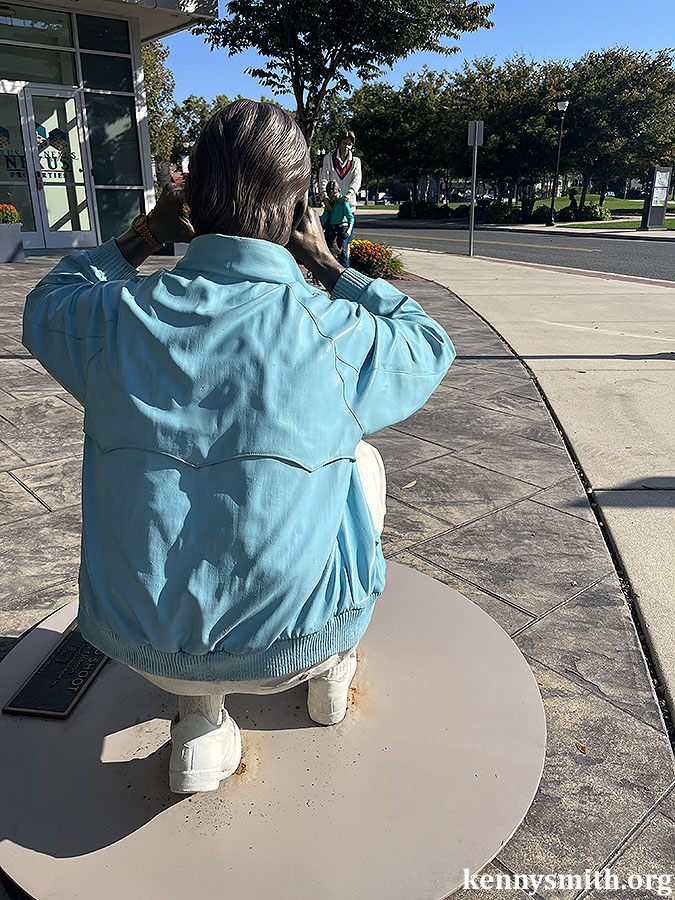
We can see them a bit better from this angle. And it is interesting that the color scheme of his “clothes” closely mimics the wardrobe of the subject of his photograph. We, the viewers, need to understand these two pieces go together. There’s just enough distance between them (I wonder how far apart they were in the original installment, before they came here.) that a visual line needs to be made and the color scheme can make that connection.
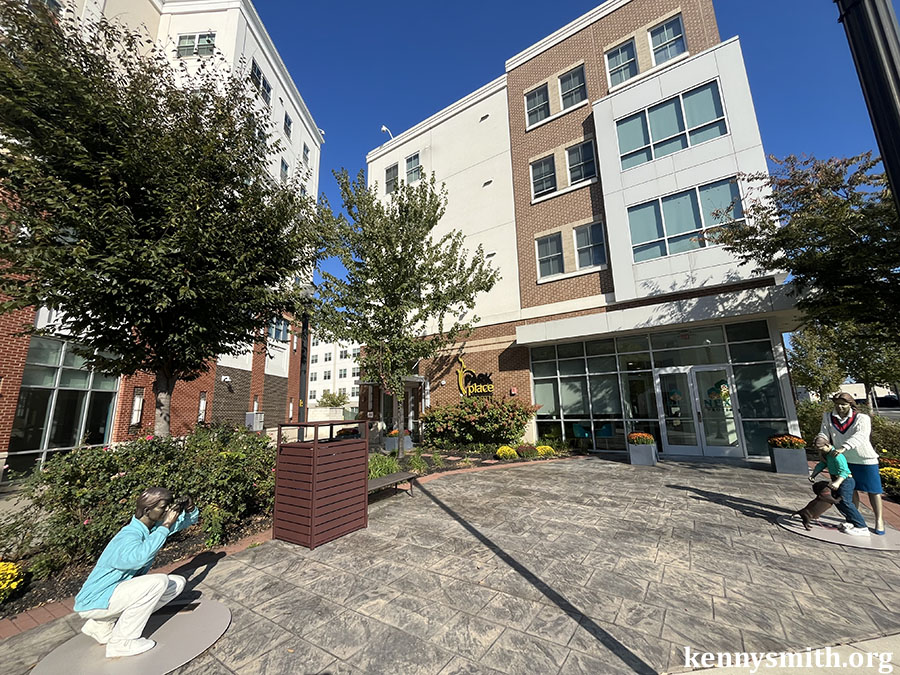
Here’s a view from over the mother’s shoulder. Neat sweater, tasteful skirt, the classic Armani tote. Also, there’s a puppy in the mix.
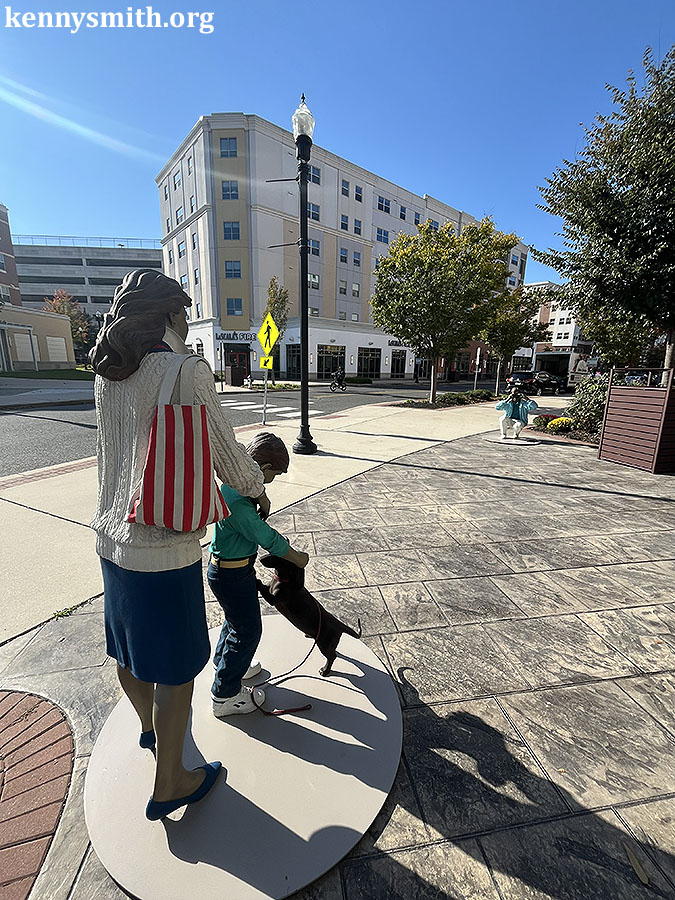
From here, you can clearly see that everyone is hanging on to something. Boy with his puppy, dog with the kid, mom with son, dad with his camera. I’m not sure if we’re meant to draw inferences from this, but you can if you are so inclined. I’m trying not to. It seems a happy piece.
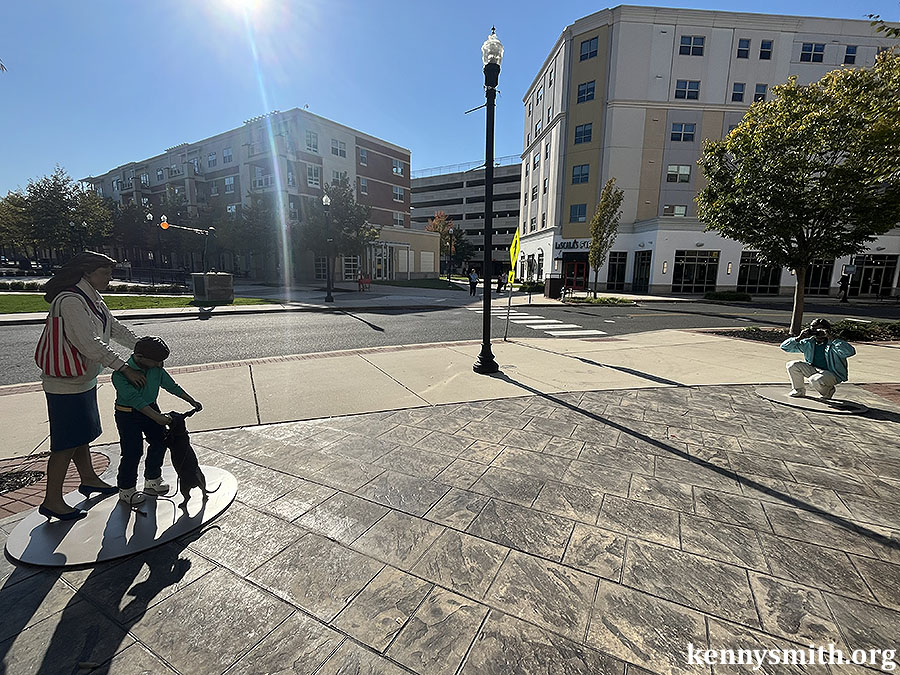
I have a small handful of photos of these statues for next week. We’ll look at a few interesting details.
For now, I have to work on a slide deck about ethics.

