


After a long time away from this feature, we return to the dusty old pages of old yearbooks. Enjoy a few pretty pictures from the Plains.

We go now to the 1920s, right in the middle of what might be the tumultuous era in the old alma mater’s history. Spright Dowell, who never enjoyed support as the president, was coming to the end of his time on the plains. He’d come over from the state department of education, which even, back then, referred to itself as The Department. Dowell replaced Charles Thach, an alumnus who’d been on campus for decades until 1920, just before his death the next year. They were engaged in political warfare with their cross-state university rival (with cloak-room maneuvering that went far beyond athletics.) State funds were low, there were charges of ethics problems through the Cooperative Extension Service. The university also had to survive a proposal that would move the campus 50 miles west, to the capitol city. Dowell wasn’t exactly against that idea, and that cost him in the eyes of his faculty and students. Also, the Great Depression was on the horizon. No one knew that in 1926.
Dowell knew, however, that he replaced a beloved man, and sometimes blamed that for his lot in life, because the real issues — disrepair of buildings, outdated equipment, debt, underpaid faculty — weren’t enough to blame. He wanted more money from the state, which often looked at the university as a secondary concern, despite its land grant status and importance to the region. People seemed to like him, there was a complimentary note about his welcoming style of conversation in this annual, but didn’t think he was equal to the job. He’d lost the alumni, the faculty were over him. Enrollment wasn’t keeping up with regional competition. Dowell might have been too much of a holistic bureaucrat for the moment, and didn’t bring the requisite passion for the place, but there was also the problems in athletics, particularly football. After the 1924 season the team was 4-4-1, and alumni wanted Dowell to be brought before the board of trustees, with students called to testify. This was the lever that moved alumni, but statewide politics that had nothing to do with sports were also at play. The students hanged him in effigy.
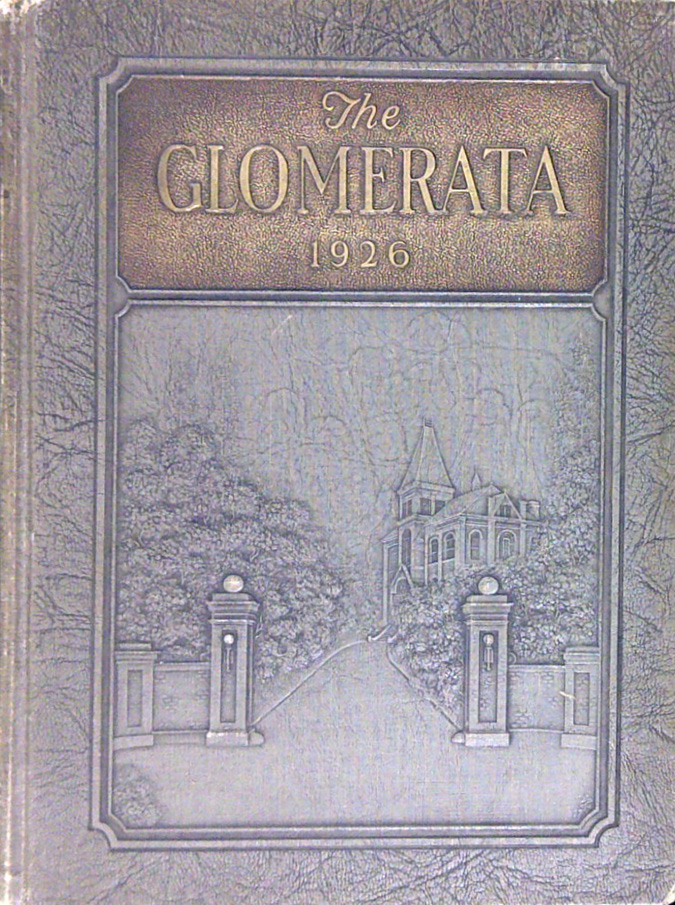
This is the cover of the 1926 yearbook.
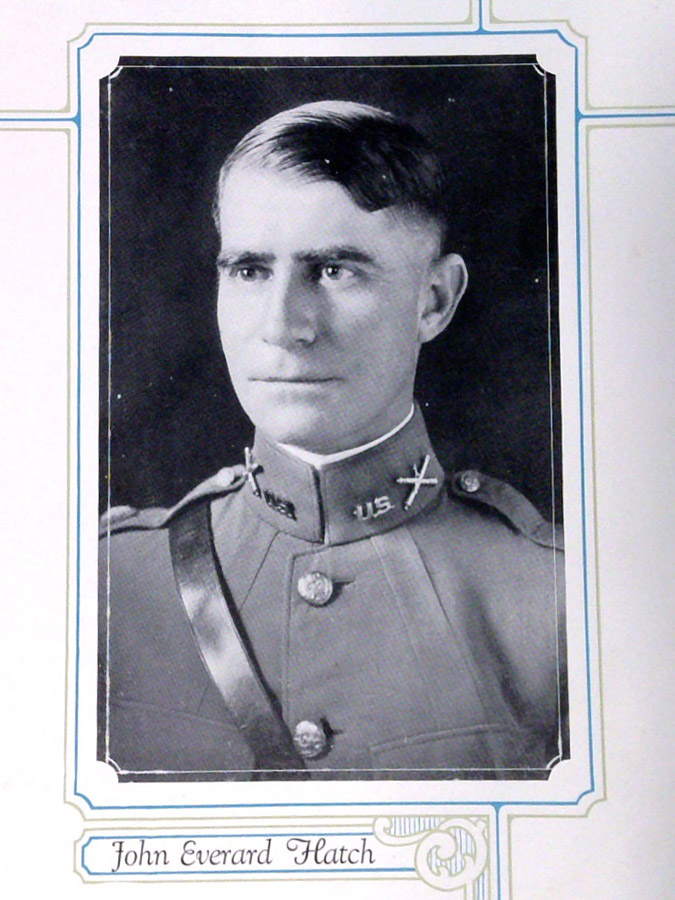
The book was dedicated to Maj. John Everard Hatch, “who has been an inspiration to us throughout our four years of college life … in token of our love for him as a man, our admiration for him as a solider and our devotion to him as a leader.” Hatch retired as a colonel. He and his wife, Helen, are buried at West Point. They had a daughter and two sons, both of whom served as officers in the Army. They would have all been 10 or younger here. His father was a brigadier general, buried at Arlington.
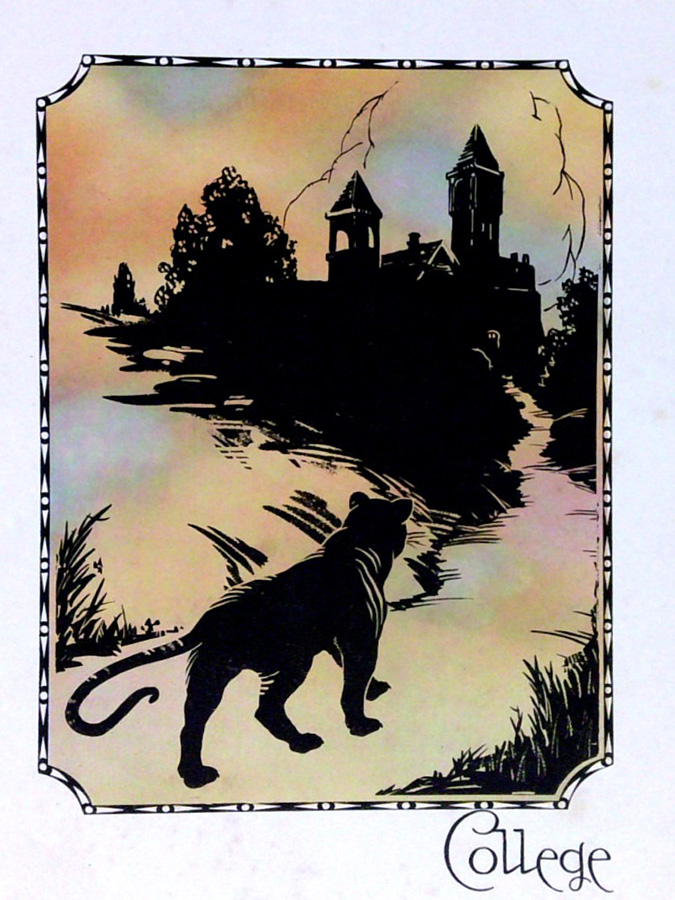
Sometimes it is easy to think of the way-back-then as a monochrome moment, a sepia-toned, yellowed piece of paper is what we’ve got. That’s what we see, after all. But this book is here to show you, they knew about color. There are several plates like this marking the different sections of the book. Though, to my knowledge, we didn’t often have tigers walking a path to Samford Hall.
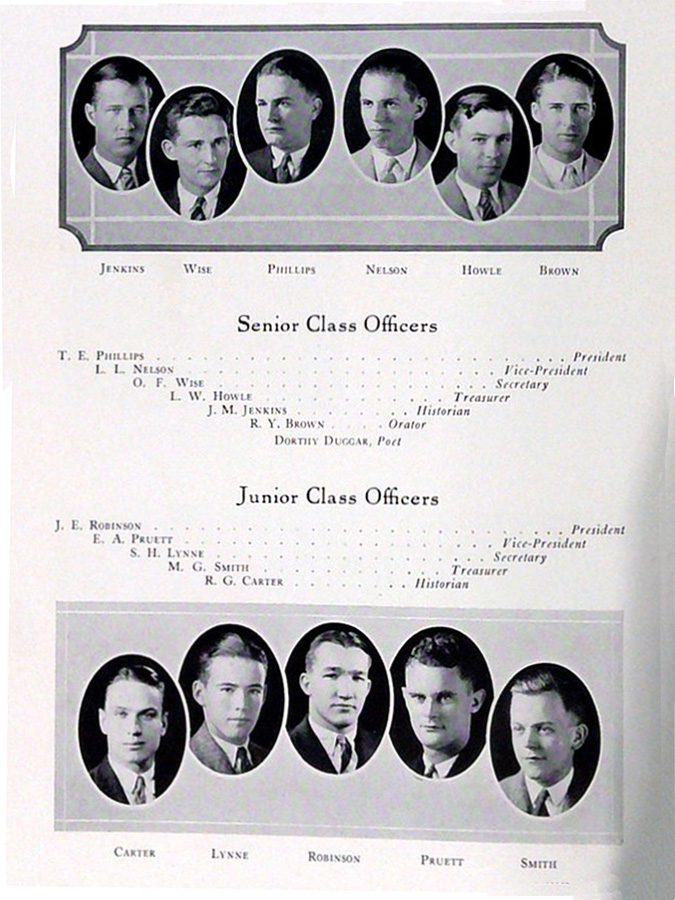
Nevertheless, it is the 1920s. The photos here are large shots of buildings, which we’ve discussed before, and small headshots, like these, of the senior and junior class officers.
Vice president of the senior class was Leon Nelson, who was from Gadsden. He went to Florida to coach and then to coach in south Alabama. A decade hence, he was the head football coach back home in Gadsden, and had a legendary decade-long run there. He went back to Florida in 1948, where he stayed until 1964. The stadium there is named in his honor. He died at 67, in 1970, in Miami.
Owen Frederick Wise return to Auburn in 1970 to receive an honorary doctorate. He was the director of the state’s Vocational Rehabilitation Service where he worked for more than 40 years, started in 1928. He died in Montgomery, in 1973. He had his wife, Louise, had two daughters, and at least one of them went to Auburn and would be listed as one of the Glomerata’s favorites — a fact which was mentioned in her obituary, at 88, in 2023.
Louis Howle left school and signed on with the American Telephone and Telegraph Company, where he worked for 43 years. He and his wife had two daughters. He died in Atlanta, in 1983.
Robert Young Brown went into the foreign service. He was stationed in Baghdad, Cairo, Bogota, and Panama in the 1930s. He would also serve in Montevideo, Manila, and Athens. He was named consul general in Jamaica in 1950. He retired in 1957, and served in the National Defense Executive Reserve. He died in 1964.
Dorothy Duggar was from Auburn, hers was one of those reasonably prominent families. She would become the first woman to graduate from the university with a degree in architecture. She stayed in town, and became well-known herself. She died in 1975 and is buried at Pine Hill.
Did these juniors do much? Eldon Pruett got married in the fall of 1926 and graduated in May of 1927. His wife became a teacher. He did too, becoming a coach at neighboring Opelika High. He stayed in the Army reserves, left OHS to serve in the war. At some point he did a stint in Korea. He became a lieutenant colonel, and a business manager when he returned to civilian life. He was active in local society, ran for the county school board, married off two daughters. His nickname in college was Dizzy, and people still called him that three decades later. He died in 1968.
S.H. Lynne was a track star at Auburn and was hired as a coach at Alabama. He also studied the law there, and then became a county judge in 1934. He was named to the federal bench in 1946 by Harry Truman. When he died, at 93, in 2000, he was the longest serving jurist. His obituary recalls that his order kept George Wallace from barring two black students from attending the University of Alabama, though he wasn’t known as a proponent of integration.
His classmate and fellow class officer Moreland G. Smith was a civil rights activist, and architect. He joined a Nashville firm, studied at MIT, and then put out his own shingle. He designed a city hall, and an apartment complex where Rosa Parks would later live. He served in the Army Corps of Engineers. He later designed Montgomery’s Garrett Coliseum, served on the board of trustees at Tuskegee. He also worked on a church, a library and three county courthouses. He sold most of his interest in the architectural firm Sherlock, Smith & Adams because the very racist governor was threatening a bank with which they did business. He moved to Atlanta and joined the Southern Regional Council. He and his wife, Marjorie, had three children. He died in 1989.
It looks as though Rodney G. Carter became a teacher, and then a principal. He’s difficult to pin down, however.
All of the senior headshots look like this, though Sarah Frances Blackman is the only one smiling.
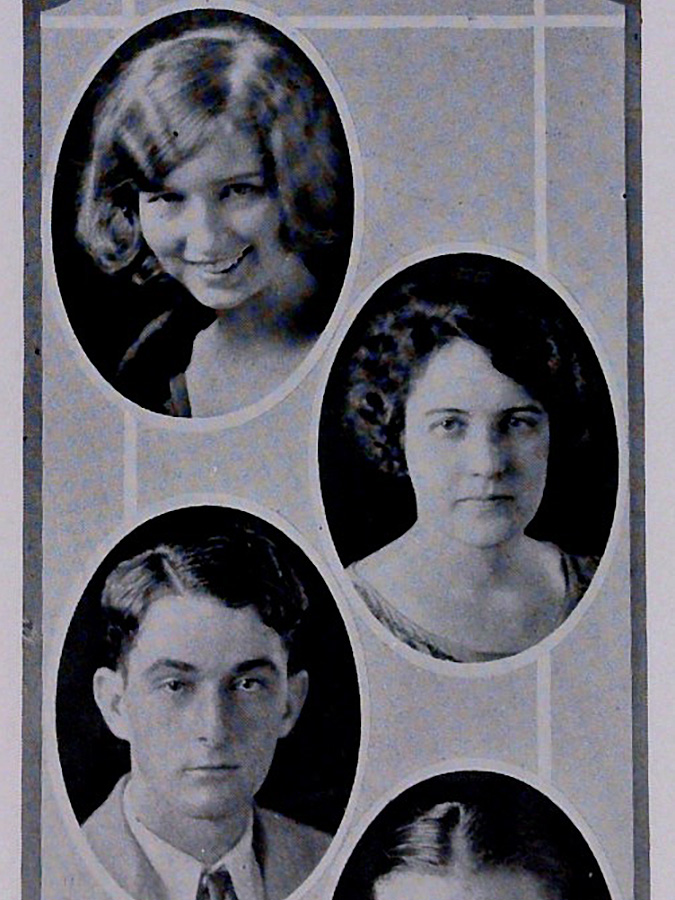
If I have the right woman, it seems that she got married in 1953. It’s possible she lived in Florida. And, if I found the right one I think I’ve just stumbled upon my favorite newspaper mention in this long-running project. In 1983, Frances Blackman was demonstrating the microwave. No wonder she was smiling, decades and decades earlier.
The next woman is Mrs. Margaret H. Blair. She would go on to work at the Georgia Teachers College and the University of Georgia. By the mid-1940s she becomes nationally renowned in clothing and textiles. She’s in her 30s here, but she’s difficult to trace. She died in Savannah, Georgia, in 1973. Her sister, Agnes Harris, was at this time the dean of women at Auburn. The next year she went over to Alabama.
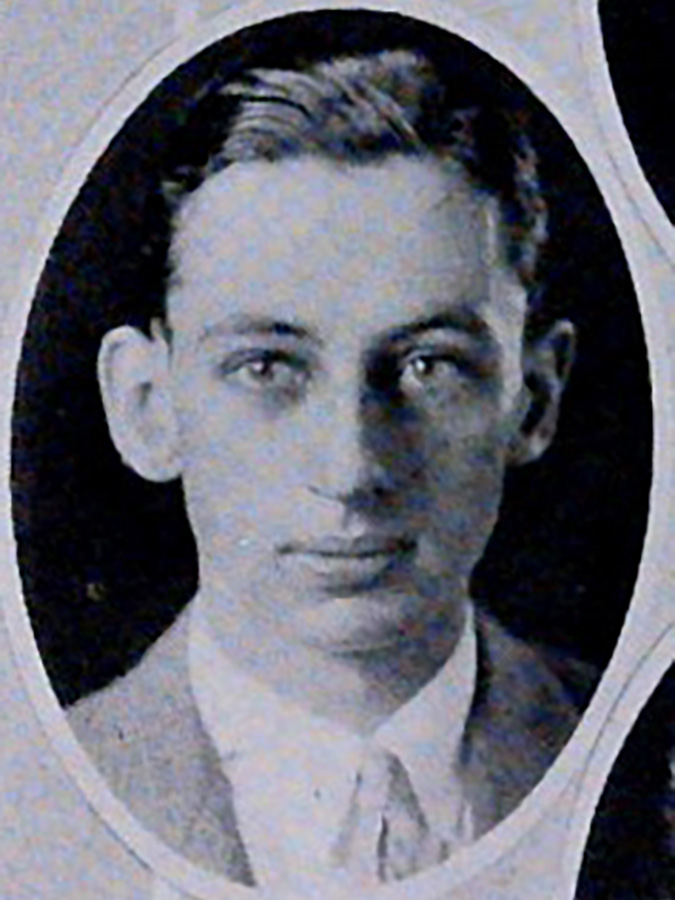
I only included the third guy because he was easy to find. Samuel Bonifay studied electrical engineering, became a meter tester, and eventually settled in Anniston, working for Alabama Power for almost 40 years. He served as a captain in the reserves, retired in 1966 and had a daughter and two grandchildren when died at 75 in 1977.
On that same page, at the bottom of the column, is Margaret Brown. She was studying education and, if you’ll read her blurb, was a total jock.
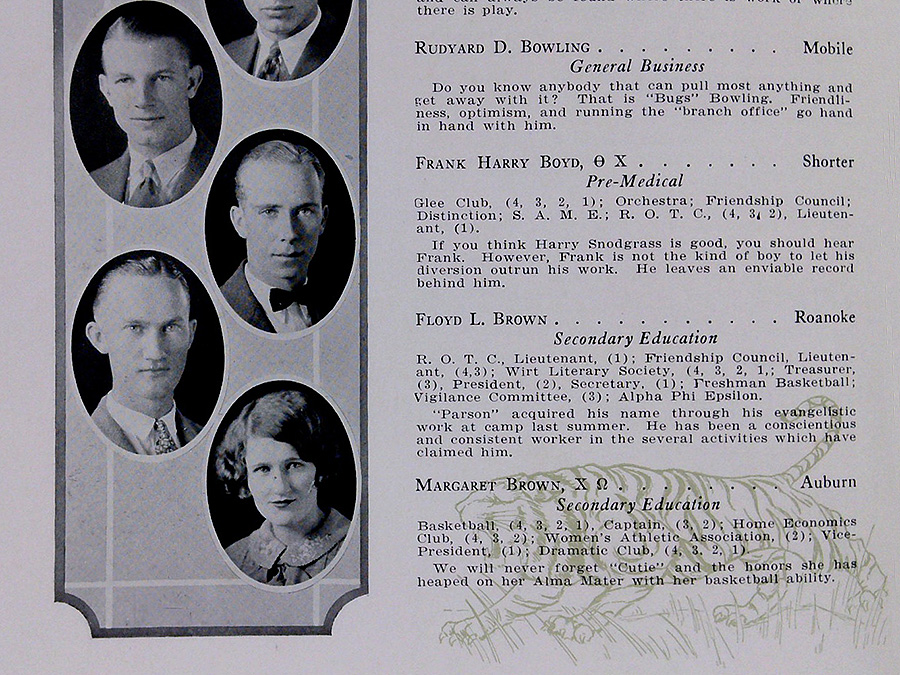
The varsity team didn’t form until 1971, of course, but women were doing things prior to that. And this, in 1926, is the first time I recall the yearbook bragging about it. Unfortunately, the athletic department doesn’t record or recognize those earlier teams. And Brown, of course, is quite the common name.
This is Wiliam Alton Goode, he was studying agriculture, livestock in particular. He’d eventually own a dairy concern. He died in 1979, age 75, the father of a son and two daughters. He is from one of my ancestral haunts and I bet someone in my family knew him.
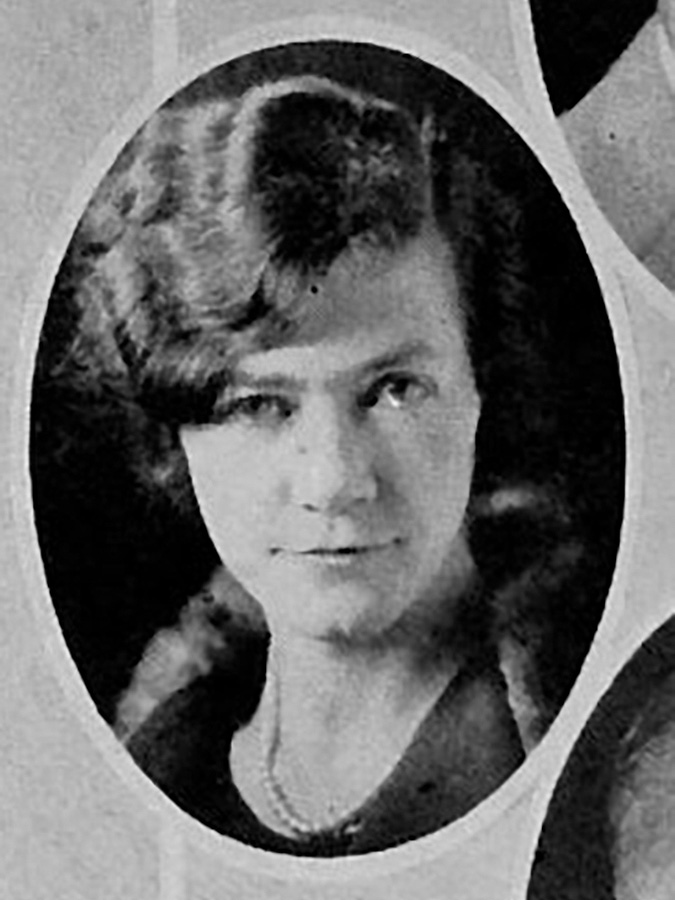
I don’t profess to being an expert on the photography or portraiture of the era, but I bet this woman, Oriel Nevada McGinty, was desperately ready to be done with the 1920s.
She was the oldest of five from nearby Camp Hill. She was to become a teacher. She died at 86 in 1976.
It is a shame the photo isn’t bigger, but you can tell that the band is awfully proud of those capes. I bet they were new.
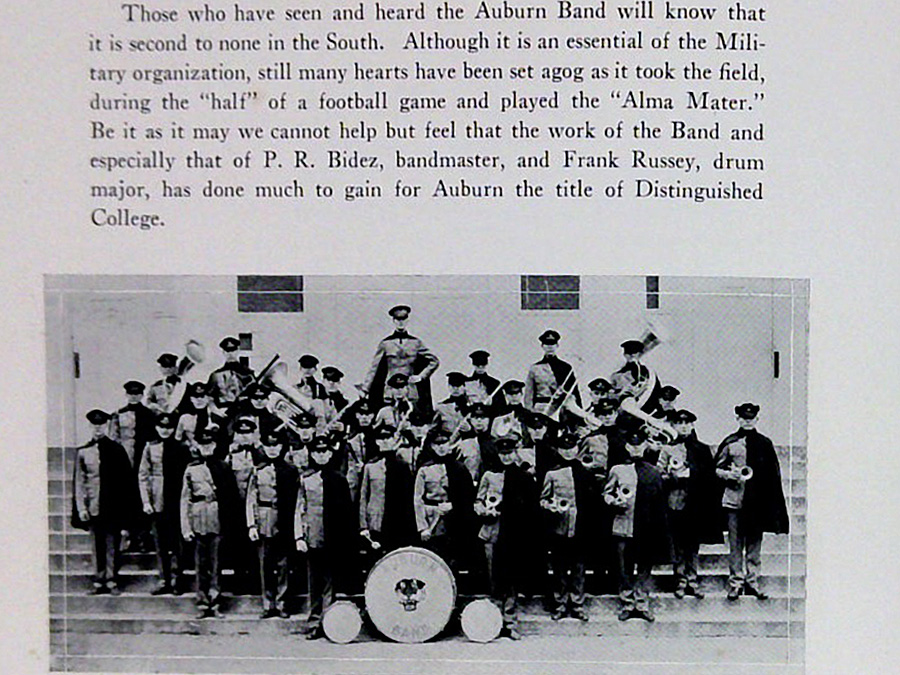
“They weren’t good, but they had rifles, and so we’ll say whatever nice things they want us to.”
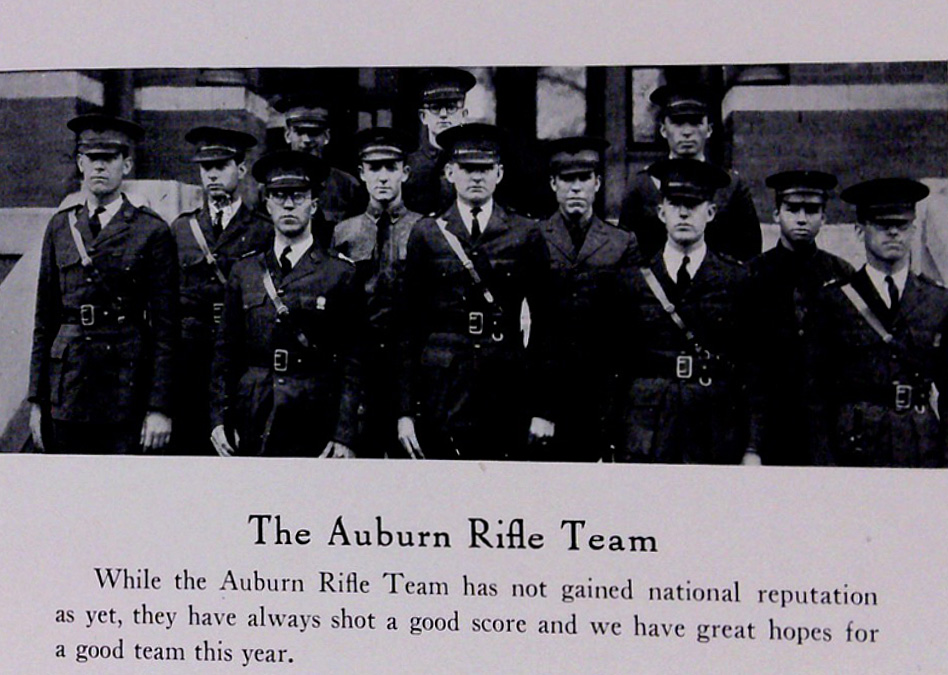
Earlier we learned that the athletics were struggling. The solution was a rebuild. The university brought in David Morey, center. He was an All-American football player for Dartmouth College and a pitcher for the Philadelphia Athletics. Auburn was his third stop, where he stayed for three years. He went 10–10–1 in football, with the high water mark being a 2–0 win against Tulane in the first game of New Orleans’ Sugar Bowl. In 1927 his quarterback was expelled for sneaking into a women’s dorm after a night of drinking. (Could you imagine that headline today?) His team started 0–3 and he resigned. he went back north to coach again.
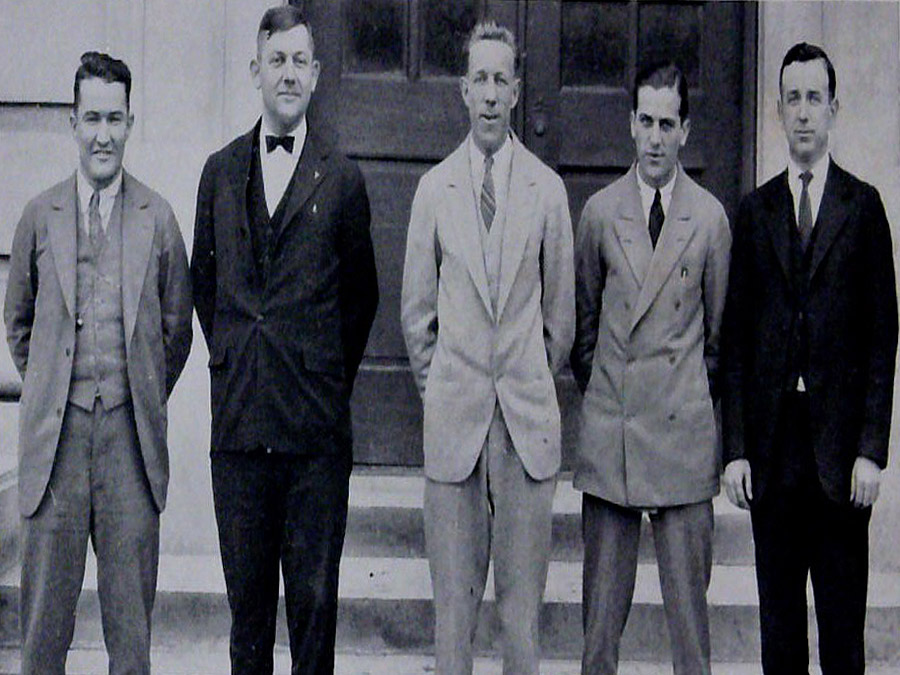
Some of these other guys would have distinguished careers on the plains. These guys all came in together, Red Brown, who coached the freshmen, Boozer Pitts, Morey, Mike Papke, and the great Wilbur Hutsell.
Pitts was a local boy, and was a standout player at Auburn in the glory days. He was a center at 190 pounds. He’d coached the team in ’23 and ’24, and would step in for Morey in 1927. Aside from World War II, when he served as an army officer, he taught math at the university for more than 30 years. He died in 1971.
Papke would coach the basketball team for three seasons and still has the second-highest winning percentage on campus.
Wilbur Hutsell was fast his whole life, being a conference champion in the 400 when he was in college. He’d been on campus for a few years as the first track and field coach. In his career he sent five athletes to the Olympics. He also coached the basketball team for a time, before Papke came along. He trained the 1924 Olympics wrestling team and was an assistant track coach for the 1928 Games. He was also the athletic director, twice. The track venue on campus was named in his honor and he was inducted into four different halls of fame.
Morey, on the gridiron, had guys like this to work with. No idea who they are, as there’s no caption. The football team began their rebuild, in 1925, going 5-3-1. The yearbook says they were a thin team. As yearbooks must do, they were incredibly optimistic about the future.
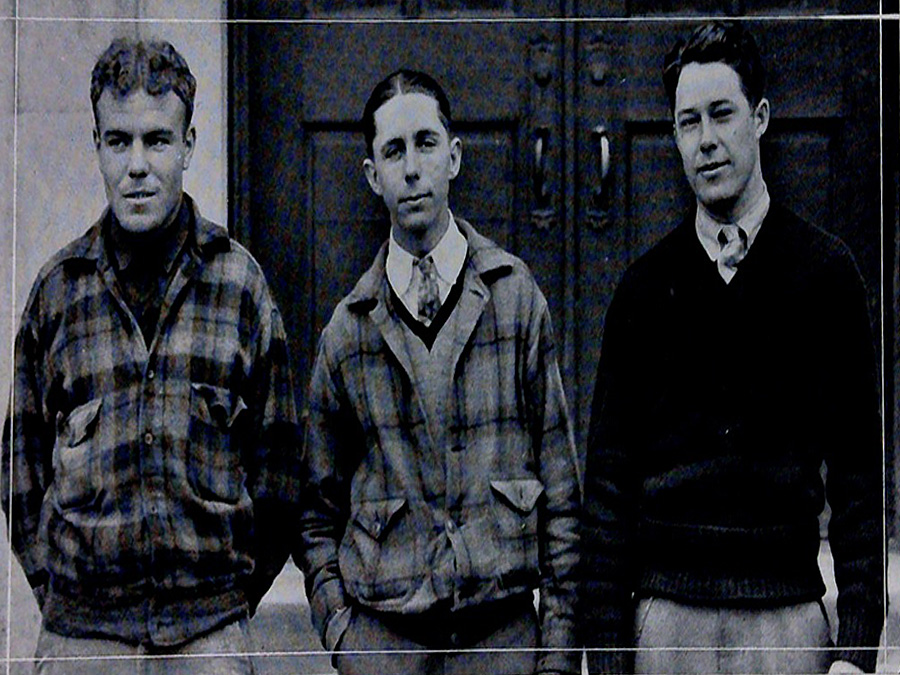
They were wrong. The team would go 5-4 in 1926 and wouldn’t see a winning season again until 1931. None of the fans knew that. Some 5,000 fans came out to see the homecoming game, a 19-0 loss to Virginia Tech. It was the largest crowd to ever watch Auburn play. In contrast, the 2026 A-Day game, the spring scrimmage, had 34,276 fans in attendance.
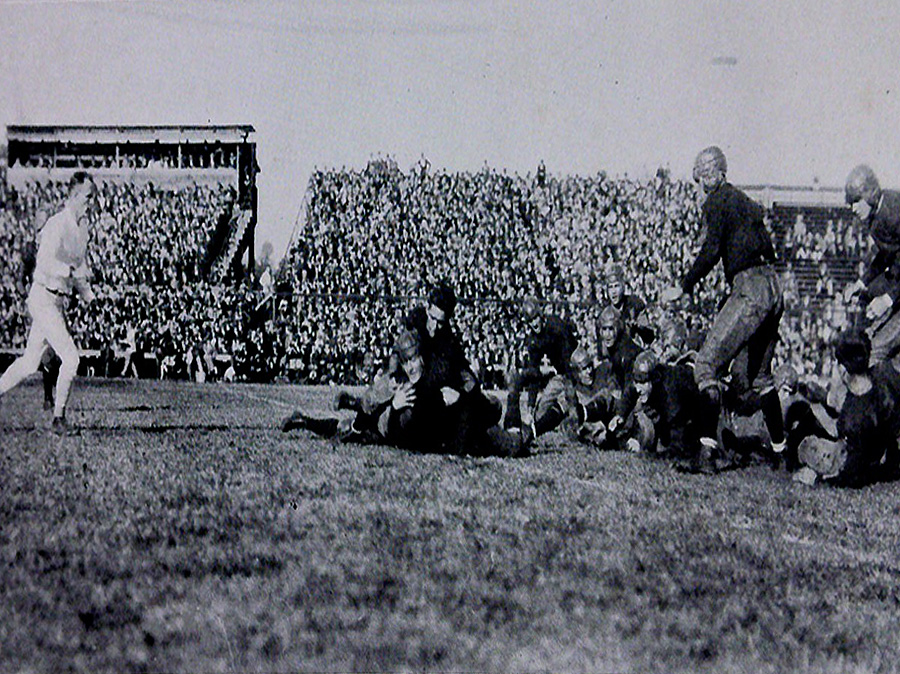
There were quite a few on hand for this game. Not sure where it is, but I want to say Columbus. The sports photography had a long way to go, in the 1920s, and this is the best of the shots assembled here. But, still, look at that referee running in at the end of the play.
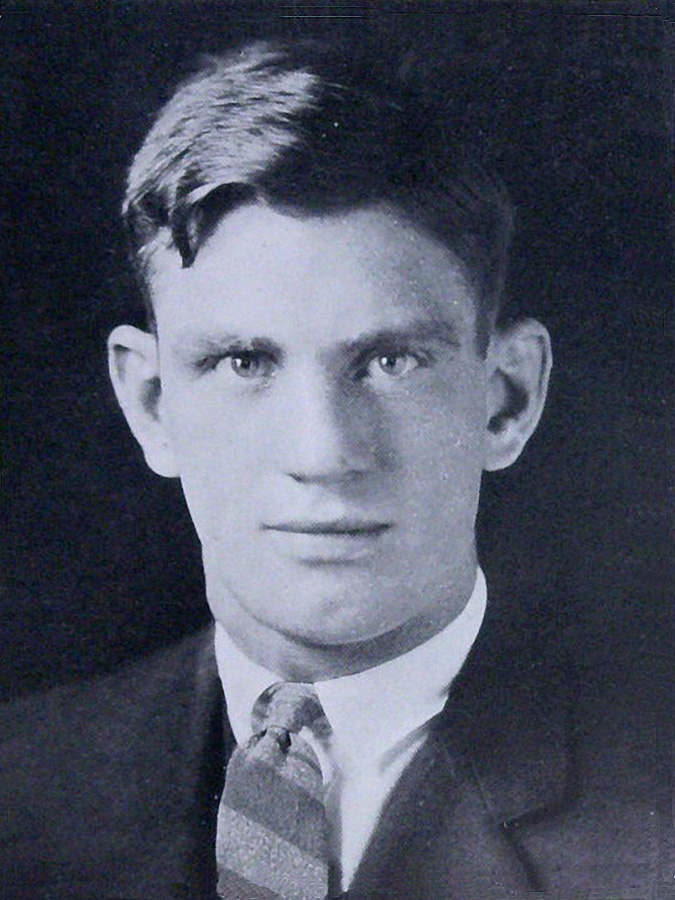
This is the captain of the team, Edward “Red” Hawkins. He was a senior from Bessemer, studying civil engineering. He got married in 1928 to Mildred and graduated in 1929. He taught and was the athletics director of a high school for some time. He joined the U.S. Forest Service and then the war came. Overseas for more than two years, he was stationed in Calcutta, India for at least part of that time, where he was promoted to lieutenant colonel. Ten days after his 90th birthday, in 1992, he died in south Alabama.
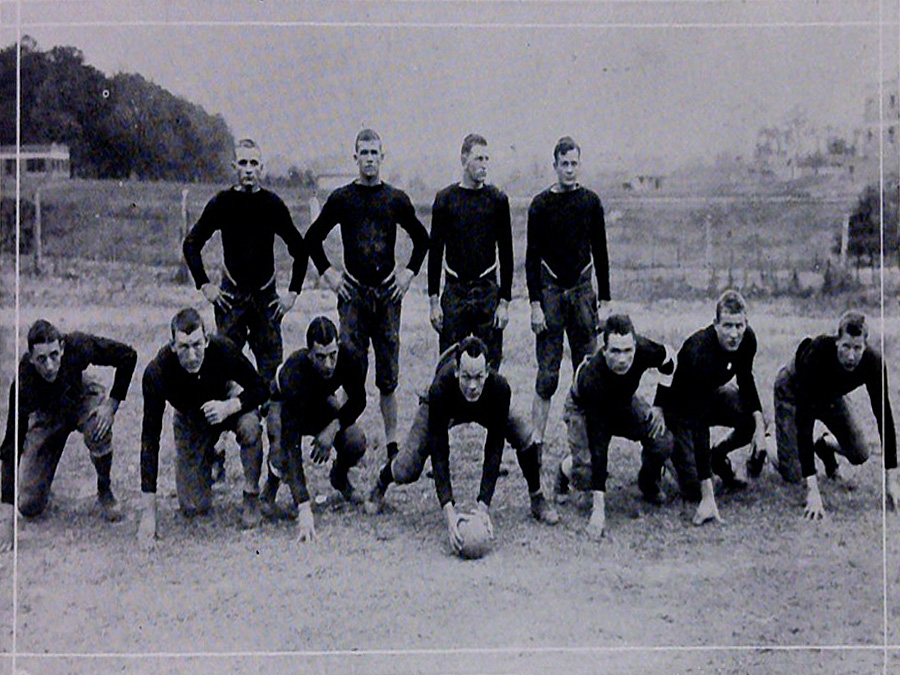
This is the rat football team. The freshman team, and the first one in the university’s history. It says here that some 120 “freshies” came out for the team. Twenty-two of them are listed above this photograph. It looks like a pretty fierce group to me.
Cheerleading was different then. These guys didn’t merit a real mention here, but they did get this photograph. I wonder if they had to supply their own white-on-white cheer uniforms. We do learn the cheer leader is Charles Roberts, a junior from Wadley studying electrical engineering. He’s the guy in the middle.
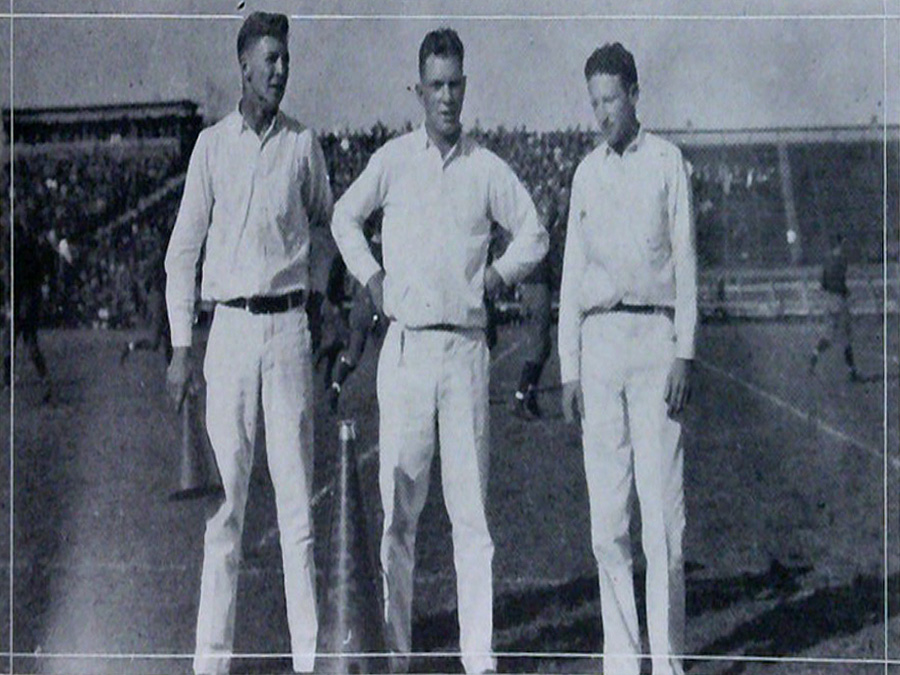
Roberts worked at Georgia Power, where he was a vice president for a quarter century. He cheered on the Red Cross and the United Givers as chairman of the local fund drives. He’d been president of the Rotary, the chamber of commerce and the Georgia State Fair Association. When he died, at 67 in 1971, he had a son and daughter, and seven grandchildren. His wife died three years prior, almost to the day.
Here’s the captain of the basketball team, which earned a two-page spread. Bill McKinney was from Mobile. He was studying electrical engineering. The season was still underway when the Glom went to print. They finished 5-10, but were looking forward to better days. And the next few seasons were better.
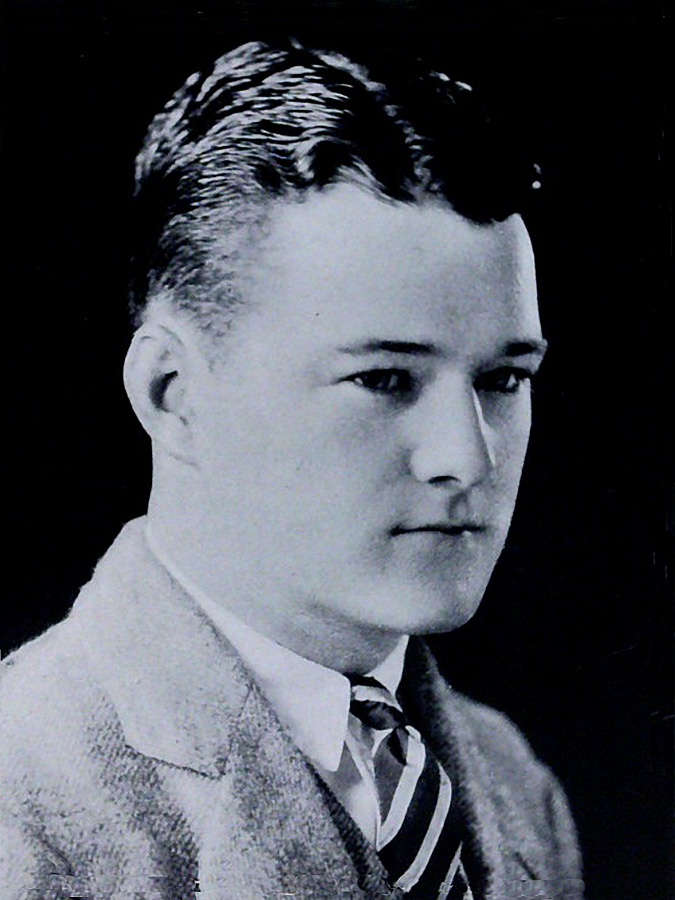
McKinney came from a time before load management. We learn here that he’d played every minute in the last two seasons. He made it to 98, his time at the university and his four varsity letters, his time in ROTC, and his being a team captain are sentences three through seven in his 2003 obituary. But he was more than an Auburn Man — they for sure got that in his obit, as well they should. He was in the Rotary Club. He worked for the American Blower Corporation, which made industrial fans, for two decades. He started McKinney Associates in 1948 and, it says here, he never missed a day of work until he retired at 97.
One of the guys on the team is the great Emil “Snitz” Snyder. Streak was his college nickname for a time, and he came by it honest. He was a three-sport start, but it was the track where he shined. He held the American record for the 300 meter race for a time, at 48 seconds flat. He ran the 100-yard dash in 9.8 seconds. In two years he would become Auburn’s first Olympian. He would win a heat race in the 400 meters, but didn’t advance past the quarterfinals.
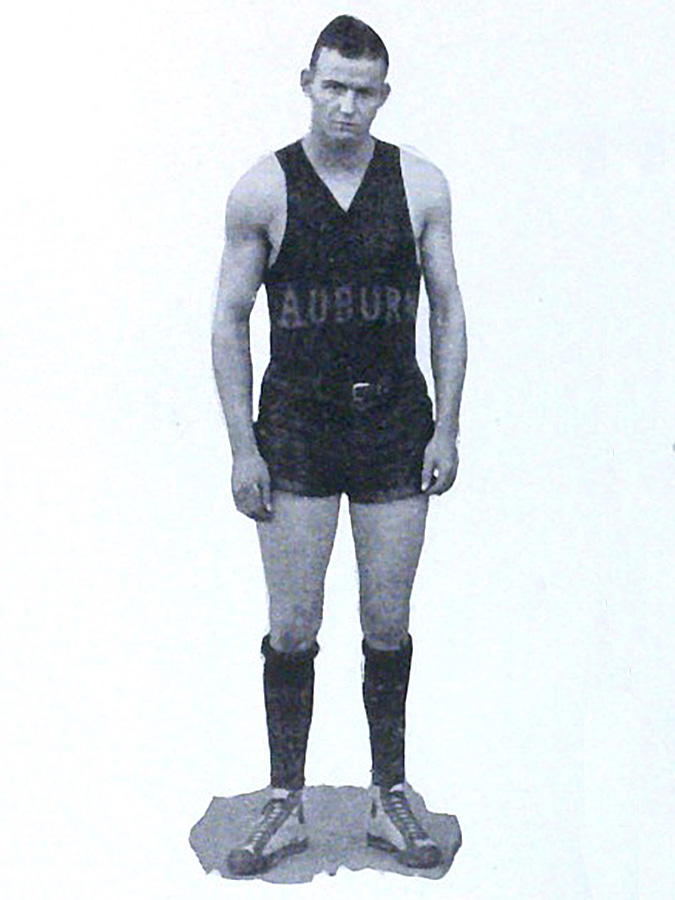
After school, Snyder coached football for 30 years. I grew up near a stadium named in his honor. The mayor said “Everyone didn’t love him — no man can claim that — but everyone respected him. Not many can claim that.” Wilbur Hutsell, who we met above, said “I never played for Snitz. I envy those more fortunate.” The newspaper wrote “He produced so many outstanding athletes for Bobby Dodd at Georgia Tech that he was often accused of running a Tech training camp.” He trained at least three All-Americans and one football national champion. He won seven state football championships. His basketball team was a state runner-up. During World War II he ran a physical fitness program on a college campus. The Boston Celtics came to town and his team beat them. He died, at 72, in 1978.
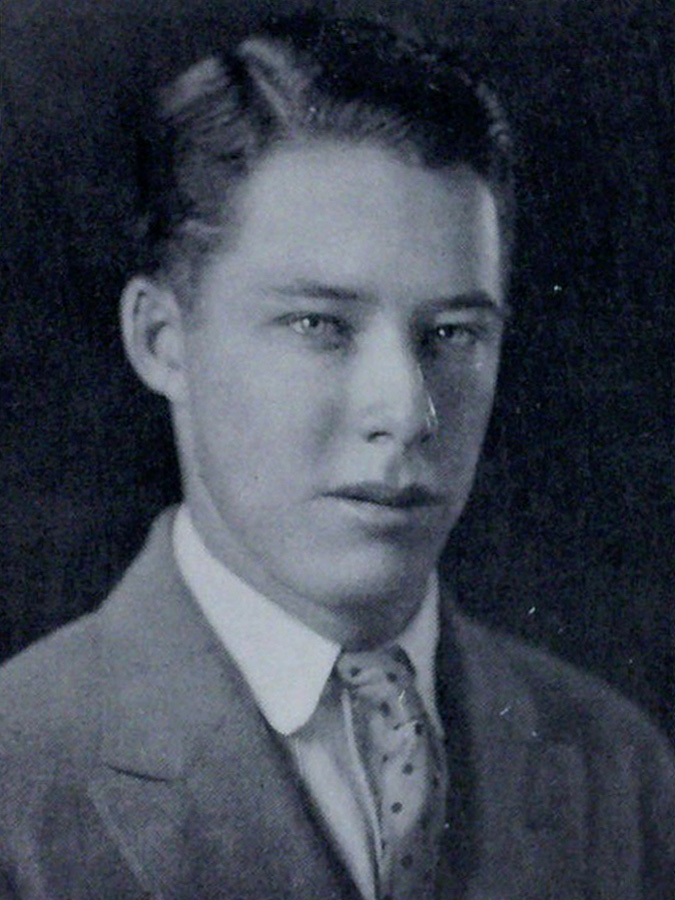
This is Cecil Stewart, captain of the baseball team. The Glom says “his uncanny ability to wield the willow and handle the horsehide is sure to carry him to the top.” Those are both baseball references, though I had to look up the first one. Stewart played seven years of minor league ball as a second baseman. Soon after he hung up his spikes he got married. He and his wife, Catherine, started their lives in Dallas. Geechie, as he was known as a young man, died at 85, in 1988.
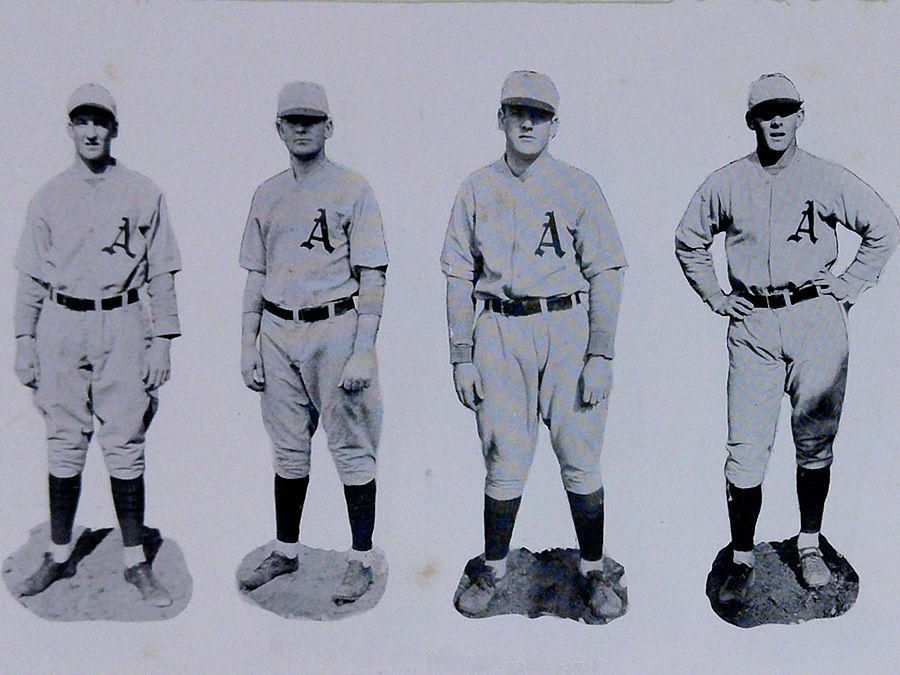
Here’s one more baseball shot. The guy on the right is Ben Sankey. They bragged about him here as a shortstop, and they weren’t wrong. He spent three years in the bigs, playing all around the Pittsburgh Pirates’ infield. He died in Georgia in 2001, at 94 years old.
Last one for the day, these are the track and field captains. I’m not sure what the Ts mean on the uniform. Leon Lavert “Nurmi” Nelson has them, but the whole team does not wear them. Nelson was also the vice president of his senior class, we learned about him, above.
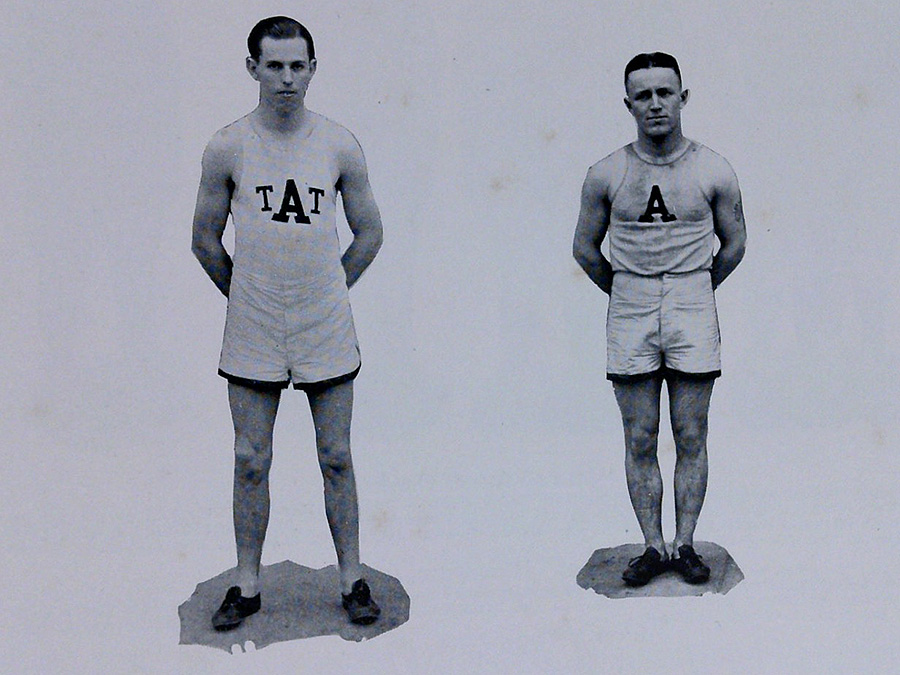
The other guy is George Clifford Murrow. He ran cross country. He got a masters degree at Alabama. He became an educator, and then a principal, which was one of his job titles for 32 years. In the summers he worked as a funeral director. He retired in 1971. He died in 1988, survived by his wife, Ola May, and two daughters.
All of these will wind up in the Glomerata section (eventually). You can see others, here. Or maybe you’d like to click through to see all the covers. The university hosts their collection here.

