history


14
Apr 12

My day, and a bit of recent San Antonio history

Busy conference day. I presented two papers. The first was a piece I co-authored with my pal Skye titled “In the Huddle: SCCT Analysis of NFL and Players’ Association 2011 Lockout Strategies” which looked at that particular piece of business through the Coombs’ Situational Crisis Communication Theory. In the final analysis they followed part of the model perfectly, but blew it elsewhere.

The second paper was a piece on the Colbert Super PAC, which was one part history of PACs that led to this moment, one part speculation on what Colbert was doing, where Super PACs are taking us and, finally, announcing the latest financials they’ve raised and spent. That is a lot of money.

That paper, which I co-authored with The Yankee, was well received. It won top paper honors. I got a plaque and everything. Not too shabby.

And immediately after that session I served as a respondent in another session.

How this works: someone has grouped a small handful of papers together for the researchers to discuss their examination and findings to their audience, as I did twice earlier today. Another person, the respondent, is assigned to make some larger sense of it all. The respondent’s job is often to find a common thread, but also give some feedback on the papers, deliver some helpful criticism as they continue their research and so on.

I was asked to be the respondent on a mass communication panel titled “‘Talking’ with the People We ‘Know’ Best: Traditional Interaction as it Happens Online.” (Academics aren’t known for riveting titles.) I had four fine papers to read, which makes being a respondent enjoyable. You read things beyond your area and, if you are conscientious about it, you find yourself working hard to make your actual response worthwhile.

It takes some time and sometimes a bit of trepidation. One of those papers I knew nothing about when I started reading. The nice person that wrote it is the expert. What can I say to that person? But eventually you find something. No study is perfect and all that.

And this might be a first: the timekeeper flashed me a one-minute sign. Not sure I’ve ever seen a respondent threaten to go over the allotted time before.

I hope it was at least a little bit worth it to the researchers.

This is Schilo’s:

Schilo's

Pronounce it “She-Lows.”

This is one of those downtown dining institutions. I’d had lunch there two days in a row. Yesterday it was the Wienerschnitzel of breaded pork and a side of red cabbage. Today I had the Friday special, which was a deliciously salty roast beef with mashed potatoes and green beans.

(UPDATE: The next day, Saturday, we returned for breakfast. I had the potato pancakes, which were not the best potato pancakes I’ve ever had by any measure. But the lunches? Oh they know their lunches.)

A man named Fritz Schilo opened a saloon 90 miles away in Beeville, Texas just after the turn of the 20th century. In 1914 he packed up his family and moved his booze joint to San Antonio. Three years later: Prohibition.

So the saloon business dried up. He opened a restaurant. His wife made the food for a location not too far away from this one. He moved next door in 1927, and Fritz Schilo stayed on through the first part of the Depression, until he died in 1935. His son, Edgar, took over and in 1942, during another war, they moved to the current location. You wonder if the family, before they sold the business sometime after the war, ever measured big personal events around big international events.

You’d think, from the perspective of history, everyone did. But do we? Aside from the occasional “Where were you when?” moment, probably not. Still, that Prohibition timing was pretty rough on ol’ Fritz.

A bit more local history, John Wayne stayed at our hotel twice during premieres of two separate movies. He charmed them so well the second time they named a suite after him:

JohnWayne

And here’s the man John Wayne wished he could have been. That’s Audie Murphy, second from the right:

AudieMurphy

The man next to him, unknown to whomever wrote the caption below the picture on display in the hotel lobby, looks positively beside himself with nausea. You would, too, if you were taking a picture with Murphy. If you don’t know what that’s about, you should do a little reading.

(UPDATE: The guy on the far right might be Harold Russell a World War II veteran who is one of only two non-professional actors to win an Oscar for his acting in The Best Years of Our Life. Russell had an amazing life.)

The hotel itself is lovely, in the lobby. The rooms are a bit shabby for the $160 rate they’re asking from conference-goers. We got a slightly better rate. The joke of the conference has been “What broke in your room this morning?” Oh, roughly everything. We’ll see about those rates again later this weekend.

Oh? The Alamo? Everyone says it is smaller than you’d think. And there’s no basement.


12
Apr 12

Signs of downtown San Antonio

Took part in a roundtable panel on the presidential primary season. I made a great Rick Perry joke.

“There were a couple of problems there. The back surgery, the painkillers and … well … I forget the other one.”

Brought down the house. If anyone remembers anything I said on that panel, it won’t be the analysis but the joke.

We got the chance to walk around downtown a bit. Here are a few signs from the area:

Aztec

The Aztec opened in 1926. It cost $1.25 million, which would be something like $22.6 million today. You wonder what the owner thought a few years later when the Depression landed on him:

In response to competition from other theatres, a magnificent chandelier was commissioned and installed, in only 35 days, in the main lobby in 1929. Weighing over 2,000 pounds, this ornate, 2 story, 12 foot in diameter fixture was billed as “The largest chandelier in the largest state in the Union”.

This says something about the barber, or the client, or both:

barber

We were trying to resolve the mystery when we noticed they also had a foosball table inside.

This sign isn’t old, but I love it like it was creaking from decades in the sun and wind:

Walgreens

This isn’t a sign, but I would like to point out that this is the level of ornamentation they’ve put into a parking garage:

deco

This theatre, The Texas, competed with The Aztec:

Texas

Also built in 1926, in the Spanish Colonial and Rococo style, it cost $2 million. It closed in the 1970s and was razed a few years later. The facade, though, lives on as part of an office building. (More here and here and here.)

I love this, because it is a neon sign evocative of one of my favorite songs:

Howl

Today we had lunch at a place I’ll write about tomorrow. We had dinner on the River Walk, the touristy part. The enchiladas were good, though.

And now I must return to my notes. I have three panel sessions to participate in tomorrow.


1
Apr 12

Catching up

The old romantic edition.

Just one piece today. This is the story of an old couple who met in letters during World War II through common friends. He was shipped to Europe and Africa. He saw Algeria, Belgium, France and Germany. When he came home after the war, which is where this telling picks up, they finally met and married almost immediately:

I recorded the audio on my iPhone using an app that seems to stop recording when the screen goes to sleep. Learned that lesson the hard way. (Moral: Never learn these lessons the hard way.)

There were too many people in the room. Too much noise outside. I had to tweak and tweak and tweak to get the levels to be close to comparable in Soundbooth. Since I couldn’t get it right at the scene I have failed them as an audiophile. The many shortcomings are mine, but their story is lovely.


31
Mar 12

A story about life, memories of the dead

On a beautiful, warm day in a quiet little unincorporated community to the northwest of Atlanta they gather to remember a horrifically stormy day 35 years ago. It would be the last, fatal flight of Southern 242.

It is thought to be one of the largest and longest running survivor group memorials of its kind. The older gentleman there is running the show. He’s a local boy, growing up literally just down the road from this place in a time when the only thing modern eyes would recognize was the cemetery. When he was a boy the church across the street was different. There were two sawmills, a log cabin school and a general store his family ran.

This place was important because it is a crossroads, but then this place had always been important. The place and the people there grew up knowing about loss and tragic death. Long before even the old man was born this was the site of one of the last battles before Sherman marched on Atlanta. More than 2,000 soldiers died only a stone’s throw away from this place.

But on this day they gathered to recall something that “seems like only a few months ago.”

marker

marker

A violent storm, part of a system that killed at least two dozen in Alabama, knocked a plane out of the sky. In the official analysis there was a long list of problems. The weather report was outdated. The storm rendered the plane’s weather radar useless. The pilot, an Army Air Corps veteran, reported baseball-sized hail cracked his cockpit windows. A bad command from air traffic contributed to ruining the plane’s engines. The pilots made a costly detour. Finally the DC-9, with 85 souls on board, was reduced to a glider for seven minutes. They would try to land on this sleepy road in rural Georgia.

It doesn’t look much like it did back then, the old man tells you. The intersection of the vital crossroad has been reshaped. There was a bit of a commercial boom at the turn of the century bringing in pharmacies, a grocery store and other strip mall inhabitants. In the 1970s it was just this road, that school, a gas station and the barbecue restaurant.

The pilots of the plane found this long stretch of road and hoped for the best. The co-pilot was a naval aviator. He’d put fighter planes on the pitching deck of blacked out aircraft carriers in the South China Sea, but this was a different kind of challenge. He got the plane on the road, with the wheels on the center line as the locals recall, but his wings clipped power poles, a fence and trees. The plane careened out of control. It crushed a car with seven people — three mothers and their four children, in an instant, a family lost two daughters and all of their grandchildren — and killed two other locals. The fuselage sliced through the gas station. Then the explosions started.

It came to rest in this lady’s yard:

Sadie

Ms. Sadie had just called her children inside because of the coming storm. Now there was a fireball where her kids so often played.

Because it is a crossroads, and was even smaller back then, the emergency help had to come from all over the region. They found they could get close, but could not get to the scene because the wreck itself had damaged so much of the roadway. The community, neighbors and friends and normal folks, found themselves trying to bring order to unholy chaos. The scene looked liked this some time later:

The people at the memorial remembered how they carried people out “the back way,” meaning through Ms. Sadie’s house. The people who could walk or be carried went through her front door, out the back and through the woods at Hell Hole, where that Civil War battle was fought, and to the neighboring street.

Everyone that made it into the house survived. The locals tell stories of getting the victims out using doors as stretchers and cutting people free of their seats with their pocketknives. They recall covering bodies in curtains and sheets and finding tubs of ice and water for burn victims.

Some of the survivors that have made the trip back stand to talk, remember, thank and grieve a bit.

He was on row 19, the next-to-last row of seats on the plane. He was an 18-year-old soldier when the plane crashed. Now he works in Customs. He’s got a wife, a young daughter intent on picking every flower at the cemetery where this memorial is held and a story to tell:

They all do. Twenty-two people on the plane lived, but their numbers are starting to dwindle. There were Guardsmen, lawyers and homemakers. At least three of the survivors died recently. One of whom survived near-fatal injuries in World War II and this crash and died just last year, at 86. Another survivor was also a World War II veteran who worked in forestry and construction. He lost a leg in the crash, but it never kept him off his motorcycle. He died last year at 96. Another had been in and out of hospitals every year since the crash, but she raised a huge family, too. She died last year at 71, leaving 17 grandchildren and seven great-grandchildren. Her family asked for memorial donations to be made to the burn unit in Atlanta that treated her decades ago.

At least two books have been written about the disaster. One by one of the flight attendants, who began helping train the airline liaison officers who work with the families of crash victims and survivors.

“Nobody should have to go through that alone,” she said.

Back then, they say, people were just told to return to their lives. Even the locals who ran toward the smell of smoke and the crackle of the flames found that a difficult task. One man said he didn’t eat for a week. Another said he could only eat in darkness for a long time after the accident. Another man who dug through the debris didn’t sleep for days. There didn’t seem to be much of a normal thing to return to for a long while. It would be a long time before they could hear the sound of a plane and not look up.

But in grief there is joy. In pain, there is growth. The flight attendant marvels at how they found themselves in a place called “New Hope … New … Hope.”

The survivors single her out as a hero. All of 24 years old at the time, she’s struggled with that day for years, but on this point she is adamant: New Hope.

The people of the community who remember that day understand her meaning in their bones. Over the years they’ve found themselves bonded with total strangers in the aftermath. That’s been part of their healing, seen in part by the Southern 242 Memorial Committee, which is raising money to install a proper memorial.

The people there learned firsthand how things like this change a person, can change an entire community. One man worked at a bank at the time. He’s now a preacher. Another worked on the railroad. He now owns an ambulance company. The local pharmacist changed careers and became a doctor after tending to the injured. One of the survivors from the plane crash left the budding software industry and devoted his life to counseling.

The lady that found a plane in her yard raised her kids and, now a senior citizen, will graduate in May with her degree in psychology. Inspired by that stormy day in 1977, she’s still trying to give help and hope to others.

Now to be personal about it: my grandfather is one of the names on that plaque, just another person that had probably never even heard of New Hope. The plane crashed just a few months after I was born, so this story has always been casting ripples in our family life, but this was the first time I’ve been to the site and placed scenery with the details.

They said he was killed instantly, still just the smallest of comforts for the family of a man struck down at 42.

He was a new grandfather, but an old preacher. I have the Bible from which he gave his first sermon, at the age of 16. As a newborn I was there for one of his last sermons.

Ms. Sadie, the homeowner, has become a lifetime friend for my mother, who lost her father as she tended an infant. Ms. Sadie says they pulled his last Bible from the debris in a place where everything surrounding it had been destroyed by the flames. The book, they figured, should have been, too. But it was only scorched on the margins.

They found it opened to Psalm 23.


14
Mar 12

A random assemblage of stuff and things

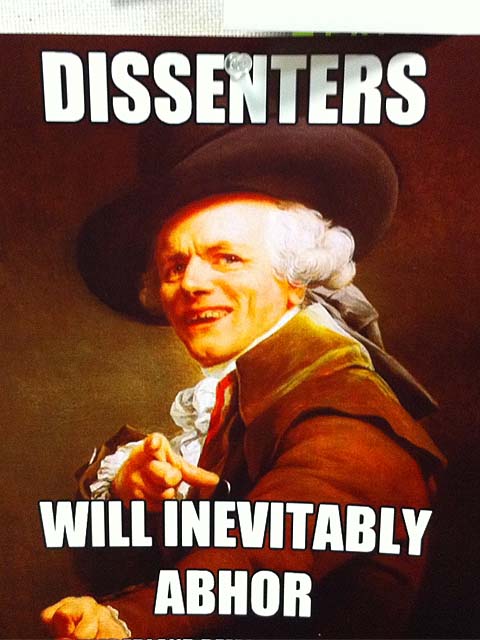
My favorite meme of all time has become a campus group’s poster:

DuCreux

That, of course, is Joseph Ducreux, who was a French portrait painter at the court of Louis XVI and after the French Revolution. He liked physiognomy, assessing one’s personality by their facial expressions, hence his unorthodox portraiture, like this self-portait and, of course, the very famous Internet joke. You can’t even find the original set anymore, so buried are they amongst everyone’s contribution.

Two students showed this video in class today during a demonstration about advertising. The gasps from the rest of the class were great. See if you can figure out where this is going:

Happy birthday to The Birmingham News, which turned 124 today. This is the June 20, 1900, front page:

BirminghamNews

So the paper was 12 years old at the time. I haven’t seen any of the first volume’s front pages.

Things to read: Ad execs bullish on digital, marketers on social: Data reveals ‘disconnect’ with agencies:

Advertising executives -– both marketers and their agency representatives -– continue to increase their optimism toward digital media options, and are beginning to swing toward it as more of a “branding” than a performance “option,” but there are some significant disconnects between the way they look at various digital media silos. While agency executives tend to be far more bullish on the overall use of digital media, marketers are much more optimistic about budgeting for social media.

The findings, which are part of new, detailed analysis coming out of Advertiser Perceptions’ Fall 2011 survey on ad executive attitudes and optimism about media, show the overall index for digital -– including online display, search and video advertising –- trending upward, but the sentiment appears to be driven primarily by agencies. That insight is interesting, because the bottom line of big agencies appears to be benefitting from their continuing shift toward a greater reliance on digital media, according to a Pivotal Research analysis released Monday (OMD, March 13).

“But there is a discrepancy in the way marketers and agencies are seeing it,” says Randy Cohen, a partner in AP — which produces an ongoing series of ad industry tracking studies under its Advertiser Intelligence Reports banner, including this one. “It’s a disconnect,” he says, adding, “But agencies tend to do what marketers want them to.”

If that’s the case, social media should be the primary beneficiary, according to Cohen, because marketer sentiment is building much more favorably toward social networks versus the rest of the digital mix.

Things to read from my Samford blog: