


The in-laws are here, visiting for a few days, and I have some laundry to do, so this is short.
This is short because I must zealously guard my laundry from my mother-in-law. We have had a delightfully playful feud about the status of clothes for 17 years. You see, I have been doing the laundry since I was 10 years old, which is long enough to develop habits and peculiarities about stuff, like who should touch your laundry — no one — and how it should be washed — as casually and haphazardly as possible — and how you put it away — long after the laundry is done, but in a series of particular ways when you do get around to it.
My mother-in-law had come for a different visit years ago and I was at work and she was home with her daughter. She somehow decided she was going to do the laundry. My lovely bride said that I wouldn’t want her to do that, that I didn’t want her to do that, that I wouldn’t like it at all. My mother-in-law — who is one of the sweetest people you’d meet — said, “He’ll get over it.”
Now, their house or ours, her washing machine or mine, it has evolved into a kind of production. No one knows any longer if one of us is initiating a new round of “Oh … you!” or seeking revenge.
So today, I’ve been kicking myself that I got down to the wash-by-necessity stage of things on the day after they’ve arrived. This will require some sneakiness on my part.
(Update: I’ve been successful, with the laundry completed largely undetected. I think it was that I minimalized the sorted, and turned off the chime on the washer and the buzzer on the dryer.)

Back to Rick Atkinson’s Fate of the Day, the second in his Revolutionary War trilogy. (Buy it and join my non-existent book club where we are enjoying this book a great deal. I like to read the contemporary passages over and over if, for no other reason, only to consider how Atkinson is writing to them and around them and how each is informing the other of the choices the book is making. It isn’t enough that a group moved from here to there. You’ll want to know what they’re feeling. And it isn’t enough to say that the trip was hard or the weather was bad … you have to find the right way to express it.
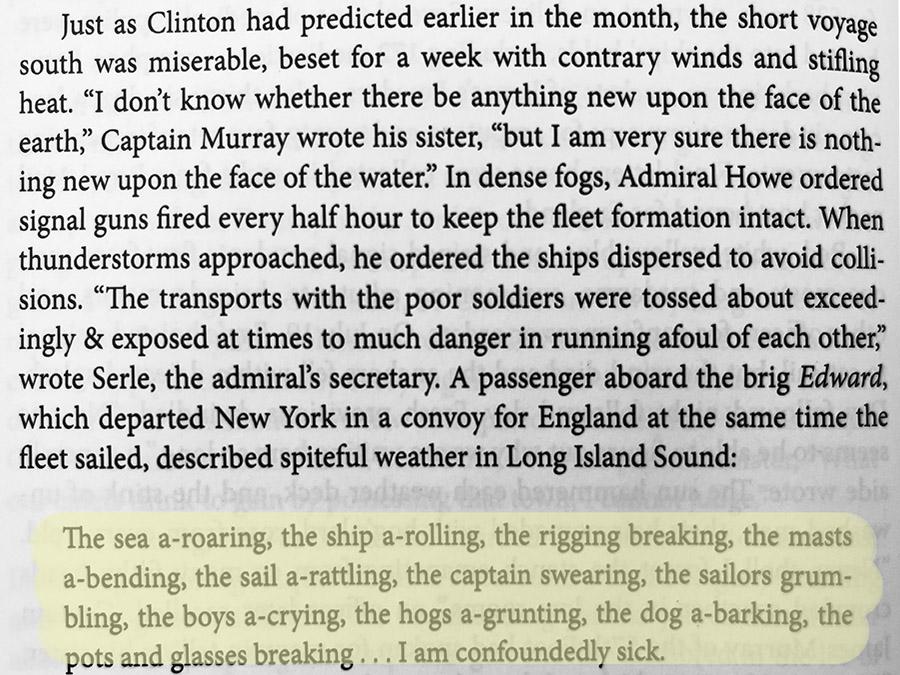
And while we don’t know who wrote that — which makes you think that perhaps they’re barely a spectator to the the grand and terrible thing going on around them, more often we can get little glances into the real fears and miseries and worries of prominent people.
Ambrose Serle was an English navy man, a clerk, a well done, who-you-know bureaucrat really. He was also a propagandist, running the New York Gazette for about a year. He wrote a pamphlet, “Americans Against Liberty” in 1775 which attempted to defend the British Empire on religious and political grounds. He was, for two years, the private secretary of Gen. William Howe and historians owe much to his journals.
Indeed, owing to his vantage point and training (he was a hymn writer and author, as well), he saw the American Revolution as a religious war. (That wasn’t an uncommon thought at the time, but it has receded into memory somewhat.) He was also haughty. Condescending. Indignant. One thing he was not was excited about a trip from New York in late July of 1777.
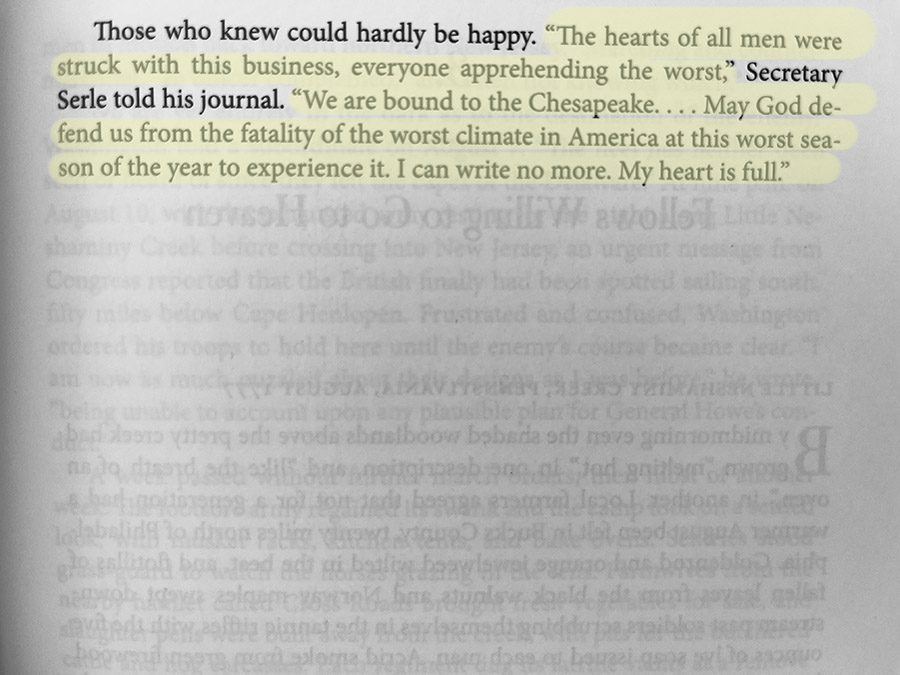
“My heart is full” must have meant something else back then, no?
He survived the Chesapeake, and the war. He went home in 1780, managed French prisoners of war. He died in his late 60s in 1812, in England.

