


I was enjoying a nice sit-and-read moment in the library when the vacuum robot decided to do its thing. I’m not sure if it is running on a schedule. If it is, I haven’t ascertained the routine. I could have gotten up and moved some chairs around, if I knew the routine, but I was also having a nice kitty cuddle and didn’t want to cause a panic. Plus the book was good.
So the vacuum rolled around in its random way, picking up things, whirring and spinning. It penned itself between a chair and one of the book cases. It pinned itself within the chair. It disappeared into another room. It came back. It found the cat tunnel, somehow got under it, and pushed it around.
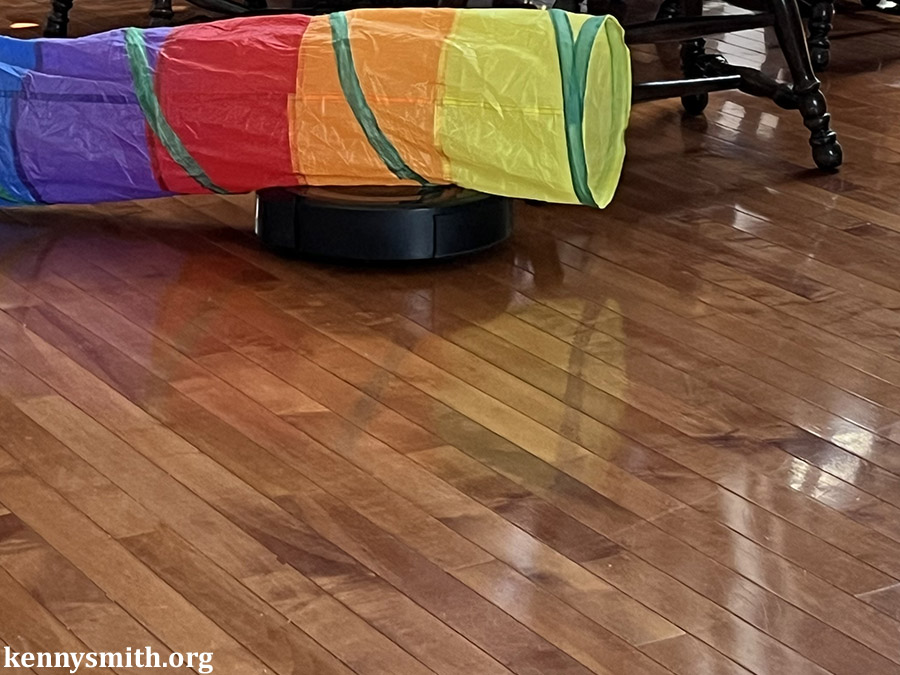
Phoebe was sitting with me, which is a good thing. Poseidon does not need to see the vacuum moving his tunnel around. Poe likes to go into the tunnel and have you slide him around the house. If it is oriented the right way he will sometimes poke his head out of that hole in the top, looking like a little tank commander. Finally, I’m sure he thinks, someone has figured out the purpose of the tunnel, to carry me places.
And if the robot can move him and the tunnel around, that would change the entire paradigm of the house.
Later, the vacuum was just pushing the tunnel around. The vinyl and wire isn’t substantial enough to alert the robot’s sensors to an obstruction, so it just keeps going in that straight line until another wall or piece of furniture is stumbled into.
For a long time I heard the robot in the distance, but it never returned. This was dimly, slowly sinking into my head, in that way that it sometimes makes you wonder why you skipped fast forwarding the commercials, or remember 80 percent of the way through a song that you don’t actually like this song. When the whirring and the spinning and the bumping finally registered, I sought it out. Somehow, it made its way into the laundry room, and shut the door behind itself.
That floor has never been so clean.
Inside the laundry room, the robot vacuum had somehow gotten confused between a throw rug and the washing machine. It would move, bump, spin 90 degrees, move, bump, spin 90 degrees, move, bump. It was horrifying scene, and I study there watching it, wondering how I could work it into a lecture on technology determinism.

I did not work it in. We had other great examples today. Also, there was not enough time to do all of the things I wanted to do in DMP today. Diffusion of innovation will just have to wait until Thursday. But, just now, as I wrote that and tried to think of the next sentence, how it will all go with the upcoming lecture clicked nicely. Let me write that down somewhere.
I had a nice chat with a student leaving class. And then they went one way and I went the other, down to the corner, to the hugging art, and then around the corner to the office. But, first, the street art.
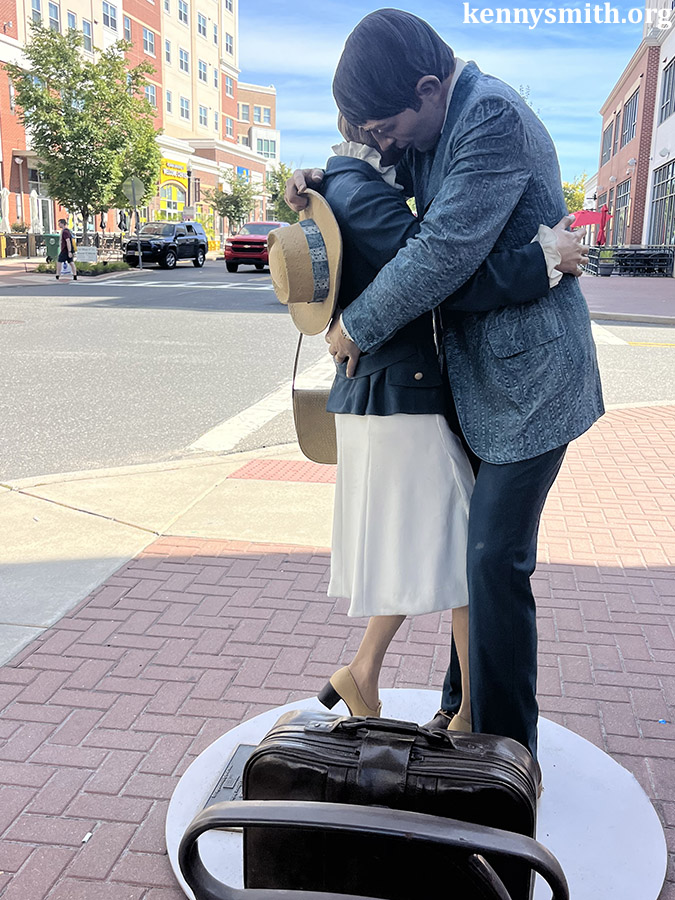
It looks like an intimate moment, right? Is it a reunion, or a departure? He’s got his hat and suitcase. He looks like he’s almost ready to scoop her up, perhaps in defiance of physics, but there’s definitely a sense of motion in this presentation. The moment we are given not only looks different from different angles, but it looks like a specific movement underway.
You can stand there all day, but they can’t complete the move. It’s frustrating. It’s wonderful.
We’ll try another angle next time, perhaps more will be revealed to us.

A mystery of my recent bike rides has revealed itself to me. We went out for a ride on Saturday and I sat in my lovely bride’s wheel and watched her calf muscles go to work. It wasn’t too long after this that I got dropped, and did the rest of the ride on my own.
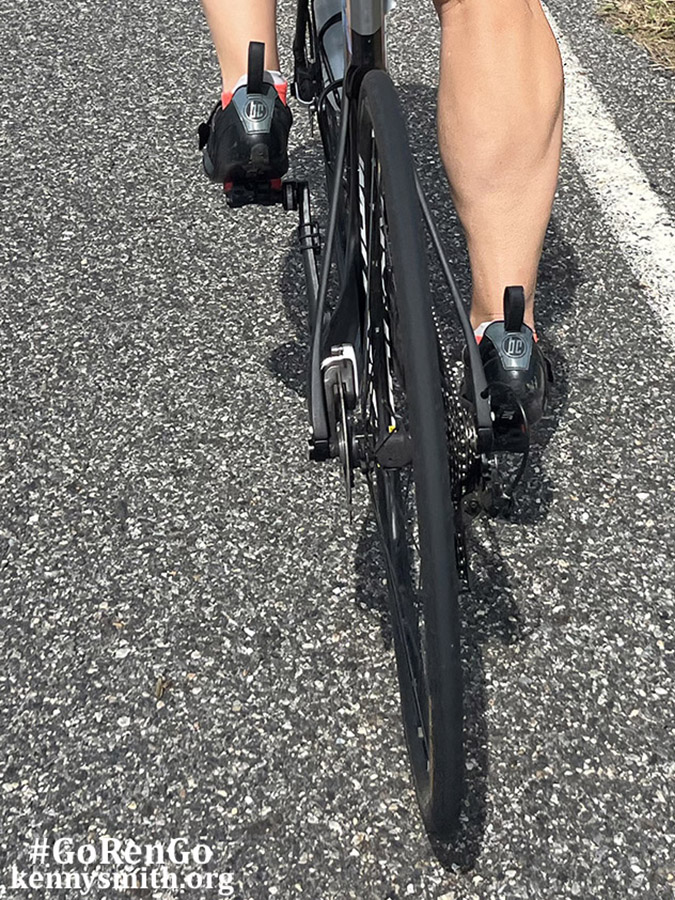
I won’t tell you how far along in the ride that was, or how much I soloed. It might be embarrassing. (But just for me. She’s riding super well, and I’m not. She keeps getting better and I stay about the same.)
On this evening’s ride, I happened upon a run of turkeys. They weren’t there when I came back by, so this is, unfortunately, as good a shot as I can offer. I think I might have scared them off with my huffing. Unless I was puffing at the time.
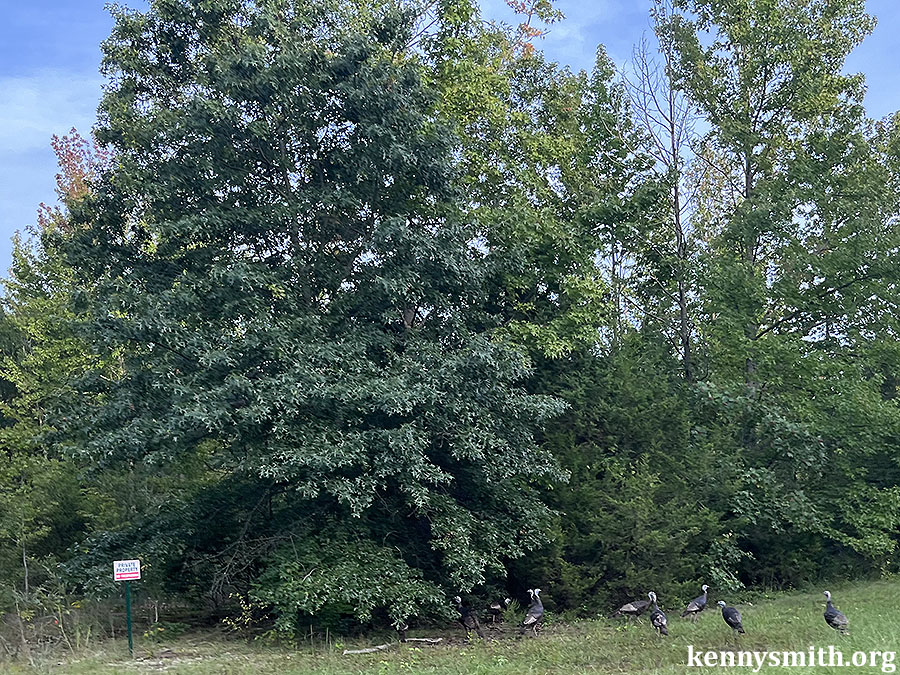
It’s possible that The Yankee startled them away. She does a delightfully hilarious turkey call and that might have been enough to send them into the treeline and out of sight. I passed them, first, however, so I don’t know. Which is to say I was out front. I had a decent ride and she was casually letting me dangle varying distances in front of her. But here’s more proof. She took this, when I was ahead and she was chasing.
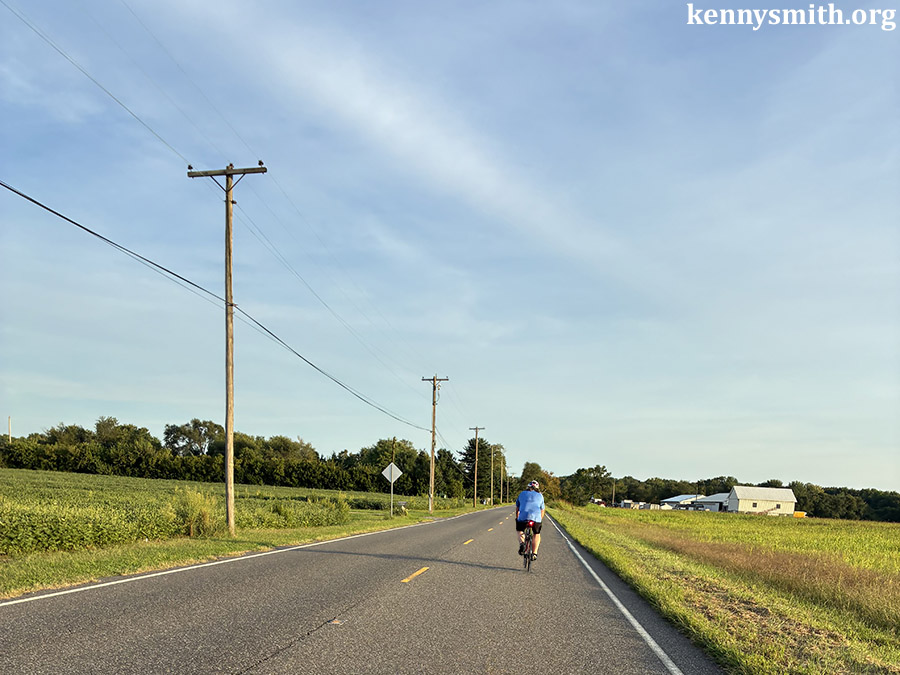
That lasted about an hour. Then she came alongside me, right near the end. But I won.
Mostly because she didn’t realize we were racing.
When I win, we are racing. When she wins, it is an exhibition.

I finished up Rick Atkinson’s Fate of the Day, on Sunday. This is the second installment in his Revolutionary War trilogy, and I need him to finish the final volume in the next week or two. It’s a wonderful book, as you’d expect from a talented and accomplished writer such as he. I highly recommend it.
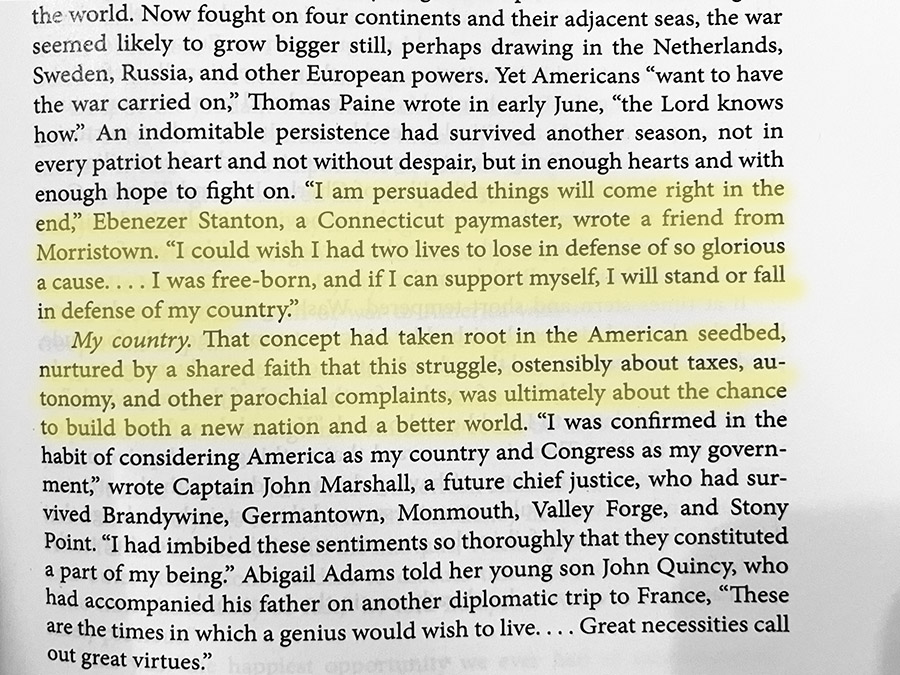
Ebenezer Stanton would become a lieutenant in the army. He was a paymaster here. Somehow, he moved to the navy, and so he takes the captain honorific. He was a fourth generation Connecticutonian. His great-great-grandfather founded the little town of Stonington. During the war he married. They would have six children. He took command of a privateer of the Connecticut Navy, but I can’t find anything on that particular vessel at the moment.
He stayed on the sea after the war, sailing from New London, Connecticut to ports on the Mediterranean Sea. He died at 53, in 1811, and would be survived by his widow by 39 years. One of their sons died at sea. His namesake died in Italy just a few months after he did. They also had two daughters, who lived into adulthood and married. One passed away in Connecticut, the other in Cuba. Their oldest child, Nathan, also lived the longest. He died at 57, in Stonington. He had a niece, who he probably knew, who lived until 1893. It all seems so simultaneously close at hand and far away.
This second book ends with the sacking of Charleston, the British general, Clinton, then sailing back to New York after the 30-page expedition in South Carolina. The Gordon Riots in London, which are the biggest disturbances there until WW2, is in the epilogue, but then so to is the return of Lafayette, from France, promising his guns and ships.
There are 200 pages of notes and citations.
When I finished it, I clapped the book shut, put it on my chest, crossed my arms and smiled for a bit.
Hurry up, Atkinson.
I started reading Adin Dobkin’s Sprinting Through No Man’s Land. This is about the first Tour de France after the conclusion of World War I. When Armistice came race designer, and editor of L’Auto Henri Desgrange announced Le Tour would return the next summer. They had to wait for the shooting to stop to go see the roads, the bombed out villages, and design the course. The route was beyond demanding.
As Dobkin writes, a few stages in, “More than 400 kilometers stood in front of them that day. After that, the cyclists would confront the longest stage the Tour had seen. Then, the alpine climbs would begin.”
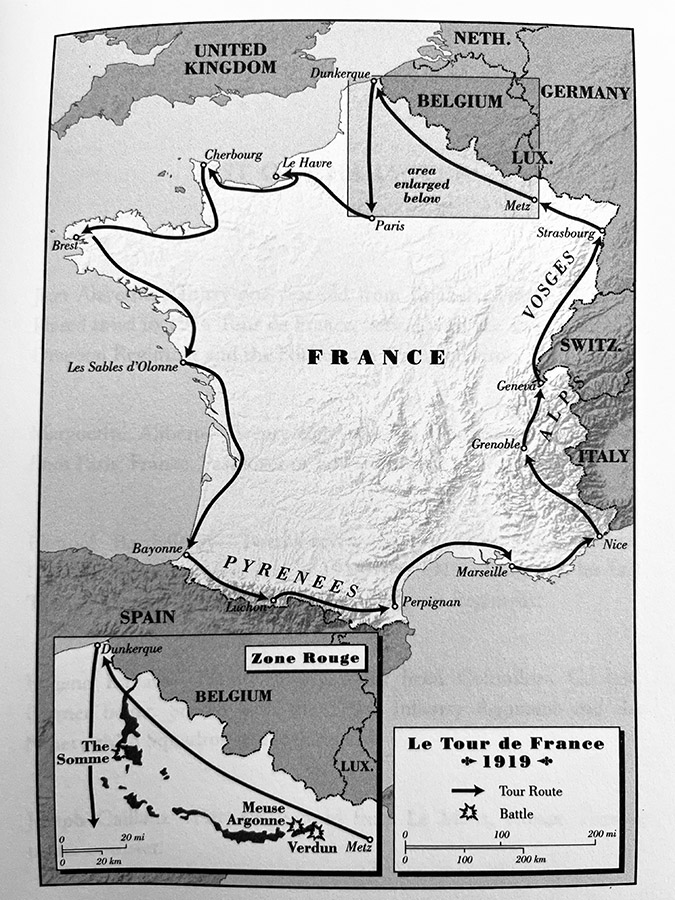
I’m five chapters and 101 pages in and there’s something missing. I think it needs more of all of the things I’m interested in. Dobkin gives a real nod to the importance of the still young race, culturally, but you could write a lot more about this.
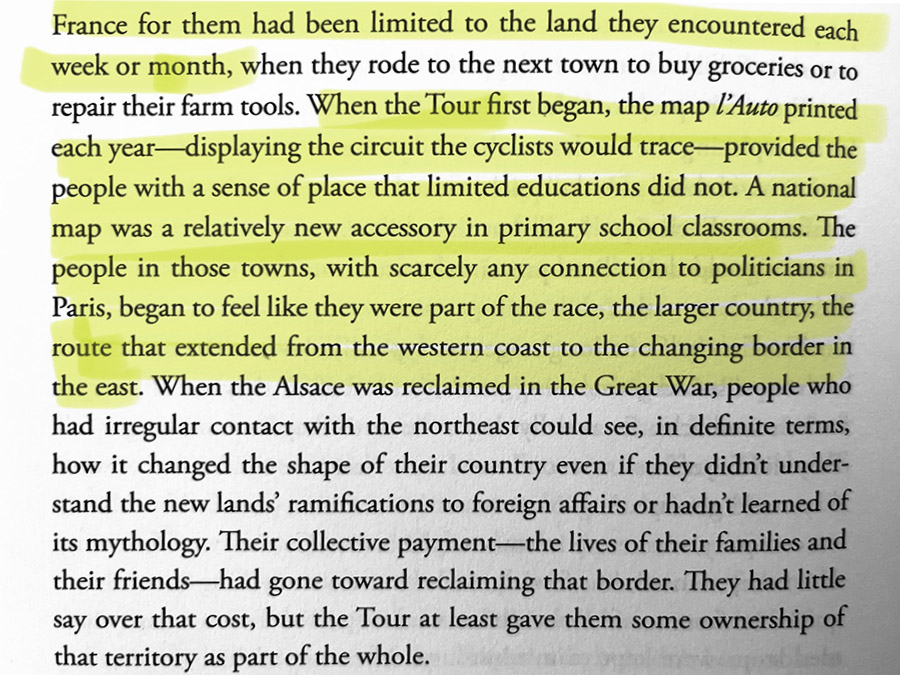
I somewhat understand how the races work today, and they were certainly different a century ago. This book alone makes that clear, if you didn’t know it already. But it’d be nice to see how all of this came to be, and precisely how this race evolved into such a cultural touchstone for France.
But that’s not Dobkin’s job here. Other people have written that, I’m sure. I’ll get to some of it eventually.
For some reason, and maybe this becomes clearer, there are asides on the war, not just the racer’s experiences. There’s a bit on the American 813th Pioneer regiment which was briefly in France. This, and units like it, deserve more attention than they have received. But how does that figure here? Similarly, there’s a digression into Camp Pontanezen an important American troop depot near Brest. The race went by there, but I don’t know why we did.
A better story would be unpacking Quimperlé. Dobkin tells us they had about 9,000 souls before the Great War, but lost something like four percent of their population. I’d rather learn about the terrible impact there.
Also, Henri Pelissier.
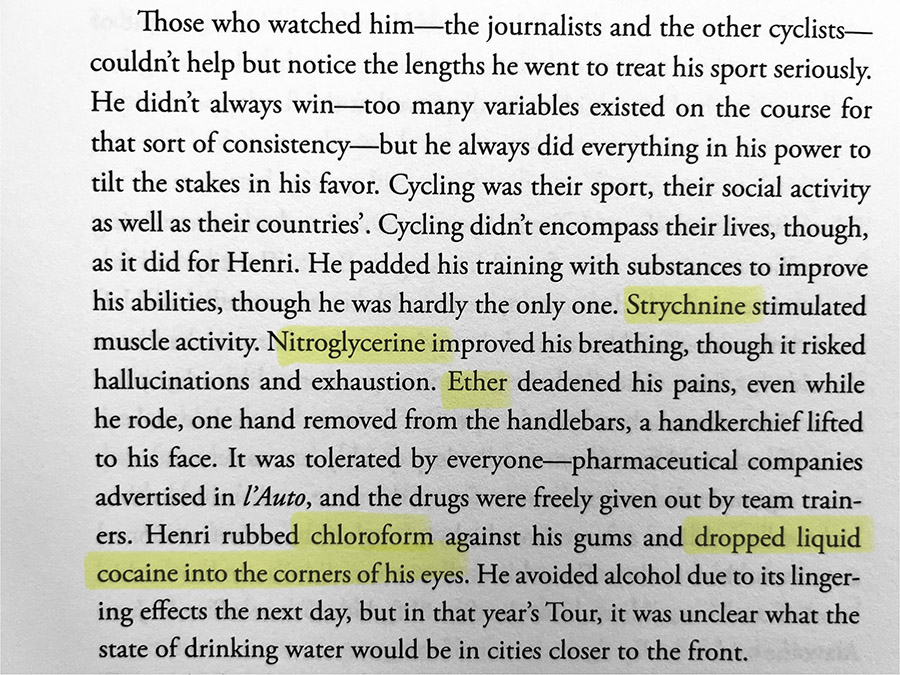
He may or may not be getting outsized coverage here. (I won’t spoil the results of a 112-year-old race.) He’s a real character though. Everyone agreed he was a strong bike racer, but he thought it most of all. And while his peers might have disagreed with his own self-evaluation, they all agreed with each other that he was not the most liked man in the peloton.
He was one of four sons. Three of them became bike racers, one died in the war. His father was a cattleman, but they feuded constantly. And Pelissier also feuded with Desgrange and other race organizers. To be fair, pretty much everyone either loved or loathed Desgrange, and I’m not sure if anyone that participated in his races went into the first group.
In his racing career, Pelissier won 10 stages of the Tour in five different years. He won the overall race in 1923. He was also a national champion, and won most of the large races in France and Italy. It went downhill when he got off the bike in 1927. He wasn’t successful in his later pursuits. His wife killed herself in 1933. He met another woman and they were huile et eau, and violence domestique. He threatened her with a knife. One night, at a dinner party, he lunged at her, and cut her face. She retreated to another room, found the revolver his wife had used — and she shot him several times, killing him.
It seemed a bad match. She got a suspended sentence.
Which is a happy place to wrap this up. It is late, there is work today and tomorrow to plan. We are building football franchises in Org Comm. I’m sure some anecdote will emerge.

