


I am back home. It’s never been my home, but in all of my childhood memories, going home meant coming here. It’s where my mother is from, and she’s there. Here. And, for the weekend, I am too. Flew in to Nashville last night. Late, as it turns out, because the airline can’t get its act together. Drove in, went to sleep.
Woke up this morning and did some work, because there was work to be done, but also to prove, I guess, that I do work from time to time.
There’s a small family routine of a Friday breakfast, so we went to that. It was my mother, my grandfather, my great-aunt and great-uncle. Two different cousins came — one of them of my generation and another that is younger. Much, much younger. That jerk.
He’s a delightful young man. He’s about to get married. About to move into a starter home. I’ve probably had the chance to see him six times in his life. Breakfast this morning is the most time I’ve ever spent with him. He sat next to his grandmother, my great-aunt, and they spent the entire morning clowning on one another, effortlessly, joyfully. I’d watch an entire series of buddy cop movies starring the two of them.
We — my mom, my other cousin and me — confirmed and corrected for him a bit of family lore about his grandfather. I don’t think he was listening at the moment. But also we didn’t tell the whole hilarious story. It involved a specific and embarrassing injury he sustained while tending to his cattle.
After we saw our elders off my other cousin and I traded platitudes and hugs. Then I went to the bank to play some video games do some banking. Back at my mom’s house, I unrolled a rug, moved a rug, re-positioned some furniture, and changed seven light bulbs. Then I spent the rest of the afternoon asking her if there was anything she wanted me to do. There was not.

I seldom get to use that banner.
Water, as I have noted in this space before, is the predominant geographical feature of the area where all of my family live. The Tennessee River forms near Knoxville, Tennessee and flows to the southwest, into Alabama, before looping back up, helping form the Alabama-Mississippi-Tennessee borders and then heading to Kentucky. It created a topography that has defined all of the people that have ever lived there.
The Yuchi tribe, the Alibamu and the Coushatta, of the Muscogee Creek Confederacy, lived on this imposing body of water. They called it the Singing River. Alabama became a territory in 1817, white people moved in and it became a state in 1819. Some of my ancestors were among the first white people in the area, some even before the Native Americans were forcibly displaced by the federal government. From what I can glean, my people were hardscrabble dirt farmers. Even if you grew enough to sell, but shipping was difficult. The shallow, turbulent water at Muscle Shoals was the problem.
Then the Great War came.
There was a worry that the Imperial German Navy would cut off shipments of nitrates from South America, so the federal government decided to build their own nitrate plants, driven by hydroelectric power. Muscle Shoals was understood to have the greatest hydroelectric potential east of the Rockies.
So in 1918 they started building a dam, a project which became a city unto itself, employing thousands. They had a school, barbershops, a hospital and more than a hundred miles of sewage lines. But the war ended before the construction did.
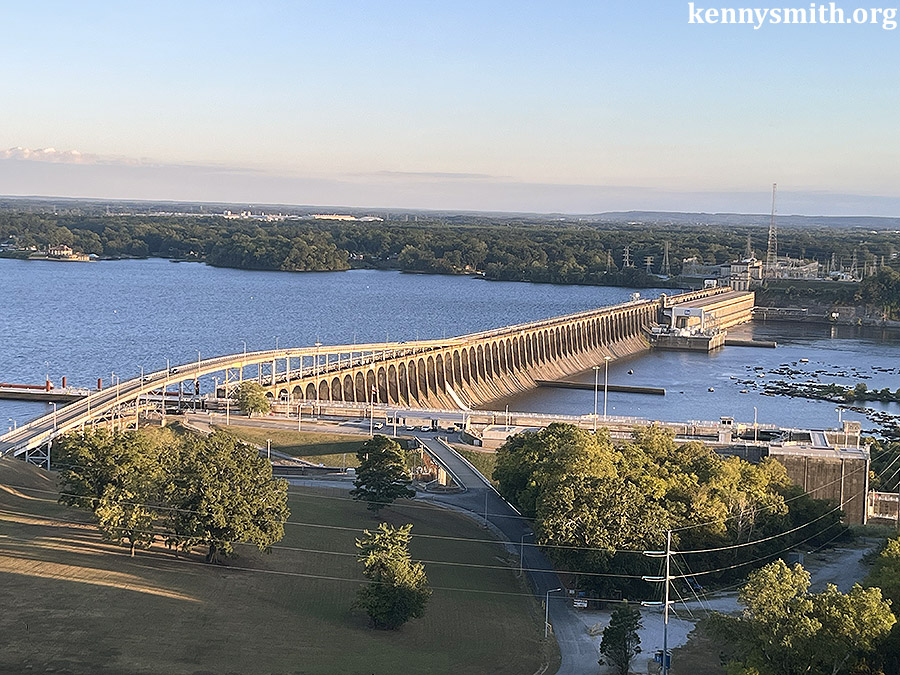
It is a narrow, two-lane dam, always a bit intimidating when I was a kid. Back then, it was one of the last little bits of road on our two-hour trip to my grandparents’ home. My mom would tell me about how she learned how to drive on that dam, in the snow.
Well, I haven’t done that, but I have driven over it. Not too long after I’d gotten comfortable with that — those lanes are narrow! — the traffic pattern changed. But that amazing structure is all about change. Without question it changed the region. In 1933 the dam was handed over to the newly formed Tennessee Valley Authority, which also touches everyone and everything in the region. The dam was put on the historic registry in 1966, and boasts the highest single lift lock east of the Rocky Mountains. They used to give tours of the place. Today you can still walk on the very tiny sidewalk, but once upon a time, the tours would allow you to walk through it, from one side of the river to the other.
I’ve jogged over it, biked over it, fished beneath it as a kid, marveled at the power of the spillways and the respect they commanded from people on the water, watched the ships pass through the locks, and, now, I’ve dined above it. (I’ve never been quite so aware of how that ascent/descent figures into the design.) I didn’t grow up here, but the dam is omnipresent in my story because of the river it sits on and because my family lives in its orbit.
Anyway, the views from the restaurant are nice. You drive down to the river, of course. You get in an elevator and go up – up – up. Some 300 feet or more, to get commanding views like the one above. The food is better than I’d expected. I don’t know what I expected, but that’s a fine place. We ordered a stuffed crab cake appetizer. My mom got a steak. I ordered a short rib.
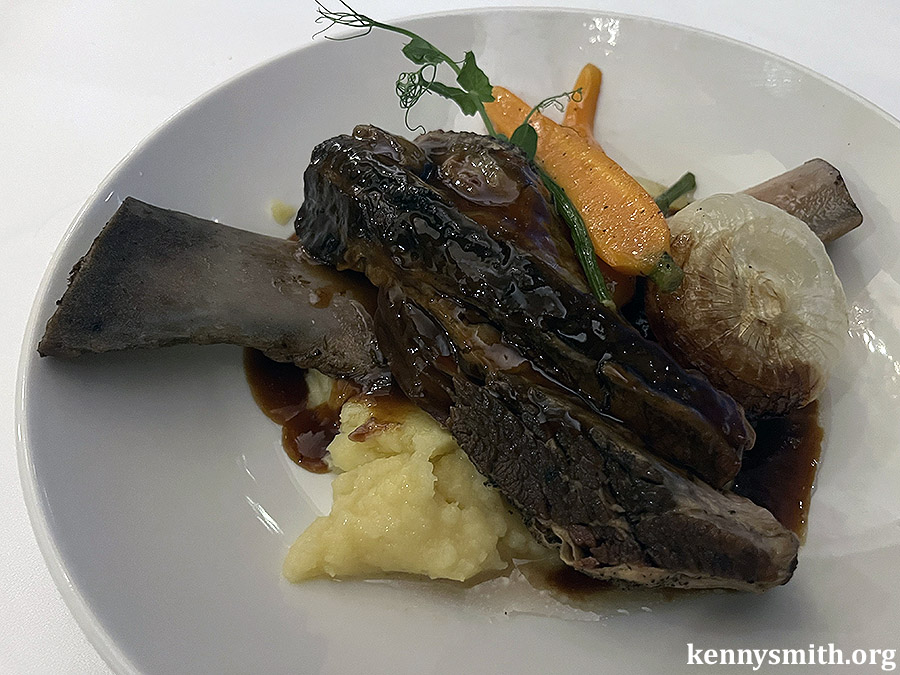
I had a bite of the steak. If I ever go back there, I’m ordering the steak.
Did I mention that the restaurant spins? We’d gone just in time to see the day’s last bright light on the dam, and then we spun to the west.
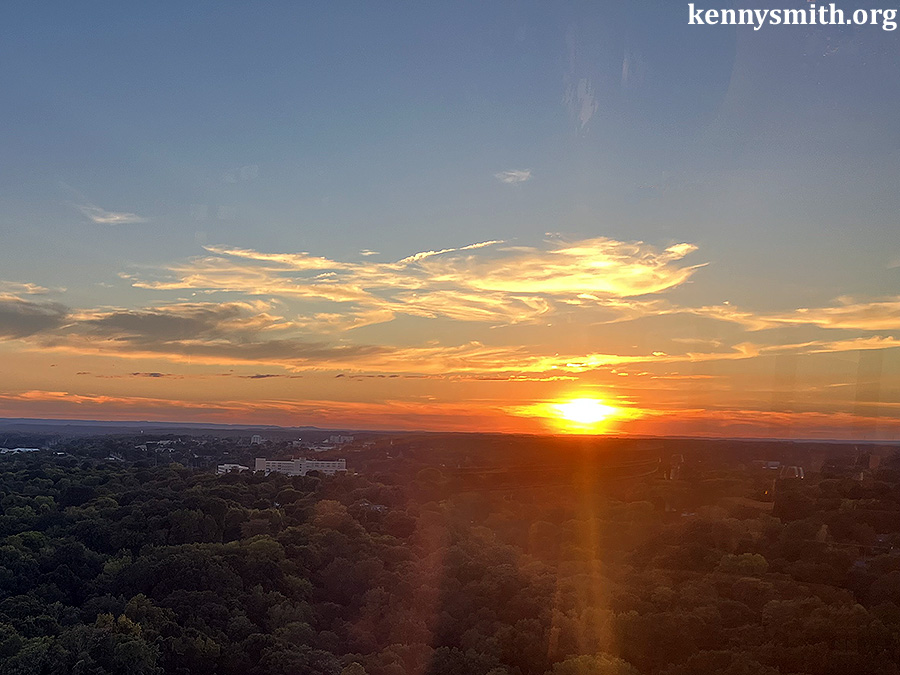
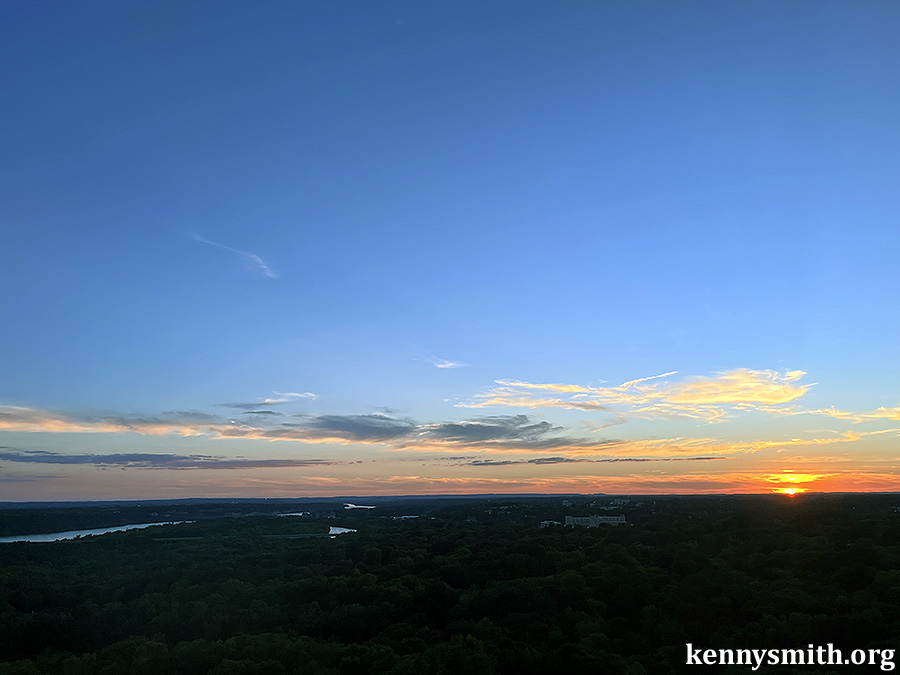
And in this one, you can see the last interesting bit of the sunset and a bit of the Singing River.
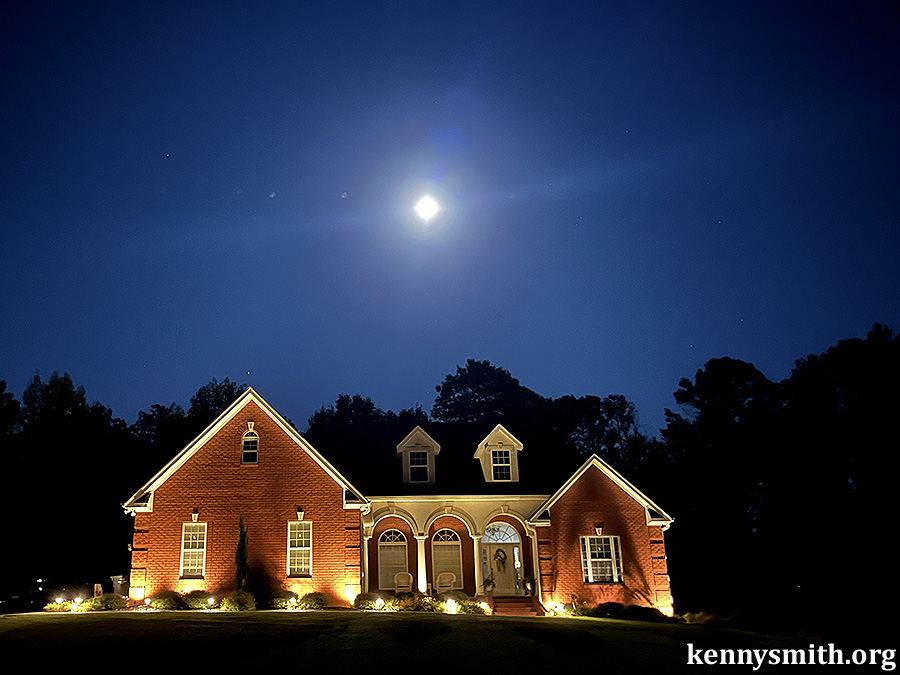
Also, I ate so much that I had to walk it off. So I walked home. That’s not right. I drove back, and then walked around the neighborhood. Here’s one of the houses in the neighborhood, waiting patiently, under a bright moon, for this big moment.
A word about those banners. The Spillway was a newspaper clipping, one of those little social happenings sections of The Florence Times, the pre-merger ancestor of the modern Times Daily. The Northwest Alabamian is an old masthead from the still publishing paper of the same name. It’s been a twice-weekly community paper since 1965, tracing it’s own heritage back to 1911. The current publisher has been there since 1983.

