


This is week four. I am a professional. I should have my Tuesday morning routine down by now. I do not. Almost made us late. There was just a curious moment where I had time to do the things required of the gargantuan task “finish getting ready.” And, then, suddenly, there was not time. So I drove to campus a bit faster than normal. I’ve slowed down a lot in the car in recent years. There usually aren’t that many things to rush to, but when your carpooler needs to get to work, and when you’re carpooling with your spouse, and you’re the one on the verge of making everyone late, you re-discover the accelerator.
And that is what I did. Fortunately, I am from a place where people think the road signs are the speed limits, a place with no police on the highways, and everyone operating under the mistaken impression that their morning commute was a tryout for the nearby speedway. It has been said that you have to a certain kind of mean to drive in my hometown, and that’s probably true, and I learned the lesson well.
We got there on time. I let her out at the door, so she could run to class. I went to park.

That story ends there. Nothing remarkable happened in the parking deck. I walked into the building and held my office hours. No one stopped by, which meant that I had the opportunity to do a bit of grading and study my notes for class.
Today we talked about a Bernie Hogan paper, which dives into the sociologist Erving Goffman and his dramaturgy, and also the fantastic paper, The Work of Art in the Age of Mechanical Reproduction by the German philosopher and media critic Walter Benjamin. This is the eighth section of this class I’ve taught, and so I’ve read this paper a few times. And every time there’s something new to discover. This time, this weekend, might be the first time when I didn’t find a new thing to wonder at. And so I was excited to take this paper into class and talk about it today. We had fun.
Back to the statue, Contact. I’ve been walking by this this semester, and every time I see it I think that these are actual people. I’ve been wondering, since the second time I was fooled, when I wouldn’t be fooled. And since then I’ve been taking photos of it. If you click that link you can see a post I made specifically about it, with details on the artist, and a wide shot from all four angles. Over the next several weeks we’re going to zoom in a bit. First, the hands.
It was this hand that I saw first, because I was walking toward it, but it seemed absurdly misshapen. It still does. The fingers are too long, too big, the knuckles somehow disproportionate.
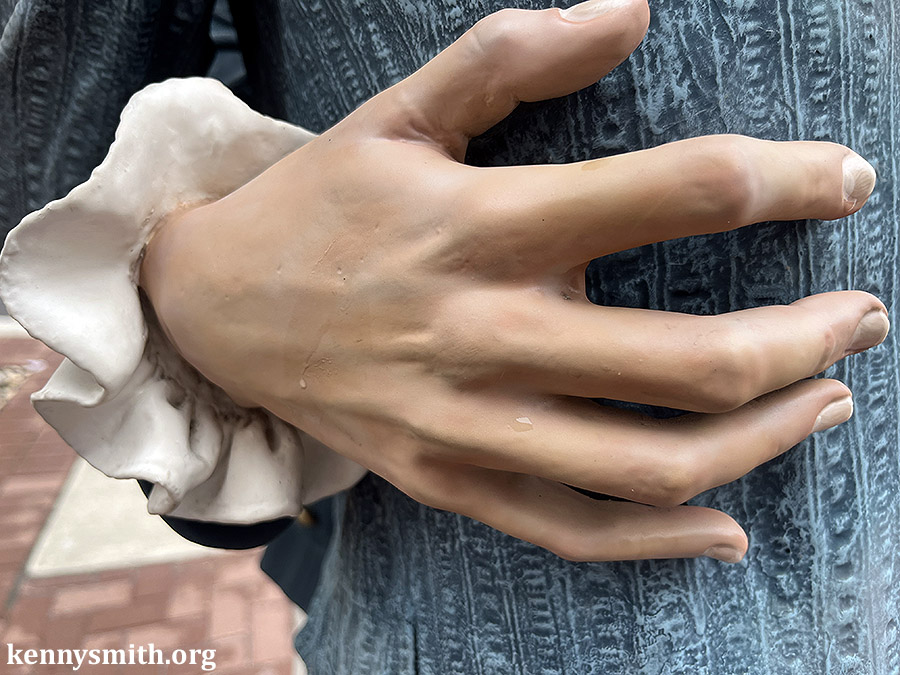
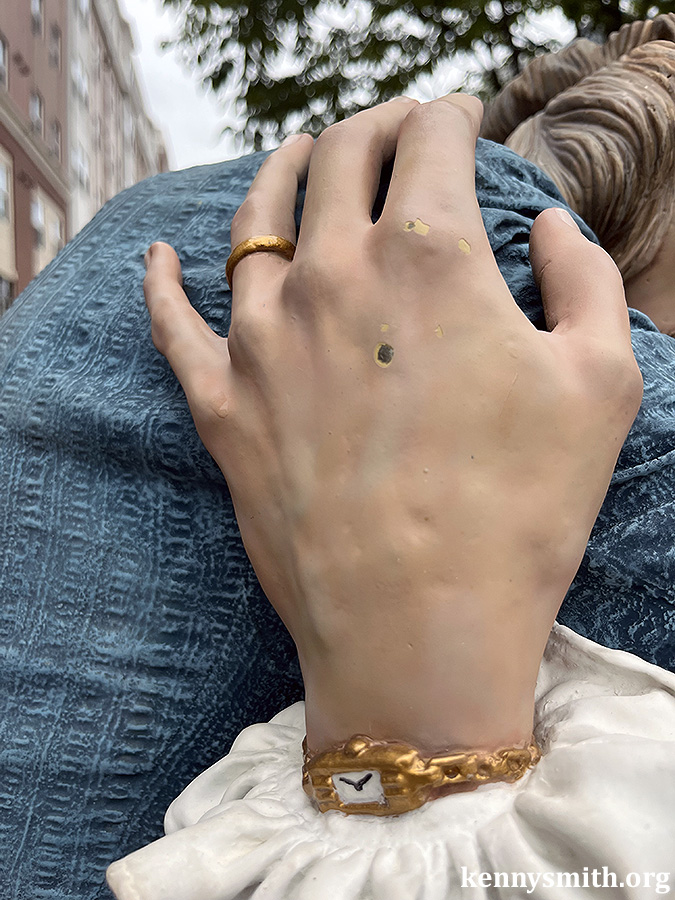
Perhaps it is the finger placement. Her other hand, a bit of wear aside, seems to work much better for the size of the figure. There are three things to notice here. The watch tells us a time. I saw that after I noticed the details in the back of the hand. It’s a dye-coating over a bronze statue, but in that you can see the bone structure, and maybe even the work of the veins in her hand. Also, she’s wearing a wedding band.
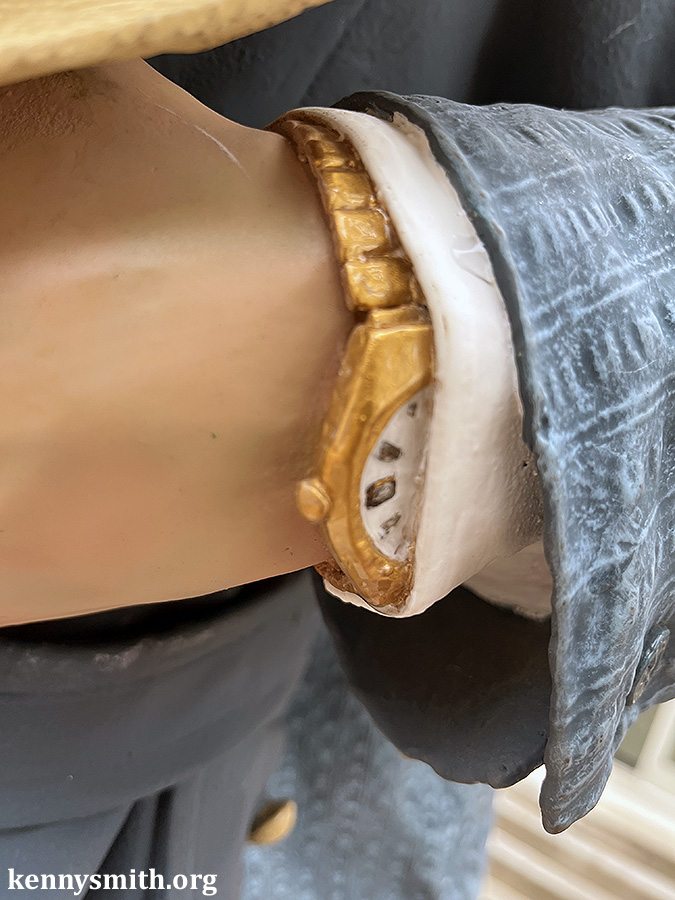
Let’s look at the man’s hands. First, he’s also wearing a watch. Can’t see the time. Can’t move the sleeve. (I tried. I tried because there’s magic in art, and I believe you have to find out all of the places where the magic exists, and make sure you aren’t overlooking any of it besides.) You would assume his time piece should show the same time as hers. If it doesn’t the commentary is entirely different. Looking at both watches carefully, there should be hands of his watch visible, based on what time she is showing. There are not. Is his watch slow? Are they from different times? Out of time?
He is also wearing a wedding band.
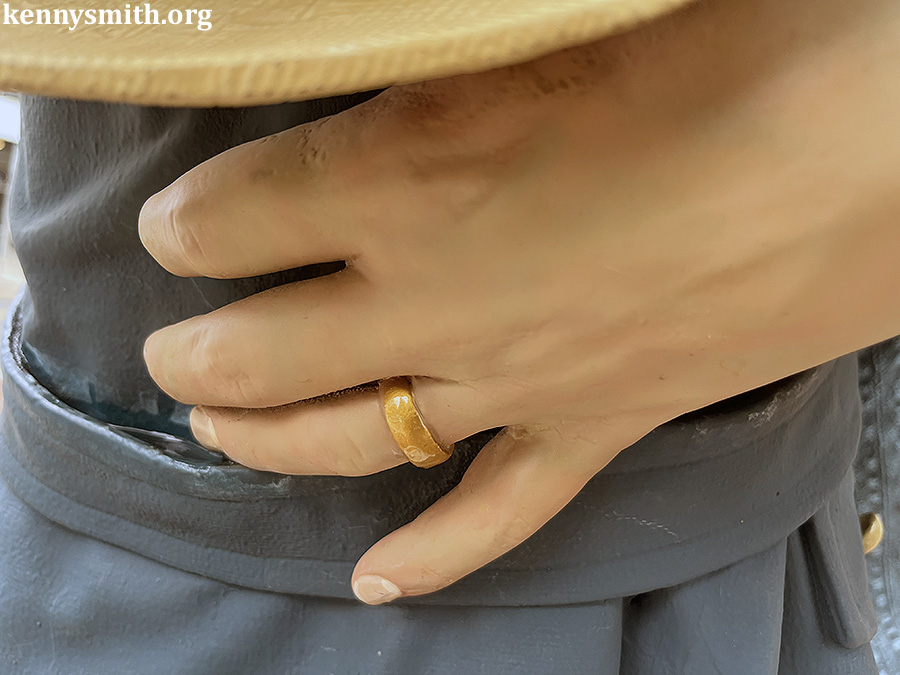
Are they married to one another? Will we ever find out? We’ll continue exploring, but we will not.
Next week, we’ll take a closer look at these two characters’ faces. As you might expect, there’s a lot to consider there.

