history


9
Oct 26

The 1936 Glomerata, part four

We go back once more some 90 years into the past for a few more glimpses at the people haunting the steps of my alma mater. It was the Great Depression. It was 1936. (Part one is here. Part two is here. Part three is right here.) This is hardly a complete look, but there’s a lot to find in 1936. Let’s see what is inside.

What is today the War Eagle Battalion traces its origins back to 1916, when President Wilson signed into law the Natioanl Defense Act. That gives us the modern ROTC, but the university’s military training program goes back to some of the earliest days of the institution and draws a line from Morrill Land-Grant Act. Back then, all males attending Auburn had to participate in the program for at least two years.

It hasn’t been compulsory for decades, but today it is a four-year program with cadets graduating as junior grade officer going into active duty, the national guard, or reserves.

Auburn University has produced more than 8,000 Army commissioned officers. Among the graduates include Ralph “Shug” Jordan ’32, who would invade Europe in between stints becoming a legendary coach, Rep. William Nichols ’39, Astronaut Jim Voss ’72, NFL Hall of Famer Kevin Greene ’84, Olympic Gold Medalist Ruthie Bolton ’89, and, even in this book, a few important future generals.

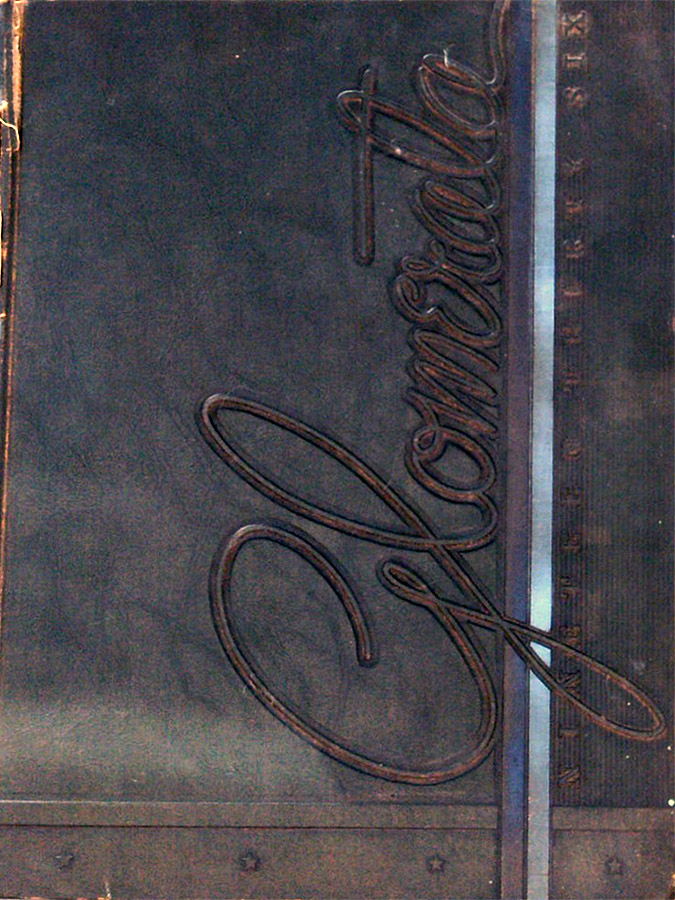
But, first, here’s the cover.
It’s a short little section, so we’ll try to concentrate on finding out who a lot of these people are. But, first, here’s a parade shot.
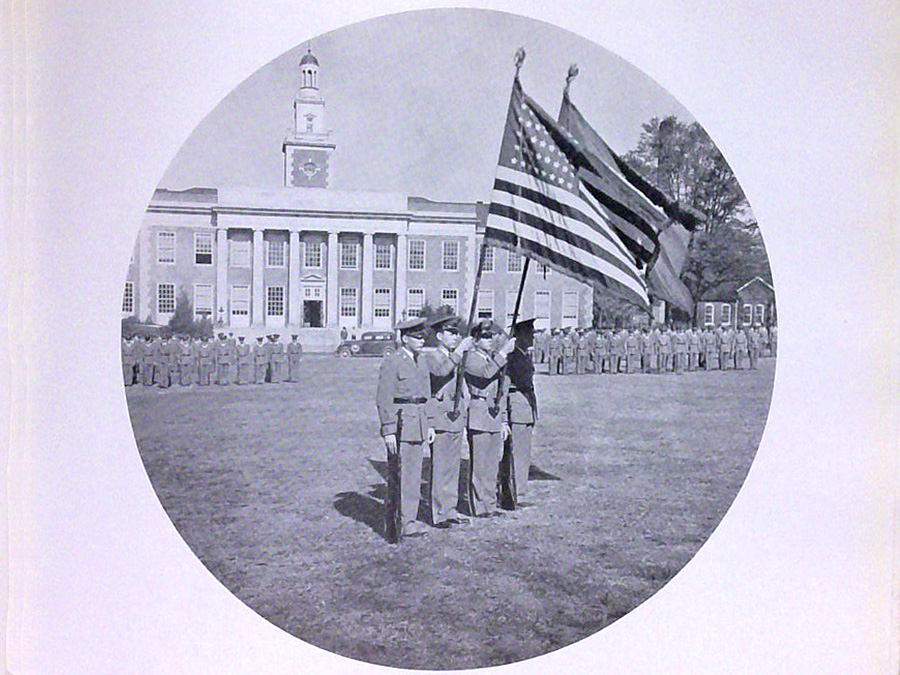
They’re standing in front of Ross Hall, which is still at the center of things. I can’t get in that exact spot on Google Maps, but here’s the view. You can scroll around through here a great deal, if you like.

Here’s the cadet brigade staff, commanded by Cadet Colonel W.T. Wingo, Jr. He’s second from the left in this formation. We met him recently: William Taylor Wingo was a chemical engineering student from Birmingham. After school he became a Marine. By 1942 he was one of the Corps’ youngest majors. He fell ill in Samoa that year. They flew him to California, but he died there, apparently of pneumonia, just before Christmas, leaving behind a wife and young daughter.
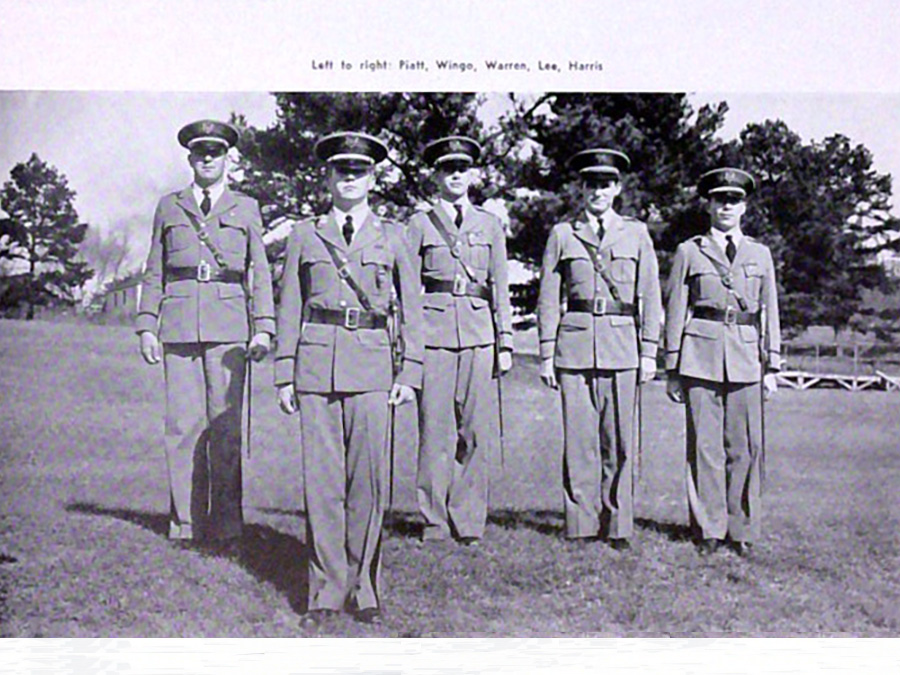
On the left is William C. Piatt, an aeronautical engineering major from Birmingham. He would stay in the army for a while, and was a major in the artillery by the time World War 2 was over. He married a Mississippi girl, and they built themselves a life there. She worked in real estate and owned a dance studio. They were prominent members of their community. He was remembered, when he died at 64 in 1974, as a pioneer in air conditioning — and that’s saying something in the Deep South. His wife survived him. When she passed away at 79 in 1998, they had a son, two daughters, seven grandchildren and one great-grandchild.

Carl K. Warren, Jr., in the back, was a science and literature major from nearby Opelika. He fought in the war, received the Silver Star while in the 4th Infantry Division. Sometime soon after he rose to the rank of lieutenant colonel and took a post at the U.S. Military Academy. His wife died while they were stationed in Hawaii in 1959. She’s buried at Arlington. It looks like he remarried. What became of him after that I can’t say.

Eugene Lee was a civil engineering major. He married a Birmingham Southern grad in 1940. He served in World War 2 and in Korea. He worked at Tennessee Coal and Iron, which was, at that time, busy building a certain reputation, shall we say. He died in 1988, at 76. His wife made it to 89, and passed away in 2002. They’re buried Fort Logan National Cemetery, in Colorado.

Herman Harris was a business student from Clanton. While he was a captain of the ROTC, he was also the business manager of The Plainsman. We met him a few weeks back. He became a brigadier general in the Air Force, finally returned from the uniform in 1971. While in the reserves he was an auditor and inspector for General Motors, ran small businesses in south Alabama and a good-sized farm. He also ran a hospital, from 1963 until he died there in 1974. People remembered his role with the local Little League, as president of the Chamber of Commerce, the Rotary, the Red Cross and Community Chest. He was survived by his wife and three adult children.

This is listed as “The Auburn Band.” It’s included in the military section, which probably makes sense for the time, even if we associate them with sports today.
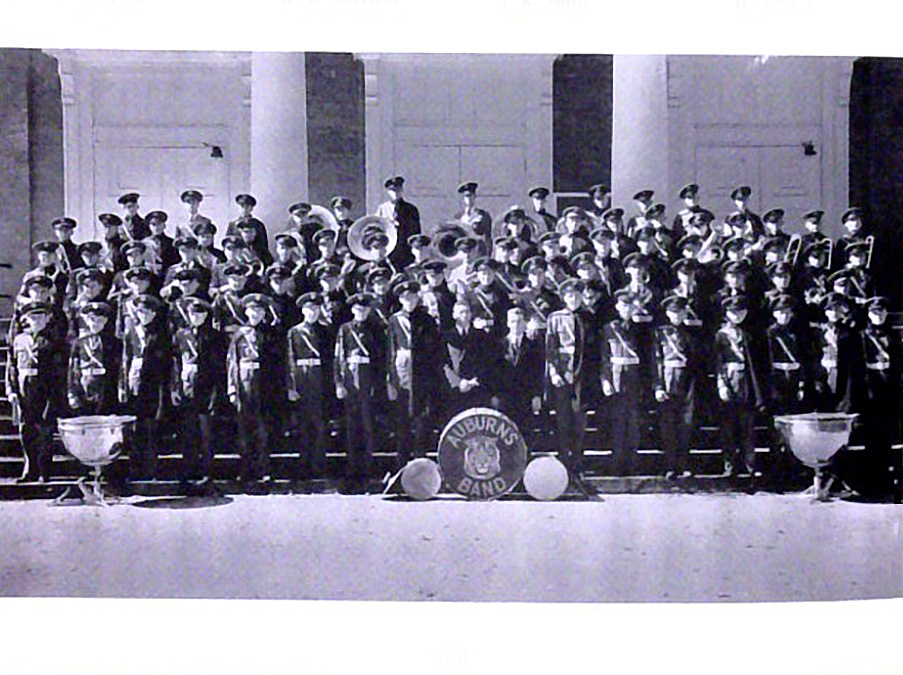
There are 83 members listed. There in the center is the band’s director, Paul “Bedie” Bidez. A generation before he’d been a captain and 175 pound fullback on some of the great early teams. By this point he was coaching and running the band, which marched under his direction for 32 years. The modern band has 380 members. Almost as many members of today’s band are music majors as those in the picture, above. Bidez deserves a bit of credit for that. He founded the music department.

And here’s the rifle team. They’d won the conference championship the year before. The team was looking forward to hosting the championship this season. The program was expanding, too. They were coached by Lt. William Ehrgott, who came from the Military Academy, MIT, and the French Tactical School. He was an engineer before becoming a professor of military science and tactics at Auburn. He was there for four years. He was in North Africa in 1942, later becoming a staff engineer in the Ninth Air Force, rising to chief of staff as they fought in Europe and North Africa. His billets would grow more impressive as his career marched on. He was promoted to brigadier general in 1952. Probably it was all the lessons he learned from this rifle team.
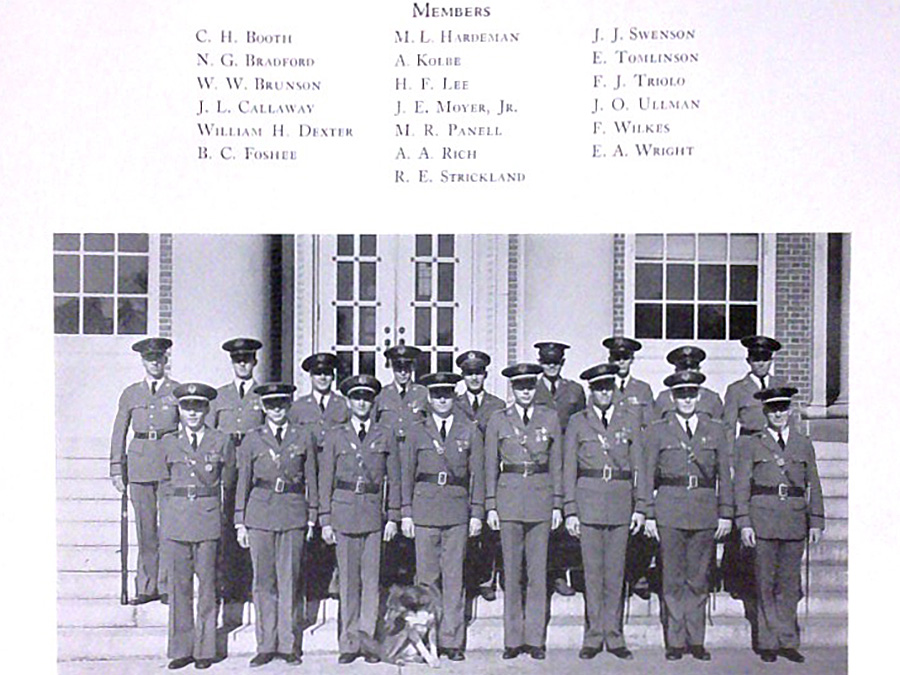
The SEC doesn’t keep records of ancient rifle championships online, unfortunately. I’ve been pouring over the campus paper for a few minutes and other state publications, but can’t find anything elsewhere that tells us how they did particular season. I do know that later in 1936 it was announced that the university would create a co-ed rifle team. That had to be pretty exciting for the 1930s.

Also, I found this, in a March issue of The Plainsman.
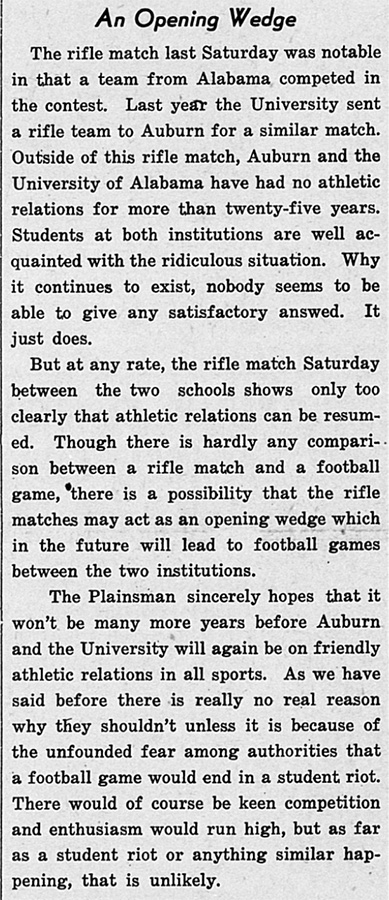
They were mistaken here about “no athletic relations.” The two schools met in basketball for the first time in 1924, for example. There may be other sports where the schools tangled, but history is a challenge for the athletic department and I don’t want to spend all night on that. We do know they’d not played in football since 1907. We know why they weren’t playing. They did, too. It’d be a dozen more years before the football teams faced off again, in 1948. The state legislature would have to strongly motivate the two schools to make that happen.

But, as you’ll soon see, even without their greatest rival, the Tigers would have plenty of competition. Next week, we’ll talk athletics.

All of this will wind up in the Glomerata section (eventually). You can see others, here. Or maybe you’d like to click through to see all the covers. The university hosts their collection here.
2
Oct 26

The 1936 Glomerata, part three

I have fired up the wayback machine and we are going way back, or a reasonably moderate distance back, depending on your perception of these things, to see the people at my alma mater in 1936. We are once again jumping in the time machine, heading back 90 years, to see what the ol’ alma mater was like in 1936. (Part one is here. Part two is here.) The Great Depression was full of depressing things, but the students were determined to make their memories and live their young lives. In many respects, theirs is a different place than the one I knew, but it is awfully familiar.

This is hardly a complete look, but there’s a lot to find in 1936. Let’s see what is inside.

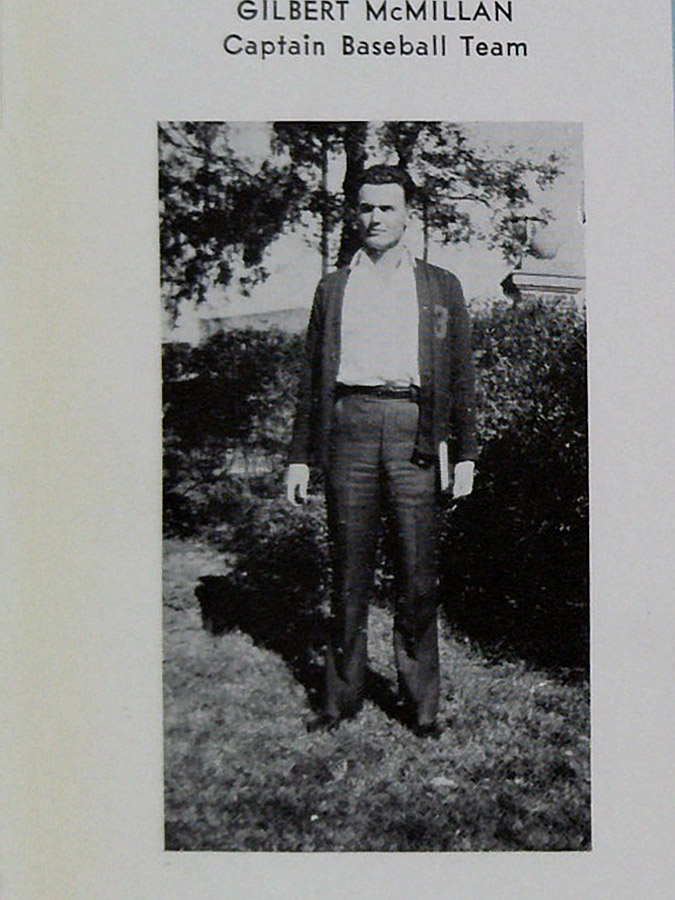
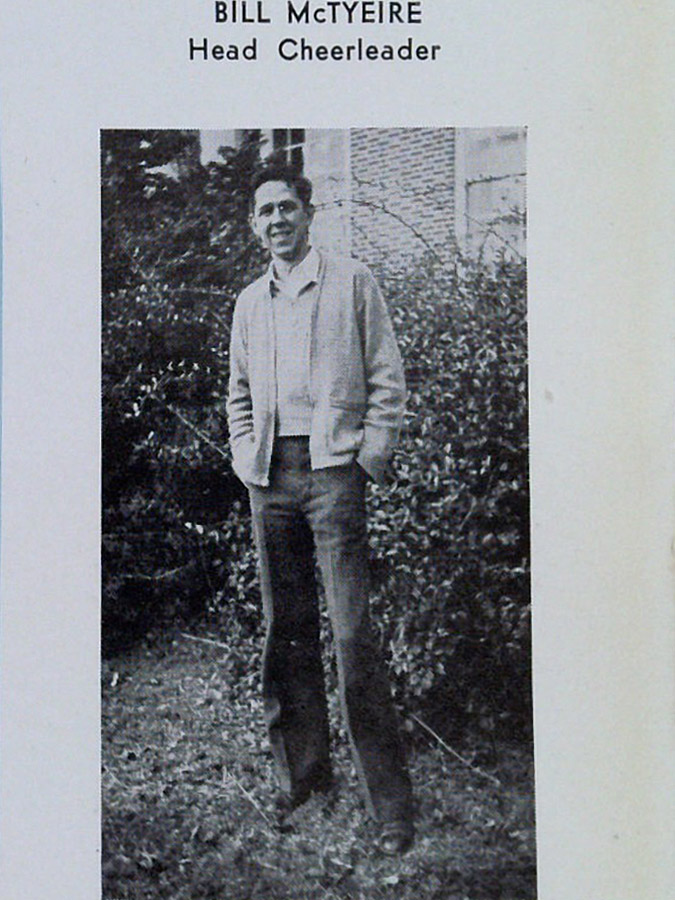
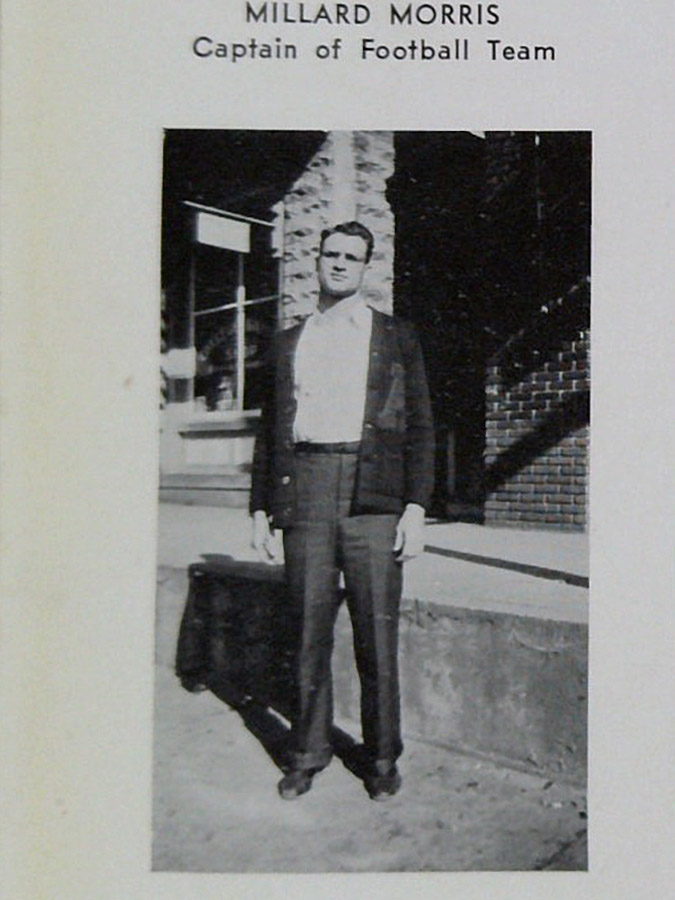
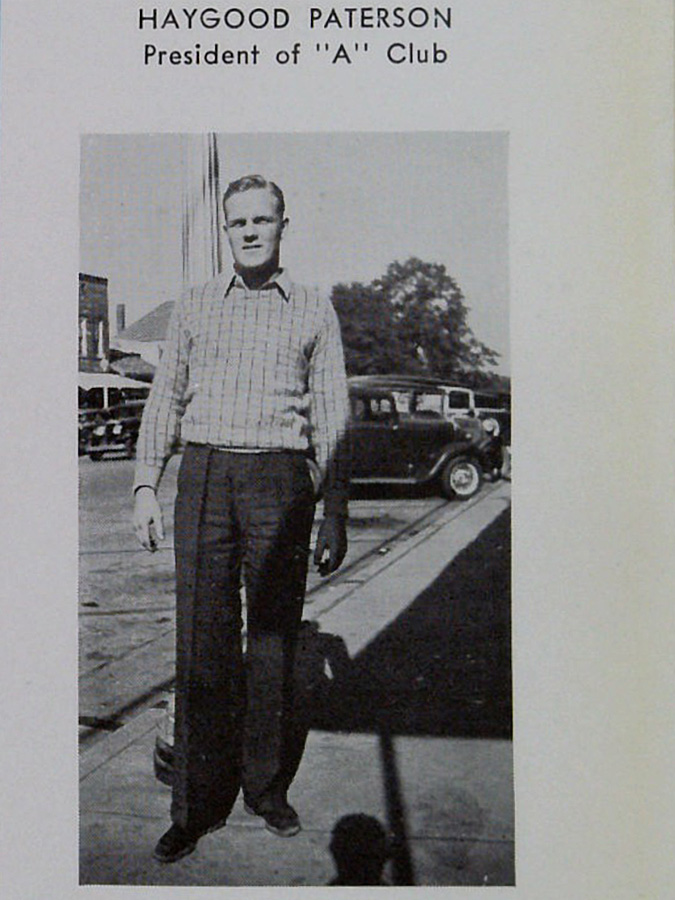
The senior class section includes 336 students and, alongside their headshots we learn their names, their hometowns, what they’re studying and some of their extracurriculars. There are also some vertical photos of some of the high profile students to fill up the margins. We’ll wrap up our look at those today. These are vertical photos, and include a little too much negative space. If I ever meet the young man who designed this — he’d be a very old man by now — I will express my dismay that something he did a century ago hurts the layout to my website. He’d probably wonder why I was hassling him. The photos are fine, he’d say. He’d be right.

But, first, here’s the cover.

Allow me to introduce you to Gilbert McMillan, a chemical engineering student. In addition to being a baseball captain he was in one of the secret societies, and also a ranking officer in the ROTC. He was born in Malvern, and grew up in Alabama, just down the road, in Tuskegee. He married a Jersey girl. And you can not predict his future from this one photo.

He went to work for DuPont, where he worked for 33 years, helping to start nuclear reactors at the Savannah River Site in South Carolina. That seems reasonable for a man that had worked on the Manhattan Project. He was a tree farmer, a city councilman, and then a state senator in South Carolina for decade, leaving that body in 1979. He was the sort of state lawmaker that did not want to spend any money on anything. He’d been a vocal ultra-conservative, in a legislature that doesn’t like loud members. He was apparently instrumental in getting the state to vote for the 19th Amendment. (This was in 1969, and was purely a formality. The amendment had been in the constitution for almost 50 years by then.) The South Carolina Senate honored him with a resolution upon his death, in 1998, aged 83. His wife survived him by a decade. They’d had two daughters. And when his wife passed she could count four grand children and five great-grandchildren.

The head cheerleader was a mechanical engineering major from Birmingham. In his four years on campus he’d been a part of almost everything. Class officer three years in a row, executive cabinet, Spades, Greek this and Greek that, an ROTC captain. One wonders how he had time to study.

After school he caught on with Goodyear Tire and Rubber, then went into the war as a captain in the Pacific. He spent much of his career after the war at at the Birmingham Ornamental Iron Company, where he established Meadowcraft, a furniture division that would, one-day, be one of the successful casual furniture makers in the country. (We have some Meadowcraft furniture in our home.) He was incredibly successful in his business ventures, which led to time as a general chairman of the United Way, and participation in many of the prominent civic and social organizations in his hometown. (I’d list them, but it is excessive.) He was also on the board of some of the largest business concerns in the state. I just found a newspaper clipping from 1998 that talks about how he was teaching fans cheers from 60 years prior. He died, at 90, in 2003. He was survived by his wife of 61 years. They had five children and eight grand-children.

Millard Morris was captain of the football team, but he was also a dynamite baseball player. He threw the first recorded no hitter in school history in 1936 and was named team MVP. He spent a year in the minors, going 2-6 with Columbus and Cordele. He threw four complete games, but that seems to be the end of his athletic career. He shows up in the society pages like a lot of the young people did for a while. He grew bananas in Panama for a spell. He was the father of five sons. He died in 1987 at 75.

John Haygood Paterson was well known for his football prowess. A 1960 Sports Illustrated feature named him a Silver Anniversary All American. He was an all-conference lineman in his day.

He went into the family business, where he was part of the third generation to run a huge floral business. He’d served as a county official in central Alabama, as a member of the state’s Agricultural Center Board, the Rotary and more. He died in 1988, aged 74. He had two daughters and four grandchildren. Extra fact, his grandfather, William Burns Paterson, made the boat ride from Scotland in 1869 or so, and a few years later moved to Montgomery, built up the flower business and started what is now Alabama State University. William died when John was young, I wonder if he had any memories of him.

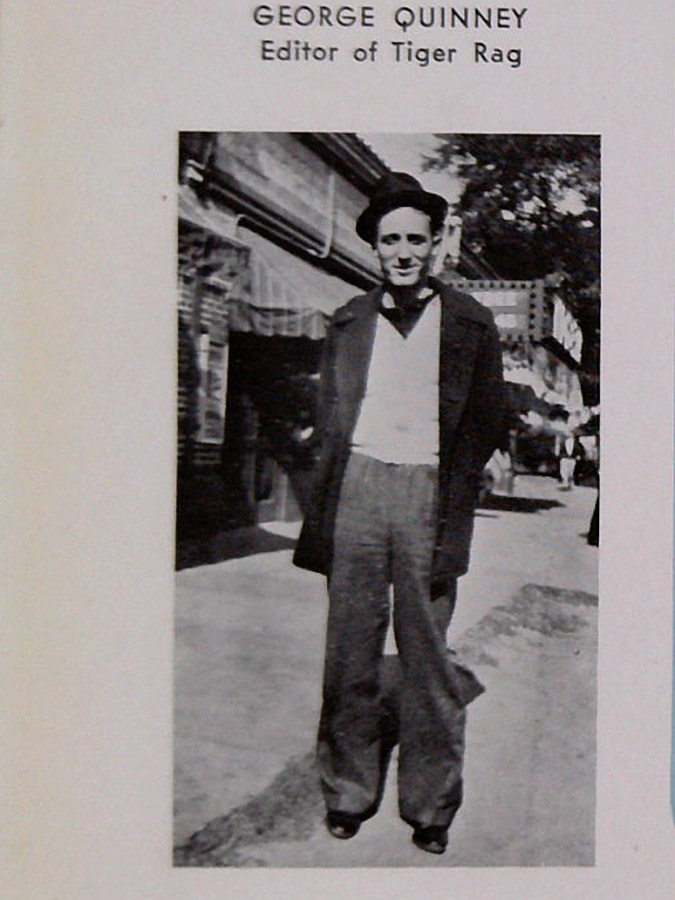
It’d be a shame to draw conclusions about a person from just one photograph, but George Quinney looks like he was ready to be the archetype of a certain sepia-toned way of live, doesn’t it?

He was from Columbus, Georgia, but would later spend 40 years in Jacksonville, Florida. He worked for Blue Cross-Blue Shield. He was a big part of the alumni organization down later well into his later years. He died in 1989, at 77, the father of two sons and four grandchildren.

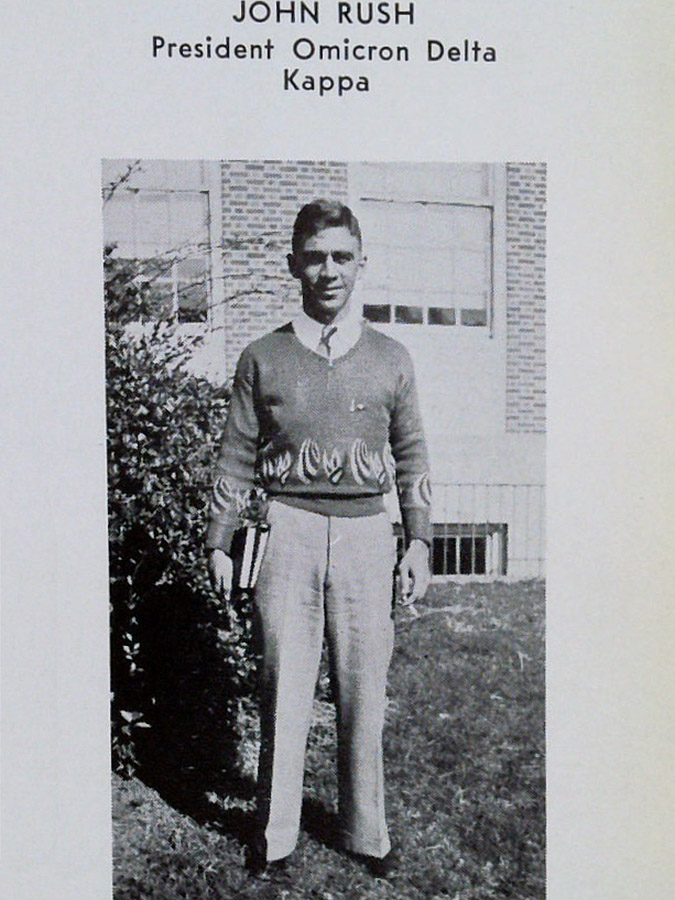
We met John Rush a few weeks ago in the first installment. His is a sad story, but that sweater … I need one of those.

He was from Mobile, the class president, majoring in aeronautical engineering. He became a naval aviator. He died just before his 27th birthday, in June of 1941. He’d been conducting a test flight of the Curtiss SNC-1 Falcon when he got caught in a squall off Pensacola. He and his co-pilot were killed. Rush was buried at Arlington. His father, John Sr., was also an Auburn man. He died when Junior was a freshman in school.

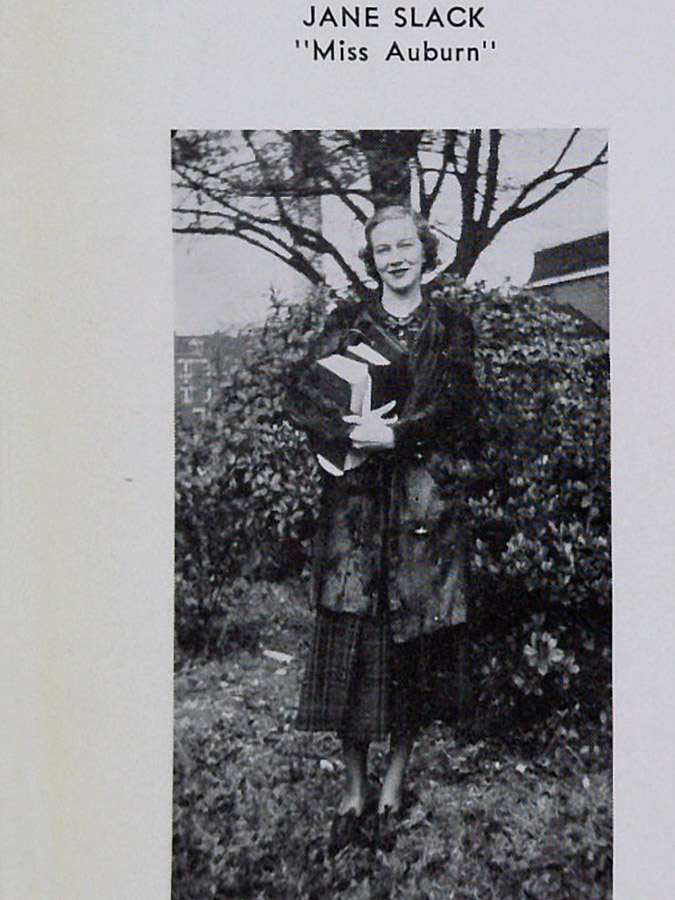
Jane Slack was Miss Auburn, a little pageant vote contest that doesn’t mean much off campus, but is one of those things that sits prominently on the school calendar. It got a few mentions for her in newspapers late that winter, all using the same contributed headshot, which is a tightly cropped shot of her senior portrait.

In 1937 she married her college sweetheart, Bobbie Black. I can find more about him than her. They met their first year in school. He was a local boy, and a serious athlete, playing basketball, throwing the javelin, football. He was, in fact, a part of the school’s first bowl team.

When his playing days were over, he coached for a bit, but soon moved into banking. He’d served in the Mule Pack Corps and artillery during the war. When he retired in 1981 they moved to Florida. They’d been married 60 years and had five children, seven grandchildren and six great-grandchildren when she passed away, in 1997. She’s buried in her hometown, Birmingham. He moved back home after that. Her husband lived for four more years. He’s buried in Auburn.

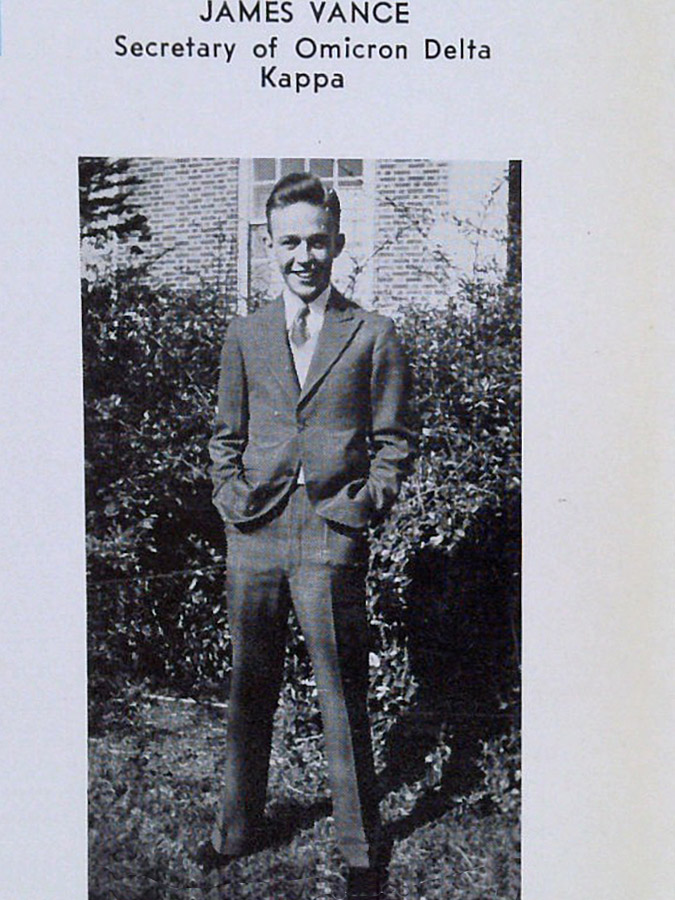
I wonder if they were friends with James Vance. He was from Gadsden, studying business. He’d been the president of the sophomore class. He played in the marching band and the jazz band.

After school, he went to Birmingham and worked at First National Bank. He’d become vice chair of the local medical clinic board and was a president of Alabama Goodwill, and the treasurer of his church. He worked with the local Junior Achievement program, serviced on some city commissions and the local lung association, among several other civic groups. He died at 69 in 1984, survived by his wife and a son and daughter.

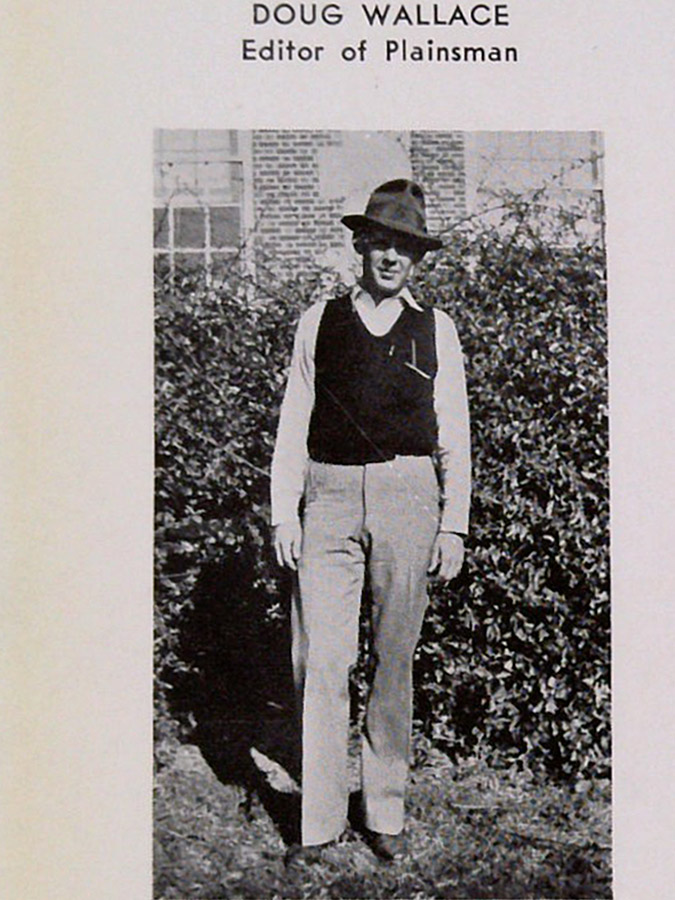
Here’s an ink-stained wretch, Doug Wallace of Minneapolis, who was studying science and literature. In addition to running the paper, he was in Spades, ROTC, and a member of the Auburn Players, which was a band, as I recall. He was destined to become a legend.

He served for five years in artillery with the Second Armored. They fought in North Africa, Sicily, and landed in Normandy, crossing into Germany late in 1944. He earned the silver and bronze stars. When peace came, but before he could return home, he ran a division newspaper, the editor of the first ever English language newspaper published in Berlin. When he finally made it back to the States he worked at the Columbus Ledger-Enquirer, and prior to their manager he was a big part of both papers. He wrote comlumns. And, in 1953, WRBL took to the air in Columbus. He was their weatherman. (He was not a meteorologist.) There are quite a few photos of him giving forecasts off a chalkboard, which would have been peak technology in those days, I guess. He stayed in that role until 1985, retiring at 70. By then, of course, he was a local legend. He wrote a three-volume history of his church and was a big time gardener. When he died, at 90, in 2005, he was survived by his wife of 63 years, two children, five grandchildren and three great-grandchildren.

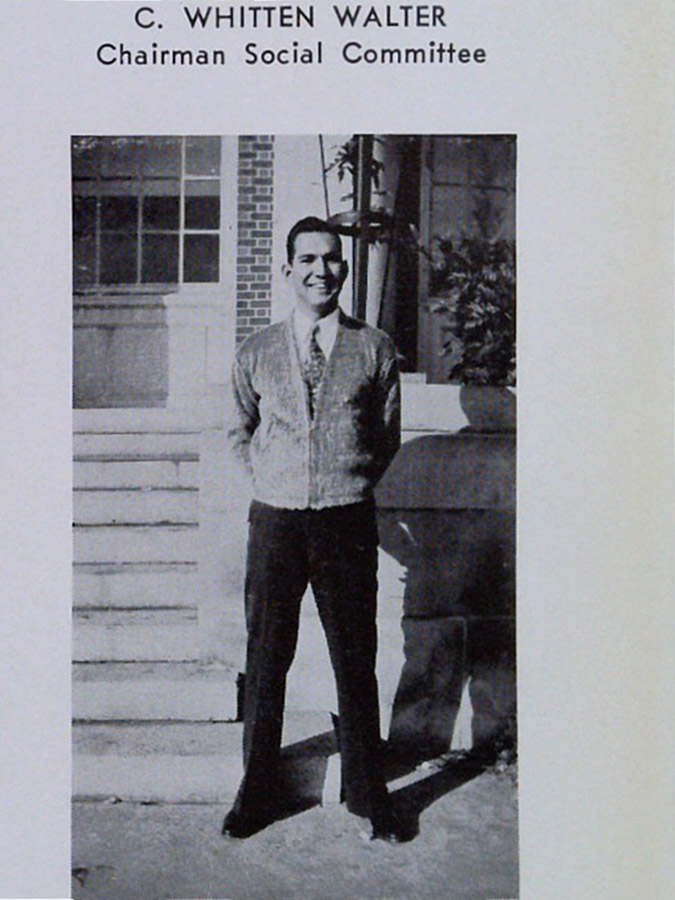
Charles Whitten Walter was a business major from Birmingham. When he died in 1986, at 72, the second sentence of his obituary gave readers the details of his college life, half-a-century prior. Isn’t it interesting how that’s the priority? He’d been in Sigma Nu, Spades, and an honor society.

Like so many of his classmates, he also served in the war. He was also in the Second Armored. Back home, he became a board member of the Birmingham Botanical Society and helped renovate the Botanical Gardens (Which is a great visit.) He ran the parks and rec board for Mountain Brook, the richest Birmingham suburb. I don’t know that he was one of the Big Mules, but the rest of his obit lines up with it. If he wasn’t, he was buddies with all of them. He and his wife had a daughter and son.

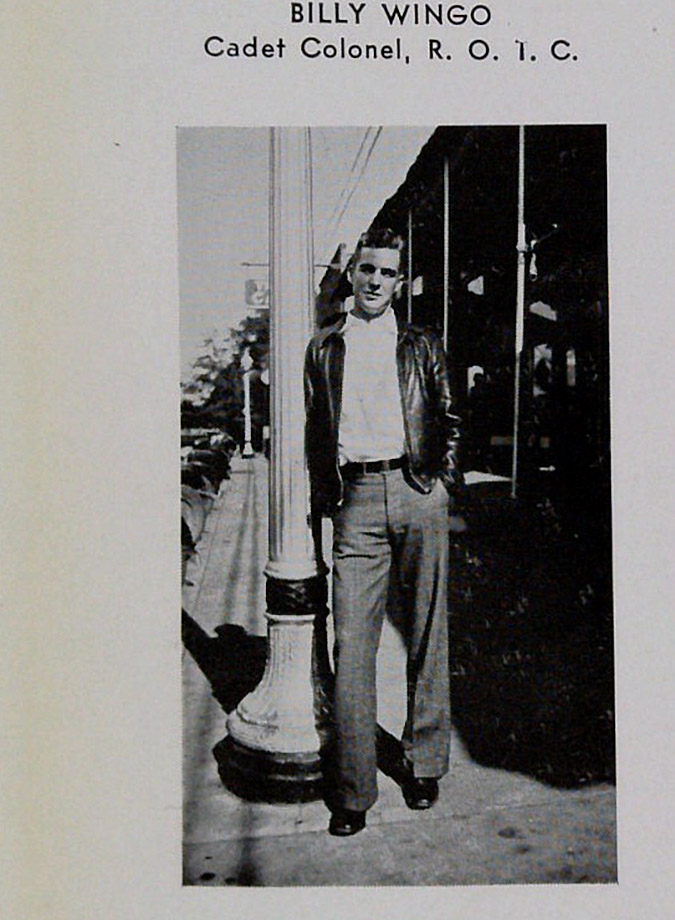
Billy Wingo was a chemical engineering student from Birmingham. He was high up in the ROTC, in all the secret societies, and somehow a part of three different organizations that use Greek letters. I assume two of those are academic and honorary.

His given name was William Taylor Wingo, and after school he went into the Marines. By 1942 he was one of the Corps’ youngest majors. He fell ill in Samoa. They flew him to California, but he died there, apparently of pneumonia. All over the Christmas newspapers there were stories about his death. He had a wife and a young daughter. Just horrible.

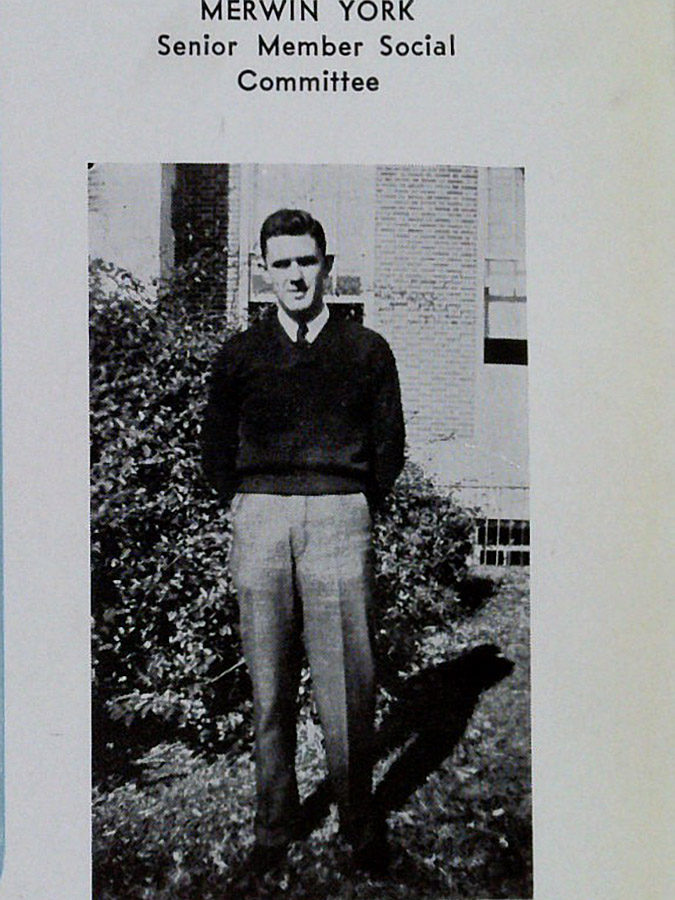
Merwin York was a south Alabama boy, a business major from Monroeville. He played in all three bands on campus.

Later in life, he was the chairman of his local hospital board for 16 years. He’d also been the fire chief and a town councilman. He was in the American Legion, the Chamber of Commerce, and was a lay leader of his church. (It’s a very small town, but still.) He was a manager for a construction supply company. He did all that and still had time to raise a family. He and his wife had two daughters. He died in 2000, at 85.

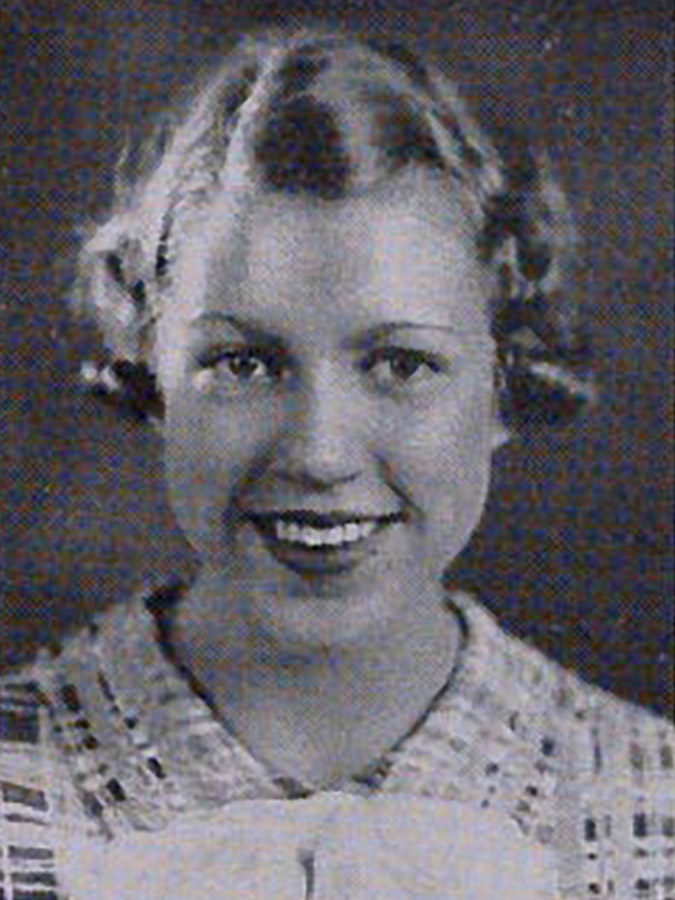
Yes, that’s a lot of men. I’m just sharing the people the Glomerata staff (also a lot of men) highlighted. Take it up with the 1930s patriarchy. But here are two of the women who were graduating seniors. This is Lois Bailey, who was an education major from neighboring Opelika.

She moved down to the Gu’f in 1946. She was in all sorts of clubs and organizations down there. She also worked with the Red Cross, taught Sunday School and played piano at her church for more than 30 years. She taught special education. Lois died at 89, survived by two daughters, her second husband (having lost her first after 56 years of marriage), six grandchildren and eight great-grandchildren.

It’s amazing, but none of these things are in these kids minds when these photos were taken. How could they be?

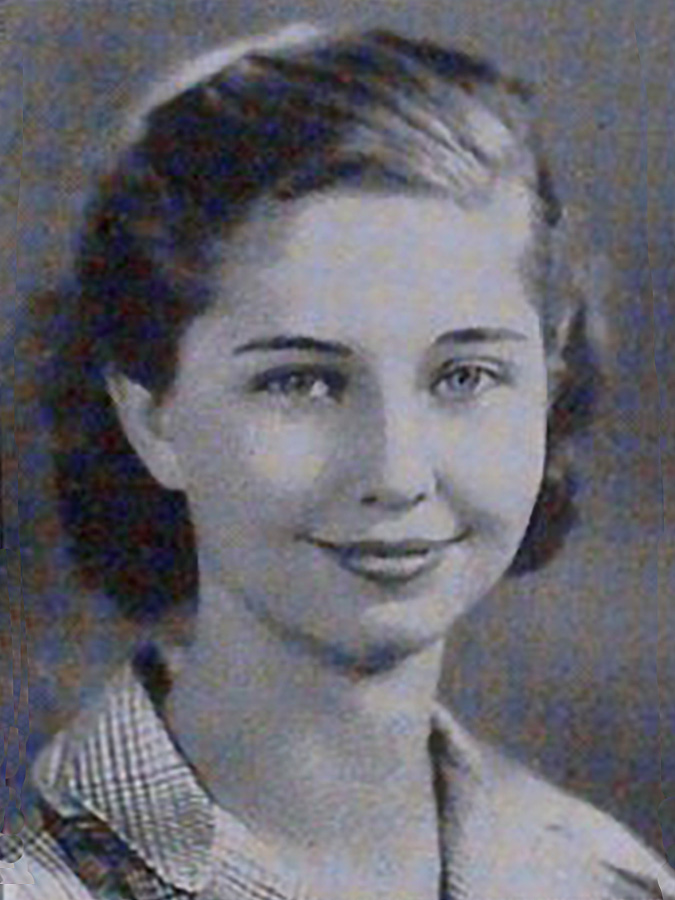
Like Luella Botsford. She was also from Opelika. Also studying education. Perhaps these two were close friends. Luella wrote for the campus paper, the Plainsman.

She moved south in 1946, and settling in for a nice life in Enterprise. She founded the first Girl Scout troop in that city, and served on the Scouts’ state executive board for a long while. She was active in the arts, and received an award from the governor for that part of her civic life. She was a Sunday school teacher. She’d been a member of the university’s College of Liberal Arts advisory council. She and her husband had one child that died as an infant. Her husband died in 2000. She lived to see 86, passing away in 2002, survived by four daughters, a son, and nine grandchildren.

Next week, we’ll start our glimpse into some of the classic student life photos, so do come check it out.

All of this will wind up in the Glomerata section (eventually). Or maybe you’d like to click through to see all the covers. The university hosts their collection here.

30
Sep 26

Coins from long ago and far away

My visit home last weekend led to seeing some old family treasures that, until recently, no one knew existed. A few notes, a newspaper clipping, some old photos, my grandparents’ high school diplomas and the like. All of this was stuffed into an old chocolate sampler box, neatly and carefully arranged in such a way that you could tell my grandmother had spend time with this. It would all only go back in the box in one particular way. The order of things almost as much a mystery as the contents. The box had been underneath this or that and was stumbled upon largely by accident, I’m told. You have to look through everything.

It’s funny, I have, for as long as I remember, wanted to discover something historically important. In my mind it, whatever it is, will be in a forgotten closet, tucked inside a box, under a blanket in an attic. It’ll be boring, the circumstance far outweighed by the relevance. I have always had this idea, I suppose. It has never occurred to me that what I’ve been imagining would be 75-year-old bits of paper that just fill in bits of the family story. It doesn’t need to be anything bigger than that, really. It had just never crossed my mind that that’s what it would be. It’s the thrill of finding the thing that is, well, thrilling.

Anyway, this was my mother’s discovery and she of course enjoyed seeing the old note cards that had verses her father used in his sermons. She enjoyed the little notes and of course the photos. But there was also a little felt pouch in that box, and inside that felt pouch there were some coins. We all liked that. I already showed you six mid-20th century Canadian pennies, but there were other coins, as well. Here they are now.

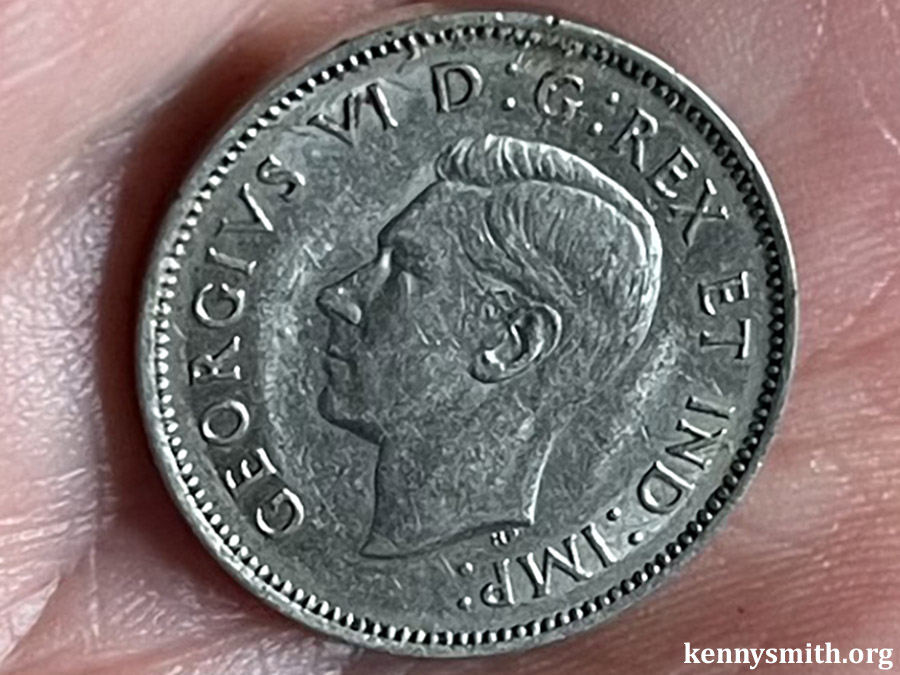
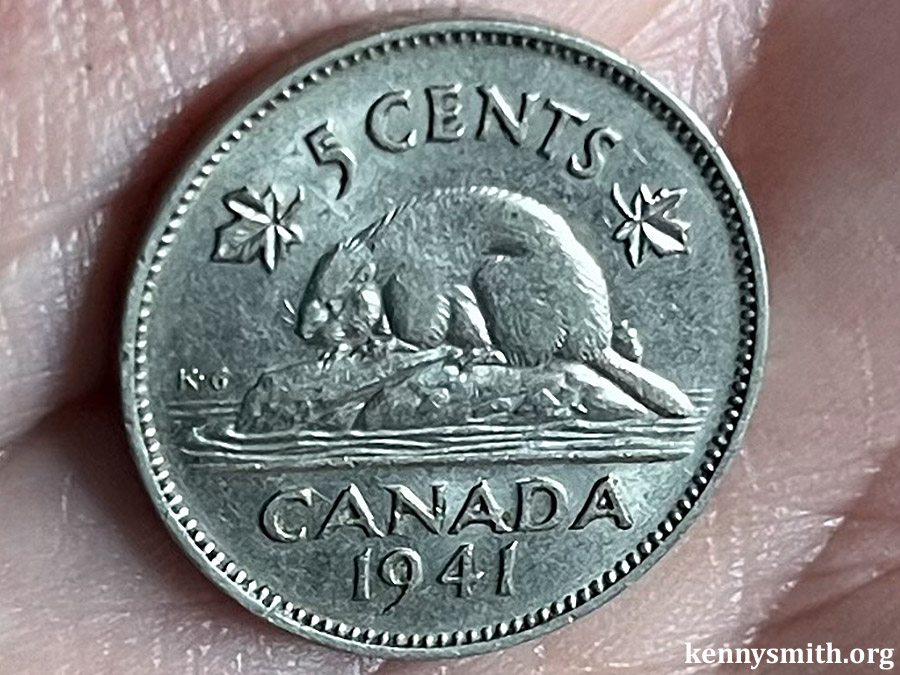
Canada made 8.6 million of these nickels. They are made of nickel. These may be worth six cents. They may be worth about 14 bucks.

But the ding above King George VI surely lowers the value here. The side with the bust of the king was designed by Thomas Humphrey Paget, an English designer and modeller. You can see his initials just below the king’s neck. He’d designed some sterling with King Edward’s likeness, but aside from a few test pieces it never made it into public hands before his abdication. He did other coins, too. including King Fasal II, of Iraq, and a Queen Elizabeth II for a commemorative Isle of Man issue in 1965. And though he died more than 50 years ago some of his work remains in circulation. He produced a likeness of the Duke of Edinburgh in 1970 that was used for a 2017 commemorative five pound coin.
The other side, the fun side, was designed by G. E. Kruger-Gray, who we learned about recently.

Small and inconsequential thing that it is, we’ve no idea why we have it. Someone brought back a Canadian nickel from somewhere and it’s been in this little bag inside a box for years and years.

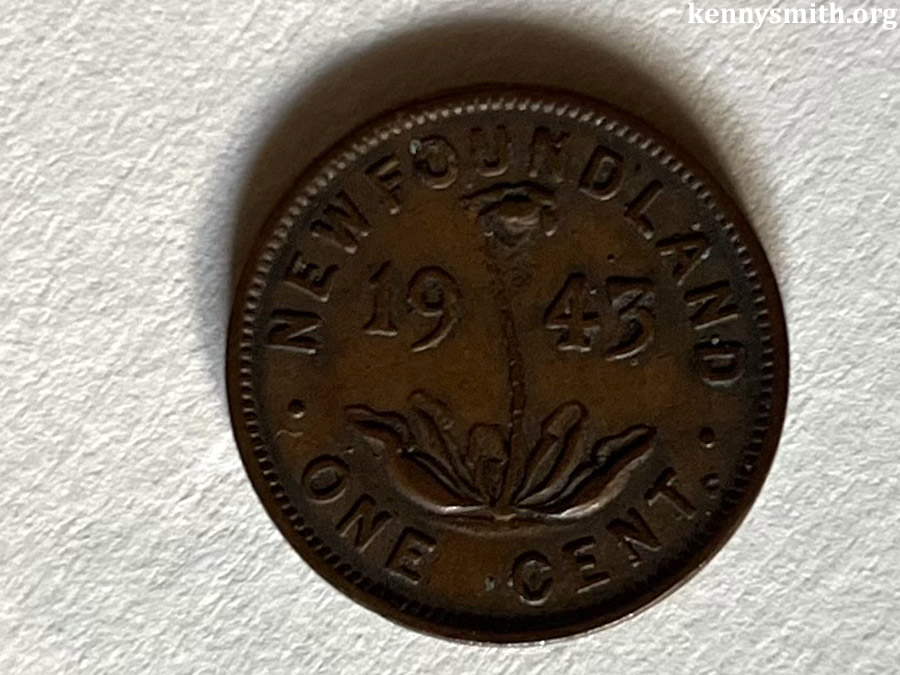
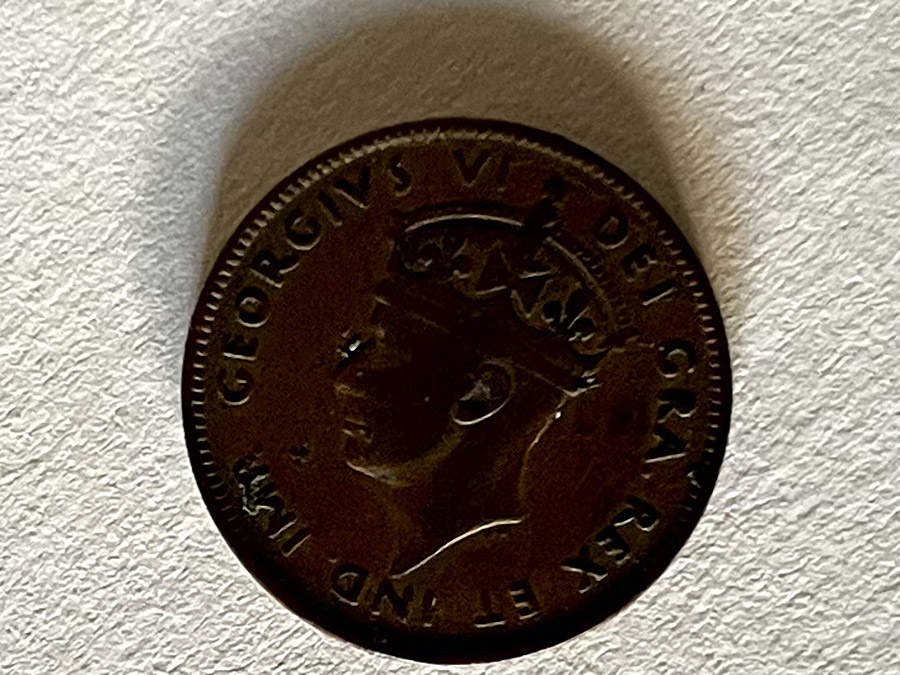
That’s the case for this 1943 Newfoundland penny, as well. Now a Canadian province, of course, Newfoundland got self-government within the British Commonwealth in 1907. They held that until 1949, when they finally joined Canada. Lingering war and Depression effects helped motivate the move. Around the time this coin was struck about 322,000 people lived in Newfoundland and Labrador. The government commissioned 1.2 million of these pennies that year.

The side with the bust of George was designed by Percy Metcalfe, an artist and sculptor. He also designed a war memorial, and some important early 20th century pottery. He designed rupees for colonial India, the first coins for the Irish Free State in 1928. This crowned image of George figures into some civilian and military awards, and the flag of Malta. Metcalfe also designed the Great Seal of the Realm, and coins for Australia, Fiji, New Zealand, Iraq, Egypt, and more. It’s a full resume for a guy who spent part of the 1930s drawing car mascots. Some of his work was freshened up a bit and put on Euros in 2010.

The reverse side shows a pitcher plant in bloom. This was designed by Walter J. Newman. Born in London in 1909 to the son of a signmaker, he joined the British mint in 1927. He submitted this design to Newfoundland in 1938. He became the chief engraver of the Royal Mint in 1961, which was a chair apparently left vacant for more than a century prior. He worked on some important British medals, retiring in 1973. He died in 2001.

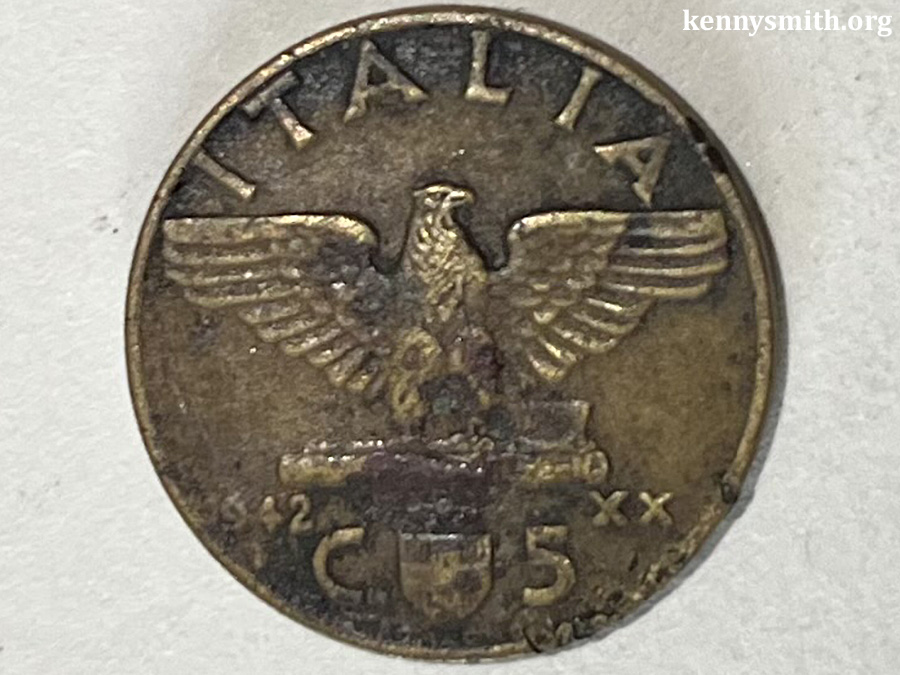
And this is a 1942 5 centesimi, an Italian nickel. The eagle is holding a fasces, from the Latin word fascis, meaning bundle. It is a bundle of wooden rods and, just seen here on the right, an axe. The fasces a symbol that pre-dates even the Romans, going back to the Etruscan civilization. It has generally been an image of the king’s power to punish his power, and later, a magistrate’s power and jurisdiction. The axe is an ancient Greek symbol. And if you’re wondering about the word fasces, yep. That’s the origin of the party name. Mussolini used the symbol, though 1942 was his last full year in national power.

Below the fasces is the crowned Shield of Savoy. It’s worn a bit on this coin, but the shield divides value at sides. The XX on the right is date in the fascist era. Below all of that is the name G Romagnoli. Giuseppe Romagnoli the engraver and medallist who made this thing. During his career in coin he also made currency for Albania and Somalia. He died in Rome in 1966.

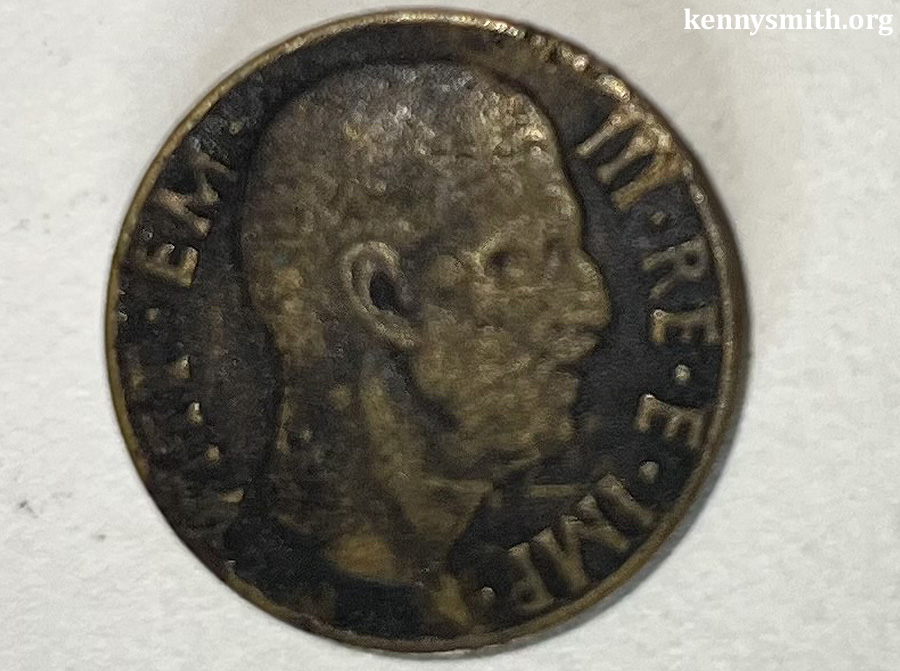
On the other side of the coin is the rather worn likeness of Victor Emmanuel III, who ruled as king for the first 46 years of the 20th century. It was under his reign that Italy also colonized Libya, and annexed Trento and Trieste, completing the national unity of Italy. There was also the little problem with the growing Italian fascist movement.

The economy was weak, the people angry, and the voices stirring them up were virulent. (Stop me if you’ve heard this before.) After the National Fascist Party marched to Rome, the king appointed Mussolini as prime minister in 1922, and accepted the additional crowns of the Emperor of Ethiopia and the King of Albania in the 1930s. Italy got into World War II in 1940, and the king sacked Mussolini in 1943 when the Allies fought their way into Sicily, before signing an armistice in September of that year. He fled to a town in the boot heel of Italy after that. After the war he abdicated the throne to his son and soon went into exile in Egypt, where he died in 1947. In 2017, his remains were returned to rest in Italy. The Italians wanted nothing to do with monarcy. His son, Umberto II was the last king, serving for 34 days. He spent the rest of his life in exile in Portugal. Until 2002 no male descendant of the family was allowed on Italian soil.

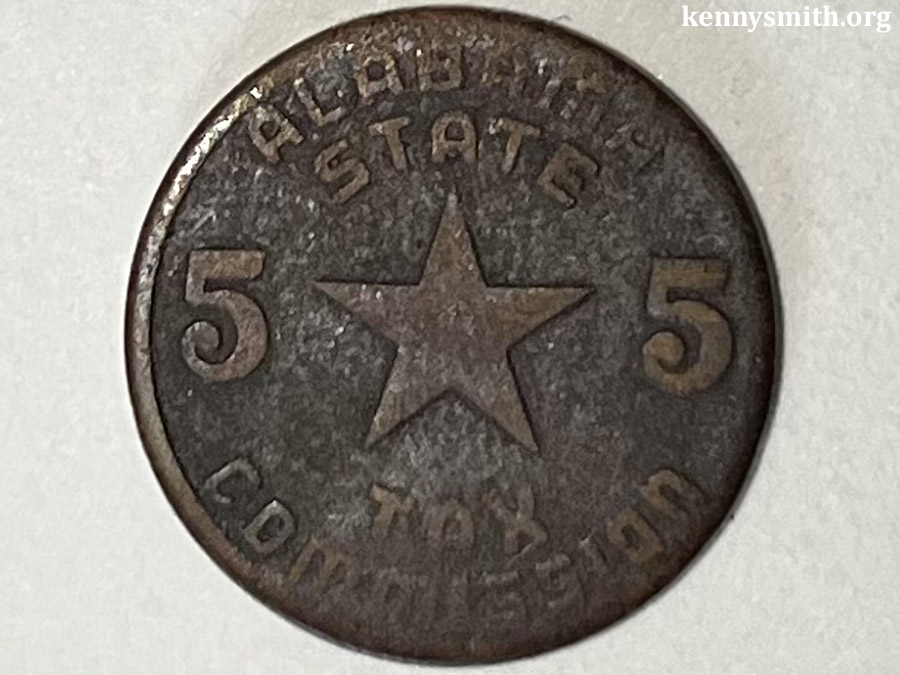
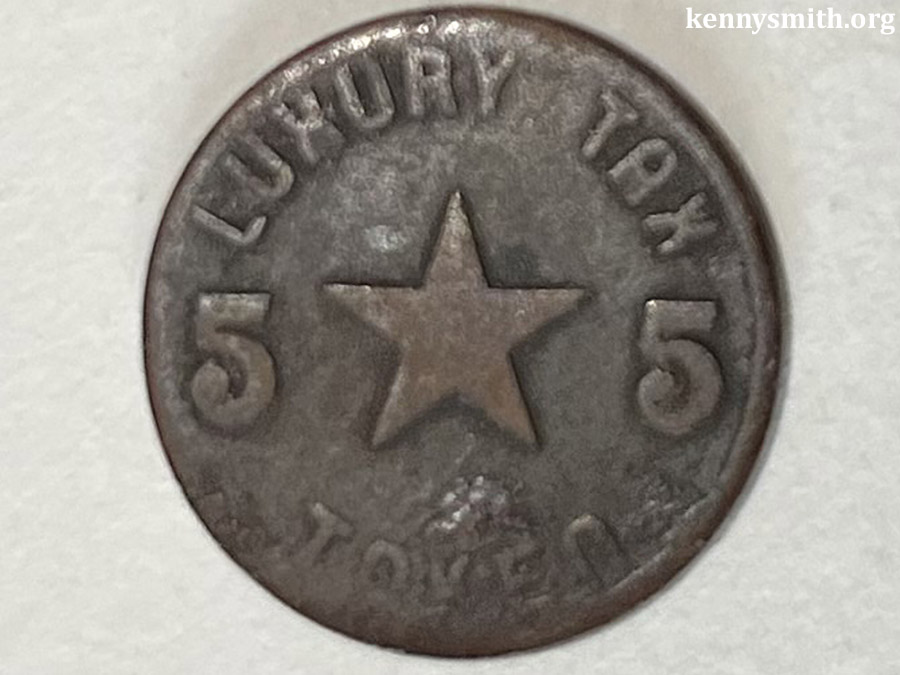
And here’s the last one, a tax token issued by the state, starting in 1935. This one feels like a penny, but that wasn’t universal. Some of these tokens (not coins) were made of cardboard, metal, and other materials. A mill was equal to 1/10 cent.

This one seems to be made in 1937 or 1938. (The design varied pretty rapidly on these, which helps with identification.) They still use the unit as a property tax instrument, of course, but it’s just figured into your bill these days. This, which was worth half a penny, could be used to pay fractional taxes on smaller purchases. People would buy these separately and use them to pay a merchant the listed price and the amount of these that they needed for the price.

It was demonetized in 1948. They aren’t worth anything, really. You can pick them up by the handful in coin collector shops, apparently. I’ve never seen one before. I might need to try to pick some up sometime.

And that’s how it starts, I bet.

Except that’s how it ends. This is the end of the coins that were in a red velvet pouch in a small chocolate sampler box in the bottom of a stack of things in my grandparents house, a memory box found by chance and filled with family history.

In my organizational communication in sport class this evening we talked about storytelling. It seems a natural progression from branding, since we’re thinking of this from an organizational point of view. And after we’d talked about a couple of different styles of things, and a few different ways we might categorize people, I broke them into their franchise groups.

Each franchise had to analyze the players on their NFL fantasy types and organize them into the typologies we’d discussed earlier. At the end of class I had them present one of their players. I walked through all of the groups helping them figure it out, crystallize their thinking, questioning their choices and supporting their decisions. The premise was that Monday Night Football was coming to town and the show wanted the franchise’s help in figuring out who to feature in a pregame package. Each franchise had to pitch one guy, and explain why he’d be the right choice.

There are seven of these groups in the class. When everyone was ready, they each had to tell the room which one of the seven players would make for the best package. As the franchises discussed their choices I wrote down the names and details. And then came the nervy part. I’d just asked them to be their franchises and now I was asking them to imagine themselves as MNF producers. Let’s decide which of these seven suggestions would make for the best TV feature, and the winning pitch gets a few extra points.

But what if they don’t play along? (They always do.) I started reading the players names, asking for votes. But no one voted. First one player name, then two, and three. And I began to get nervous. By the time I named the fifth and six player maybe two hands had been raised for votes. When I said the seventh, final name, it was nearly unanimous. They’d played along after all. And, for what it was worth, I think they picked the right person for a feature story. Maybe that means I explained everything well during the lecture.

Next week we’ll start talking about fans.

This evening we tried a Mexican restaurant that’s right off campus. My lovely bride had a presentation to make and then a meeting and I had class and who wants to make food when you can walk one block and get what turned out to be some outstanding tacos al pastor? That was the first time we’d been to that place. I imagine we’ll go back.

I wonder if they can make change in old coins.


27
Sep 26

The rare weekend post

After church and lunch, we stopped by my grandparents’ home. My mother and grandfather had recently found a box that she wanted me to see. Apparently no one knew it existed. And, inside, you could see some old newspaper clippings, a few letters, some note cards that my grandfather used to write out notes for his sermons, and so on. There was some of their school memorabilia in there, too. My grandmother’s high school tassel in there. Also, there was a little memory book from her graduating class, and her diploma. My grandfather’s high school diploma was in the box, too. It’s all a trip back in time.

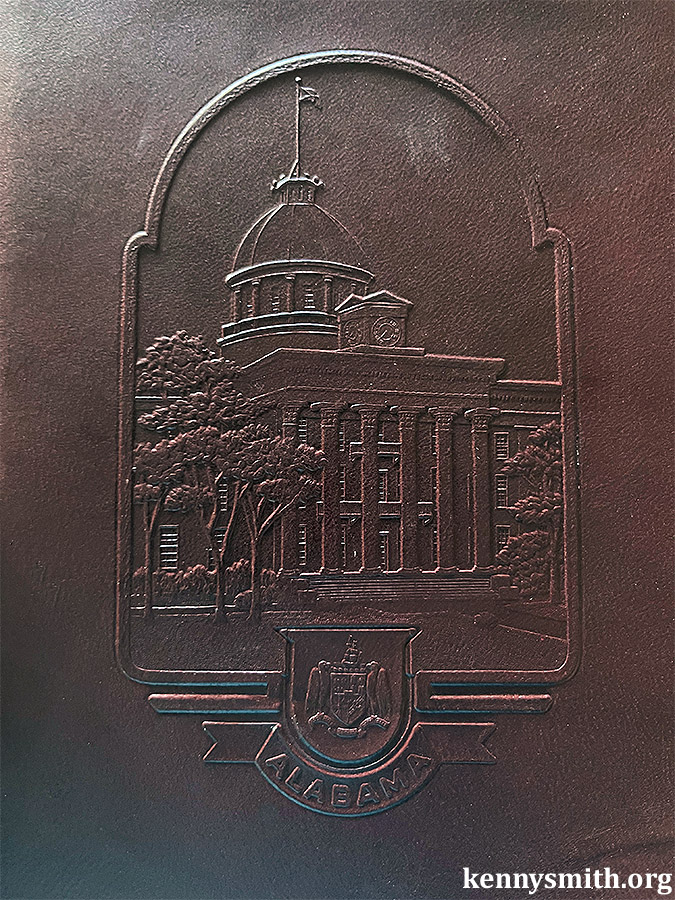
Here’s the cover to his diploma, class of 1951.

He also had some sort of memory book that was stored away in the box. He must have been a popular kid. Lots of signatures, names that mean nothing to me, but a lot to others. A few pictures. There were some notes of things that must have made sense 75 years ago. There was a picture of him, a studio headshot, maybe it was his graduation photo. I’m not sure I’ve ever seen it before.

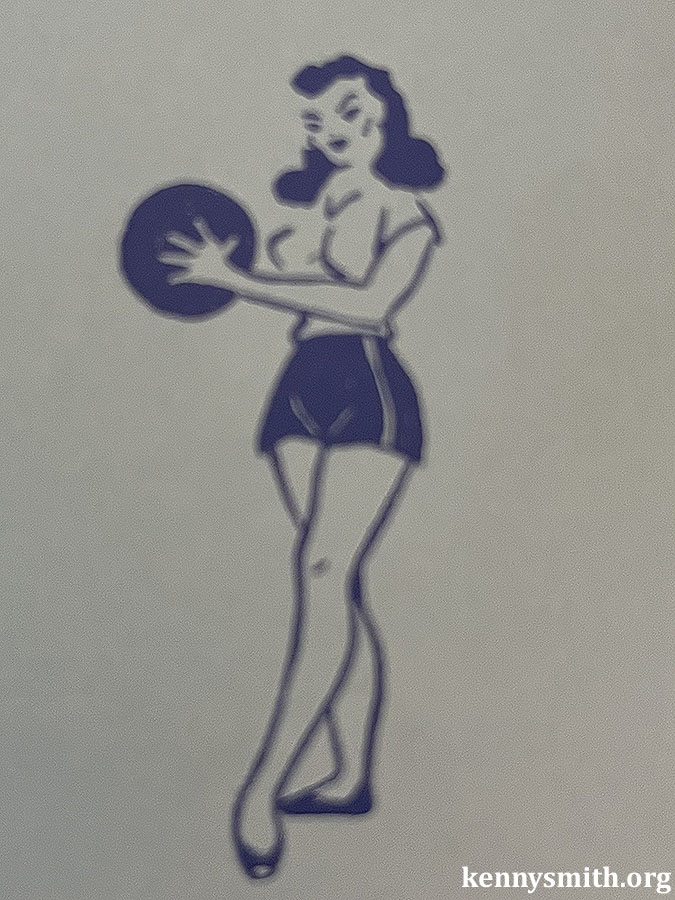
I was also interested in the line art.

I think it is important to note that my grandfather went to a Bible school.

Also, attitudes about these sorts of things might have been different three-quarters of a century ago.

I really want to know where the school purchased these books. I’m sure they caused quite a stir.

This is my favorite one. I’m saving it for some as yet unknown special occasion. I’ll change the text and use it somewhere and I’ll remember that my grandfather, as a boy, looked at this image.

I never knew him. He died soon after I was born. We met once. And I “heard” one of his last sermons. He’d come to visit and the local church had asked him to preach. Of course I was an infant, so I have only the retelling. I’m told I have some of his mannerisms when speaking, though. How could that be?

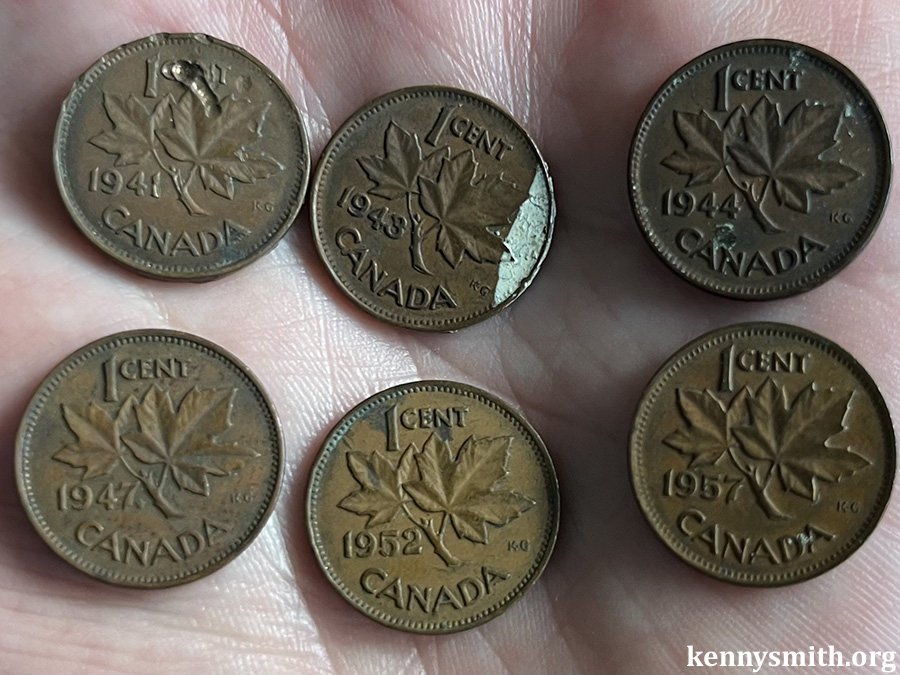
There was also a little bag of coins in this newly discovered box. I’m going to share a few more of them this week, but, for now, here’s some mid-century Canadian pennies.

So my mother is bordering on becoming a numismatist. She’s downloaded an app and is scanning these things in and telling me about the coins. It is fun and infectious and charming. And then she says to me, she says, “When you find out more about them, let me know.”

So I have to do what I do now.

That’s somewhere between six cents and $10,000 in my hand right there. I’m pretty confident it’s closer to six cents.
While I didn’t take a photo of the reverse side (for some reason) the one interesting thing of note is that the 1957 coin has Queen Elizabeth’s likeness. The others have King George’s. (His coin image looks nothing like the movies.) I’m assuming that 1952 penny was one of the last one’s struck. The KG does not stand for King George, but rather G.E. Kruger-Gray, who designed the leaves. He was a British artist. He did coats of arms, coins for places all over the British Empire and stained glass windows. He died in 1943. With just a few exceptions Canada used his design for another 70 years after his death.

We’ll wonder forever how these six coins came to sit in a box in Alabama for decades. We’ll wonder forever when they landed there. It’s better when there’s a little wonder. It makes you look for more.

Look in all the boxes.

Because you have no idea what you’ll find. And, as you’ll see sometime in the next few days, you can make some wonderful discoveries inspired by that sort of wonder.


25
Sep 26

Back in the Valley

I am back home. It’s never been my home, but in all of my childhood memories, going home meant coming here. It’s where my mother is from, and she’s there. Here. And, for the weekend, I am too. Flew in to Nashville last night. Late, as it turns out, because the airline can’t get its act together. Drove in, went to sleep.

Woke up this morning and did some work, because there was work to be done, but also to prove, I guess, that I do work from time to time.

There’s a small family routine of a Friday breakfast, so we went to that. It was my mother, my grandfather, my great-aunt and great-uncle. Two different cousins came — one of them of my generation and another that is younger. Much, much younger. That jerk.

He’s a delightful young man. He’s about to get married. About to move into a starter home. I’ve probably had the chance to see him six times in his life. Breakfast this morning is the most time I’ve ever spent with him. He sat next to his grandmother, my great-aunt, and they spent the entire morning clowning on one another, effortlessly, joyfully. I’d watch an entire series of buddy cop movies starring the two of them.

We — my mom, my other cousin and me — confirmed and corrected for him a bit of family lore about his grandfather. I don’t think he was listening at the moment. But also we didn’t tell the whole hilarious story. It involved a specific and embarrassing injury he sustained while tending to his cattle.

After we saw our elders off my other cousin and I traded platitudes and hugs. Then I went to the bank to play some video games do some banking. Back at my mom’s house, I unrolled a rug, moved a rug, re-positioned some furniture, and changed seven light bulbs. Then I spent the rest of the afternoon asking her if there was anything she wanted me to do. There was not.

I seldom get to use that banner.

Water, as I have noted in this space before, is the predominant geographical feature of the area where all of my family live. The Tennessee River forms near Knoxville, Tennessee and flows to the southwest, into Alabama, before looping back up, helping form the Alabama-Mississippi-Tennessee borders and then heading to Kentucky. It created a topography that has defined all of the people that have ever lived there.

The Yuchi tribe, the Alibamu and the Coushatta, of the Muscogee Creek Confederacy, lived on this imposing body of water. They called it the Singing River. Alabama became a territory in 1817, white people moved in and it became a state in 1819. Some of my ancestors were among the first white people in the area, some even before the Native Americans were forcibly displaced by the federal government. From what I can glean, my people were hardscrabble dirt farmers. Even if you grew enough to sell, but shipping was difficult. The shallow, turbulent water at Muscle Shoals was the problem.

Then the Great War came.

There was a worry that the Imperial German Navy would cut off shipments of nitrates from South America, so the federal government decided to build their own nitrate plants, driven by hydroelectric power. Muscle Shoals was understood to have the greatest hydroelectric potential east of the Rockies.

So in 1918 they started building a dam, a project which became a city unto itself, employing thousands. They had a school, barbershops, a hospital and more than a hundred miles of sewage lines. But the war ended before the construction did.

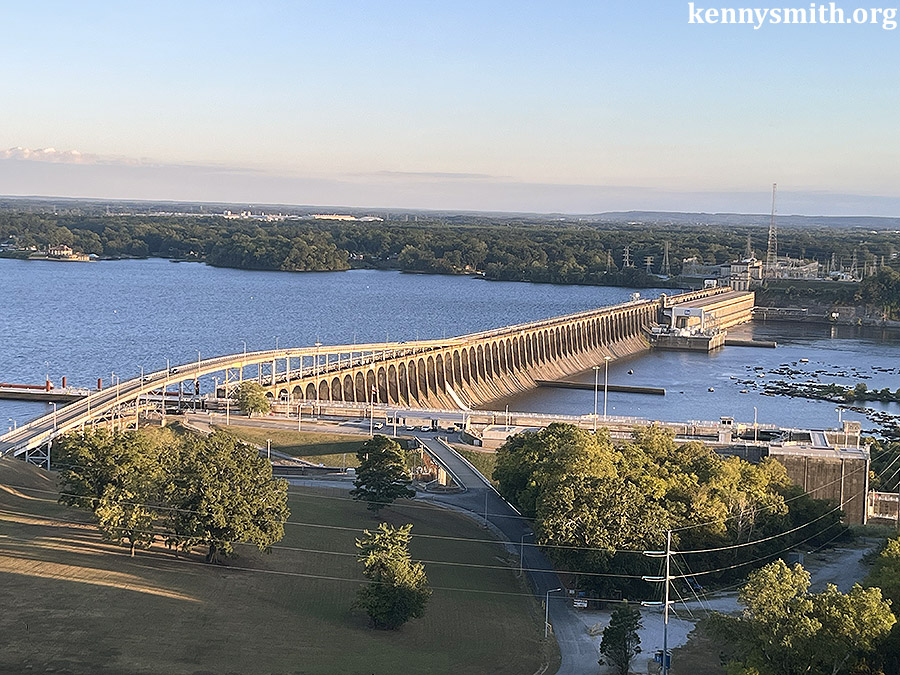
It is a narrow, two-lane dam, always a bit intimidating when I was a kid. Back then, it was one of the last little bits of road on our two-hour trip to my grandparents’ home. My mom would tell me about how she learned how to drive on that dam, in the snow.

Well, I haven’t done that, but I have driven over it. Not too long after I’d gotten comfortable with that — those lanes are narrow! — the traffic pattern changed. But that amazing structure is all about change. Without question it changed the region. In 1933 the dam was handed over to the newly formed Tennessee Valley Authority, which also touches everyone and everything in the region. The dam was put on the historic registry in 1966, and boasts the highest single lift lock east of the Rocky Mountains. They used to give tours of the place. Today you can still walk on the very tiny sidewalk, but once upon a time, the tours would allow you to walk through it, from one side of the river to the other.

I’ve jogged over it, biked over it, fished beneath it as a kid, marveled at the power of the spillways and the respect they commanded from people on the water, watched the ships pass through the locks, and, now, I’ve dined above it. (I’ve never been quite so aware of how that ascent/descent figures into the design.) I didn’t grow up here, but the dam is omnipresent in my story because of the river it sits on and because my family lives in its orbit.

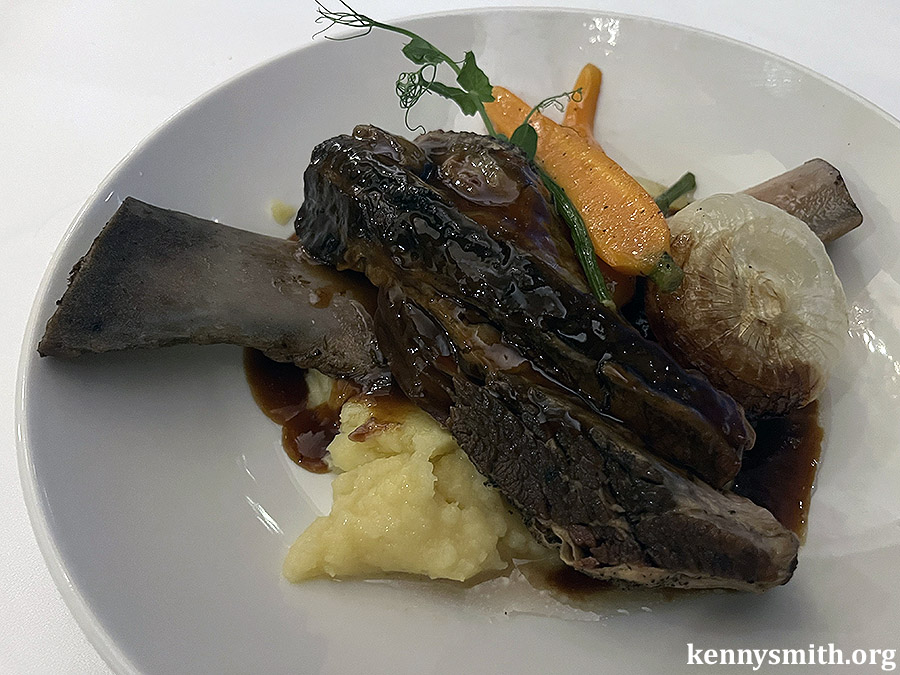
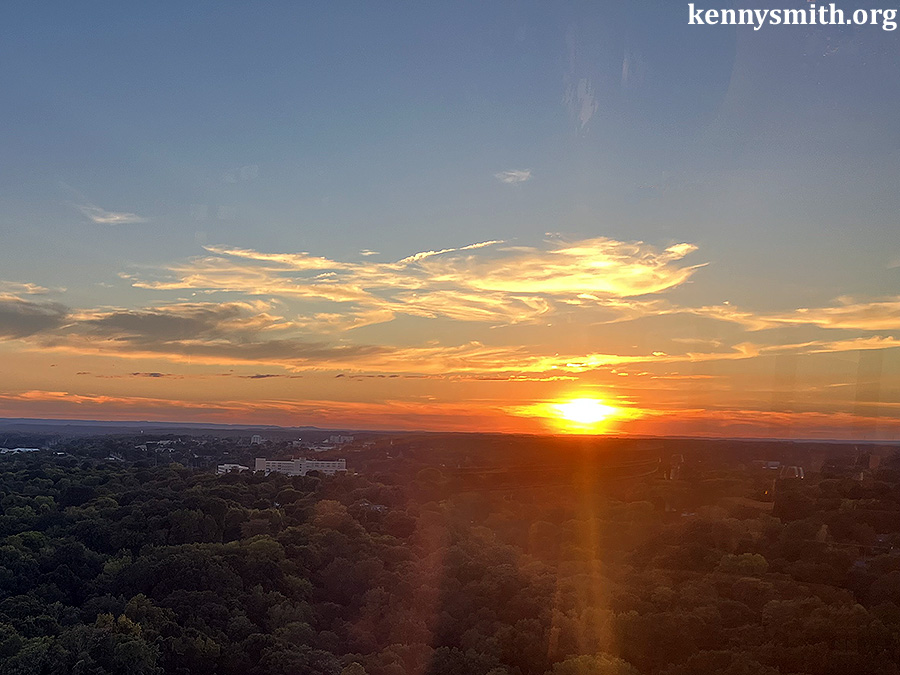
Anyway, the views from the restaurant are nice. You drive down to the river, of course. You get in an elevator and go up – up – up. Some 300 feet or more, to get commanding views like the one above. The food is better than I’d expected. I don’t know what I expected, but that’s a fine place. We ordered a stuffed crab cake appetizer. My mom got a steak. I ordered a short rib.

I had a bite of the steak. If I ever go back there, I’m ordering the steak.

Did I mention that the restaurant spins? We’d gone just in time to see the day’s last bright light on the dam, and then we spun to the west.

And in this one, you can see the last interesting bit of the sunset and a bit of the Singing River.

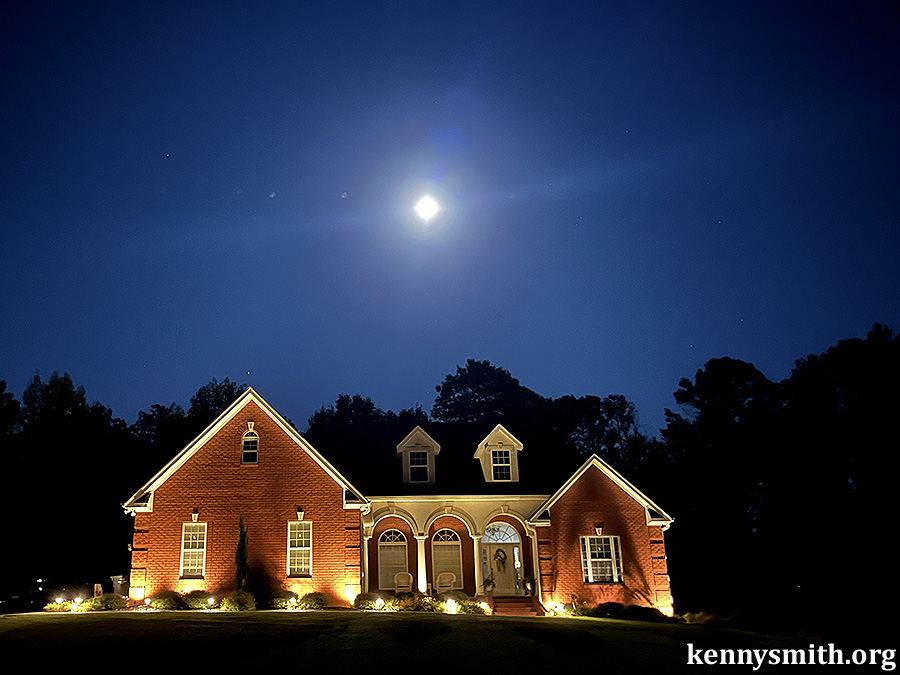
Also, I ate so much that I had to walk it off. So I walked home. That’s not right. I drove back, and then walked around the neighborhood. Here’s one of the houses in the neighborhood, waiting patiently, under a bright moon, for this big moment.

A word about those banners. The Spillway was a newspaper clipping, one of those little social happenings sections of The Florence Times, the pre-merger ancestor of the modern Times Daily. The Northwest Alabamian is an old masthead from the still publishing paper of the same name. It’s been a twice-weekly community paper since 1965, tracing it’s own heritage back to 1911. The current publisher has been there since 1983.