


My visit home last weekend led to seeing some old family treasures that, until recently, no one knew existed. A few notes, a newspaper clipping, some old photos, my grandparents’ high school diplomas and the like. All of this was stuffed into an old chocolate sampler box, neatly and carefully arranged in such a way that you could tell my grandmother had spend time with this. It would all only go back in the box in one particular way. The order of things almost as much a mystery as the contents. The box had been underneath this or that and was stumbled upon largely by accident, I’m told. You have to look through everything.
It’s funny, I have, for as long as I remember, wanted to discover something historically important. In my mind it, whatever it is, will be in a forgotten closet, tucked inside a box, under a blanket in an attic. It’ll be boring, the circumstance far outweighed by the relevance. I have always had this idea, I suppose. It has never occurred to me that what I’ve been imagining would be 75-year-old bits of paper that just fill in bits of the family story. It doesn’t need to be anything bigger than that, really. It had just never crossed my mind that that’s what it would be. It’s the thrill of finding the thing that is, well, thrilling.
Anyway, this was my mother’s discovery and she of course enjoyed seeing the old note cards that had verses her father used in his sermons. She enjoyed the little notes and of course the photos. But there was also a little felt pouch in that box, and inside that felt pouch there were some coins. We all liked that. I already showed you six mid-20th century Canadian pennies, but there were other coins, as well. Here they are now.
Canada made 8.6 million of these nickels. They are made of nickel. These may be worth six cents. They may be worth about 14 bucks.
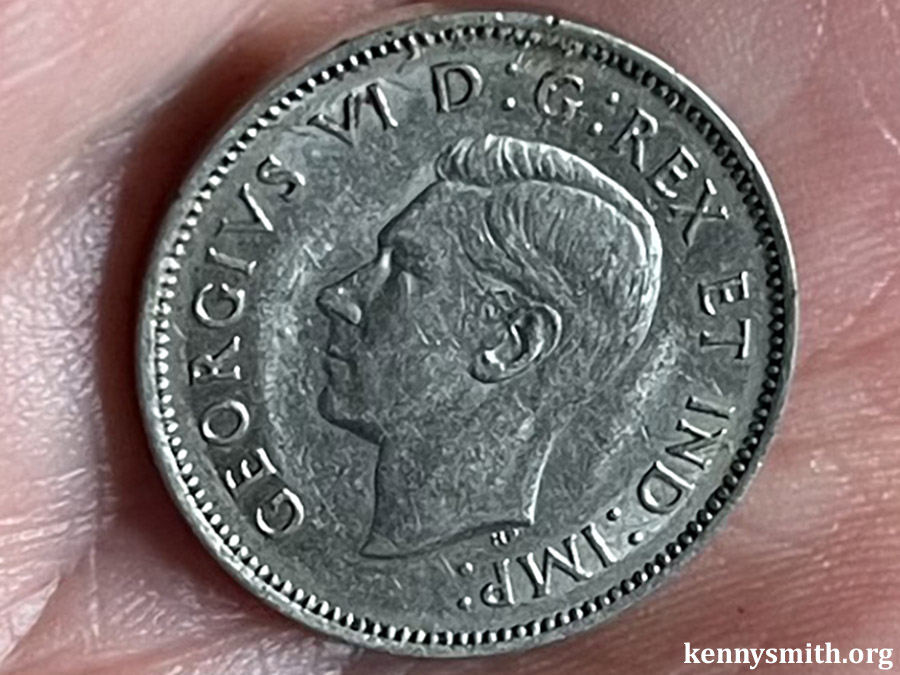
But the ding above King George VI surely lowers the value here. The side with the bust of the king was designed by Thomas Humphrey Paget, an English designer and modeller. You can see his initials just below the king’s neck. He’d designed some sterling with King Edward’s likeness, but aside from a few test pieces it never made it into public hands before his abdication. He did other coins, too. including King Fasal II, of Iraq, and a Queen Elizabeth II for a commemorative Isle of Man issue in 1965. And though he died more than 50 years ago some of his work remains in circulation. He produced a likeness of the Duke of Edinburgh in 1970 that was used for a 2017 commemorative five pound coin.
The other side, the fun side, was designed by G. E. Kruger-Gray, who we learned about recently.
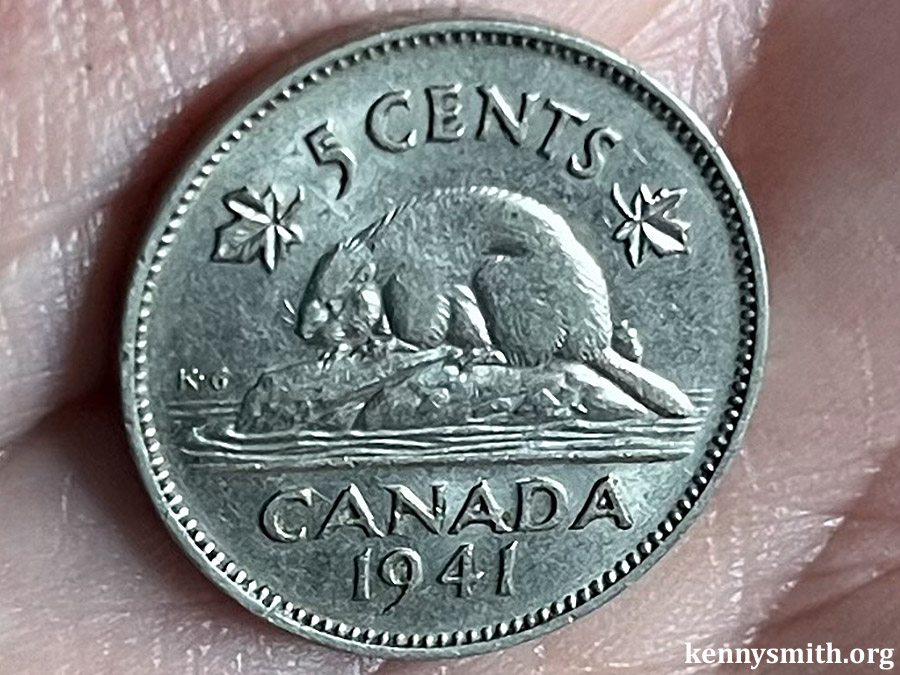
Small and inconsequential thing that it is, we’ve no idea why we have it. Someone brought back a Canadian nickel from somewhere and it’s been in this little bag inside a box for years and years.
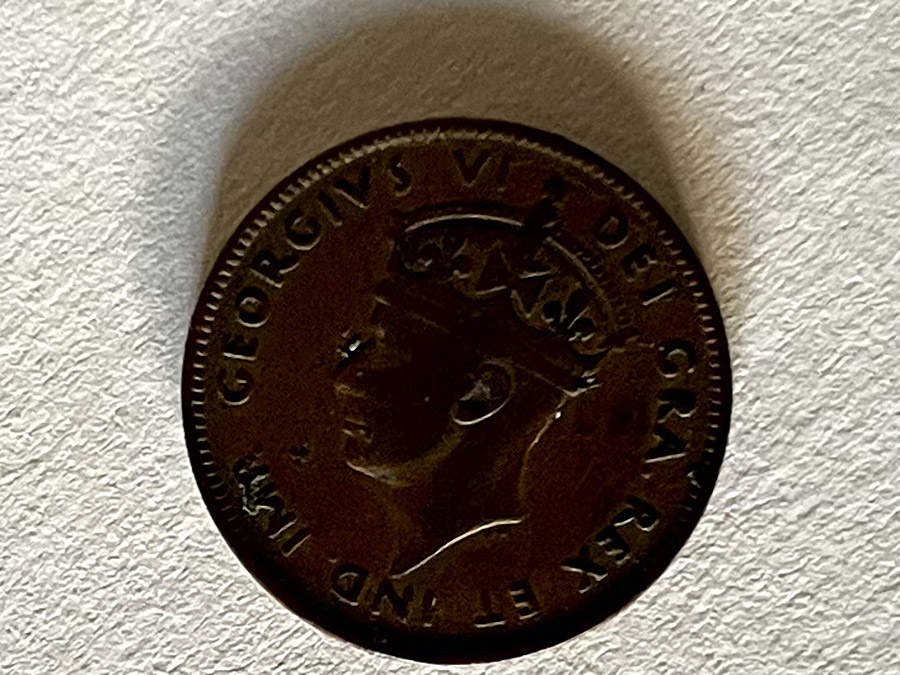
That’s the case for this 1943 Newfoundland penny, as well. Now a Canadian province, of course, Newfoundland got self-government within the British Commonwealth in 1907. They held that until 1949, when they finally joined Canada. Lingering war and Depression effects helped motivate the move. Around the time this coin was struck about 322,000 people lived in Newfoundland and Labrador. The government commissioned 1.2 million of these pennies that year.
The side with the bust of George was designed by Percy Metcalfe, an artist and sculptor. He also designed a war memorial, and some important early 20th century pottery. He designed rupees for colonial India, the first coins for the Irish Free State in 1928. This crowned image of George figures into some civilian and military awards, and the flag of Malta. Metcalfe also designed the Great Seal of the Realm, and coins for Australia, Fiji, New Zealand, Iraq, Egypt, and more. It’s a full resume for a guy who spent part of the 1930s drawing car mascots. Some of his work was freshened up a bit and put on Euros in 2010.
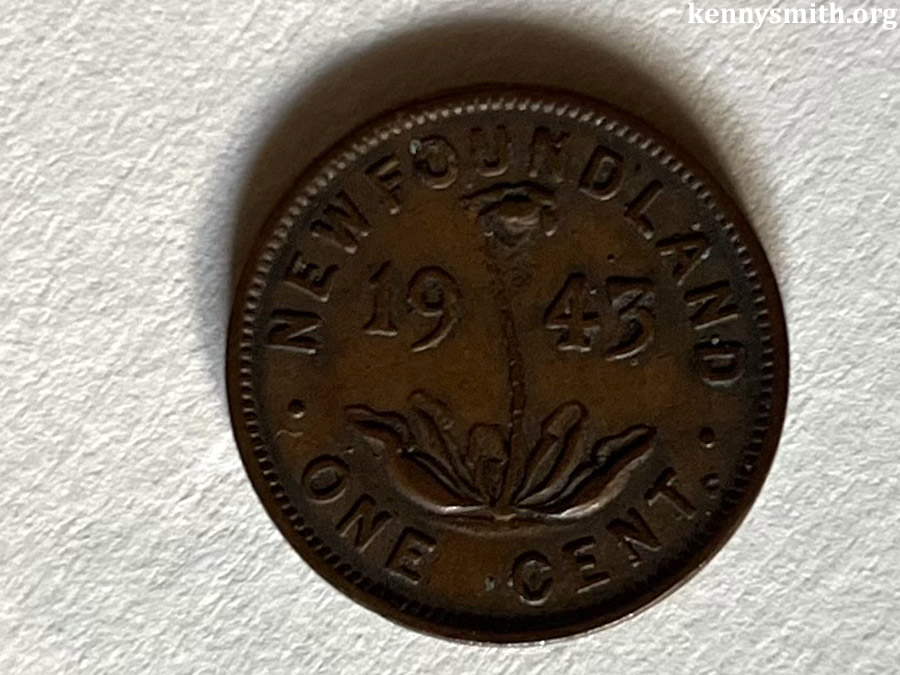
The reverse side shows a pitcher plant in bloom. This was designed by Walter J. Newman. Born in London in 1909 to the son of a signmaker, he joined the British mint in 1927. He submitted this design to Newfoundland in 1938. He became the chief engraver of the Royal Mint in 1961, which was a chair apparently left vacant for more than a century prior. He worked on some important British medals, retiring in 1973. He died in 2001.
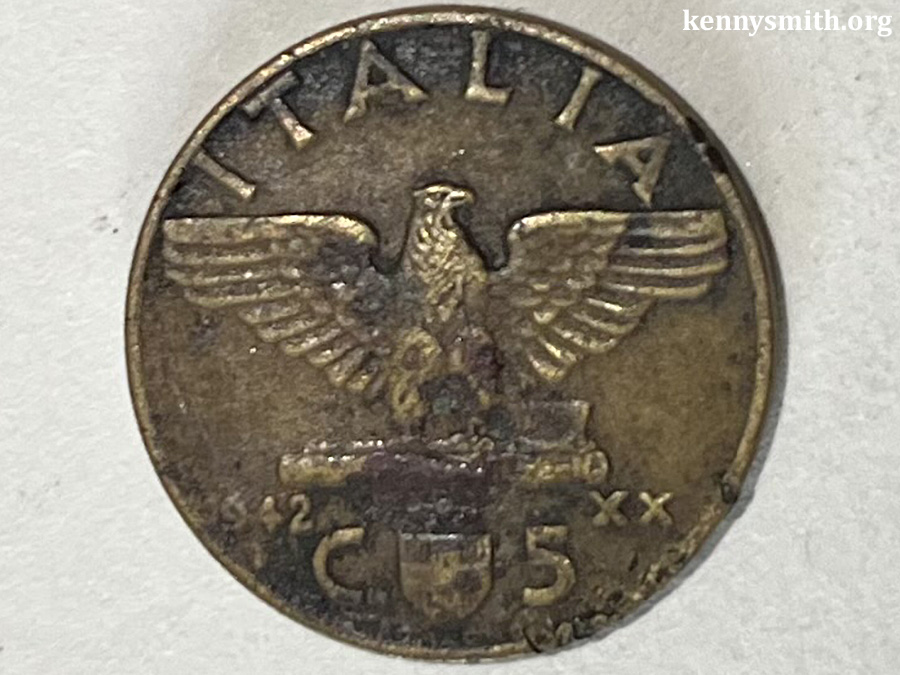
And this is a 1942 5 centesimi, an Italian nickel. The eagle is holding a fasces, from the Latin word fascis, meaning bundle. It is a bundle of wooden rods and, just seen here on the right, an axe. The fasces a symbol that pre-dates even the Romans, going back to the Etruscan civilization. It has generally been an image of the king’s power to punish his power, and later, a magistrate’s power and jurisdiction. The axe is an ancient Greek symbol. And if you’re wondering about the word fasces, yep. That’s the origin of the party name. Mussolini used the symbol, though 1942 was his last full year in national power.
Below the fasces is the crowned Shield of Savoy. It’s worn a bit on this coin, but the shield divides value at sides. The XX on the right is date in the fascist era. Below all of that is the name G Romagnoli. Giuseppe Romagnoli the engraver and medallist who made this thing. During his career in coin he also made currency for Albania and Somalia. He died in Rome in 1966.
On the other side of the coin is the rather worn likeness of Victor Emmanuel III, who ruled as king for the first 46 years of the 20th century. It was under his reign that Italy also colonized Libya, and annexed Trento and Trieste, completing the national unity of Italy. There was also the little problem with the growing Italian fascist movement.
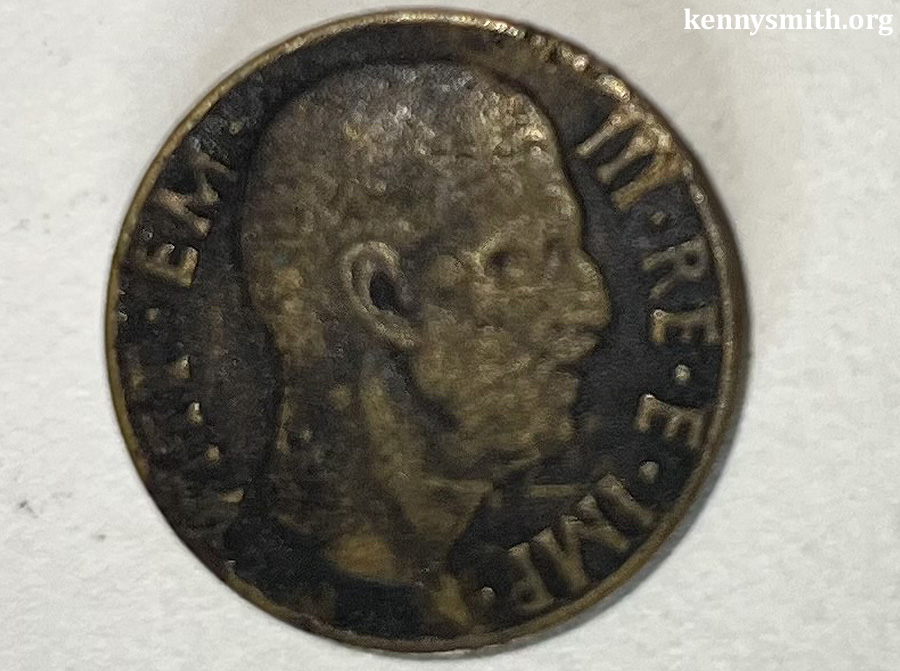
The economy was weak, the people angry, and the voices stirring them up were virulent. (Stop me if you’ve heard this before.) After the National Fascist Party marched to Rome, the king appointed Mussolini as prime minister in 1922, and accepted the additional crowns of the Emperor of Ethiopia and the King of Albania in the 1930s. Italy got into World War II in 1940, and the king sacked Mussolini in 1943 when the Allies fought their way into Sicily, before signing an armistice in September of that year. He fled to a town in the boot heel of Italy after that. After the war he abdicated the throne to his son and soon went into exile in Egypt, where he died in 1947. In 2017, his remains were returned to rest in Italy. The Italians wanted nothing to do with monarcy. His son, Umberto II was the last king, serving for 34 days. He spent the rest of his life in exile in Portugal. Until 2002 no male descendant of the family was allowed on Italian soil.
And here’s the last one, a tax token issued by the state, starting in 1935. This one feels like a penny, but that wasn’t universal. Some of these tokens (not coins) were made of cardboard, metal, and other materials. A mill was equal to 1/10 cent.
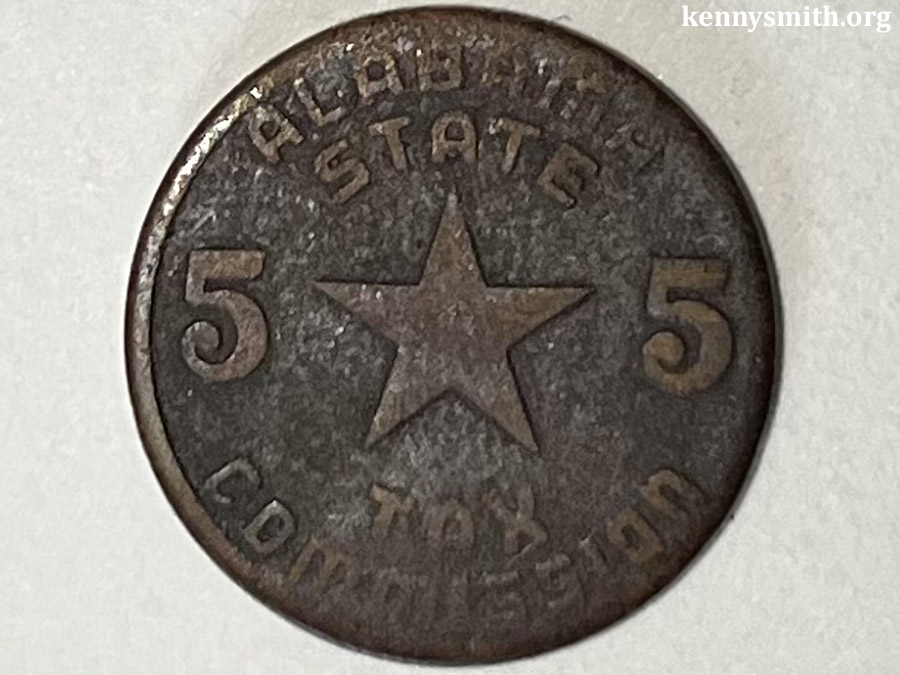
This one seems to be made in 1937 or 1938. (The design varied pretty rapidly on these, which helps with identification.) They still use the unit as a property tax instrument, of course, but it’s just figured into your bill these days. This, which was worth half a penny, could be used to pay fractional taxes on smaller purchases. People would buy these separately and use them to pay a merchant the listed price and the amount of these that they needed for the price.
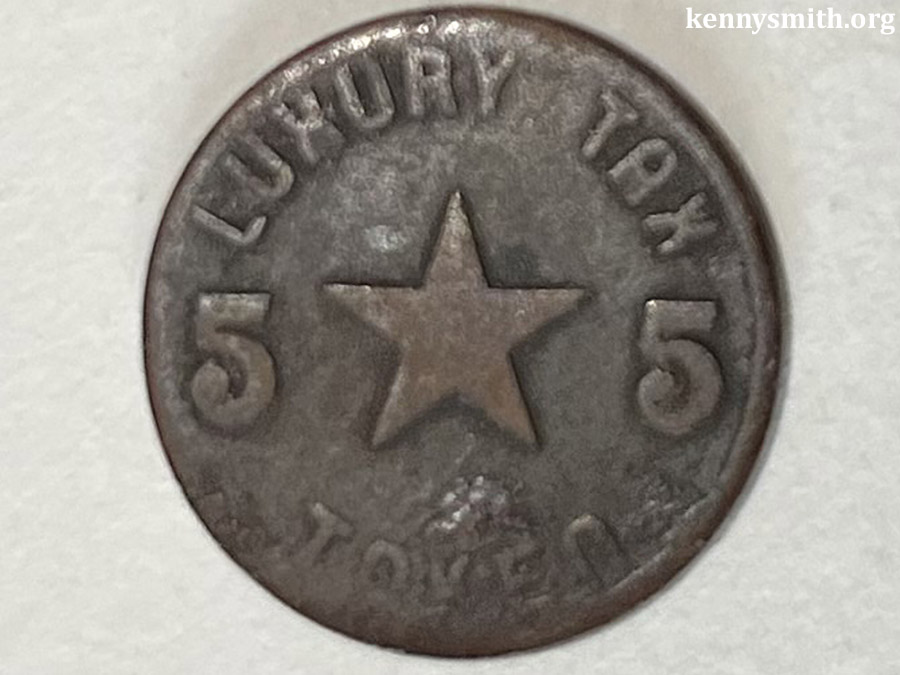
It was demonetized in 1948. They aren’t worth anything, really. You can pick them up by the handful in coin collector shops, apparently. I’ve never seen one before. I might need to try to pick some up sometime.
And that’s how it starts, I bet.
Except that’s how it ends. This is the end of the coins that were in a red velvet pouch in a small chocolate sampler box in the bottom of a stack of things in my grandparents house, a memory box found by chance and filled with family history.

In my organizational communication in sport class this evening we talked about storytelling. It seems a natural progression from branding, since we’re thinking of this from an organizational point of view. And after we’d talked about a couple of different styles of things, and a few different ways we might categorize people, I broke them into their franchise groups.
Each franchise had to analyze the players on their NFL fantasy types and organize them into the typologies we’d discussed earlier. At the end of class I had them present one of their players. I walked through all of the groups helping them figure it out, crystallize their thinking, questioning their choices and supporting their decisions. The premise was that Monday Night Football was coming to town and the show wanted the franchise’s help in figuring out who to feature in a pregame package. Each franchise had to pitch one guy, and explain why he’d be the right choice.
There are seven of these groups in the class. When everyone was ready, they each had to tell the room which one of the seven players would make for the best package. As the franchises discussed their choices I wrote down the names and details. And then came the nervy part. I’d just asked them to be their franchises and now I was asking them to imagine themselves as MNF producers. Let’s decide which of these seven suggestions would make for the best TV feature, and the winning pitch gets a few extra points.
But what if they don’t play along? (They always do.) I started reading the players names, asking for votes. But no one voted. First one player name, then two, and three. And I began to get nervous. By the time I named the fifth and six player maybe two hands had been raised for votes. When I said the seventh, final name, it was nearly unanimous. They’d played along after all. And, for what it was worth, I think they picked the right person for a feature story. Maybe that means I explained everything well during the lecture.
Next week we’ll start talking about fans.
This evening we tried a Mexican restaurant that’s right off campus. My lovely bride had a presentation to make and then a meeting and I had class and who wants to make food when you can walk one block and get what turned out to be some outstanding tacos al pastor? That was the first time we’d been to that place. I imagine we’ll go back.
I wonder if they can make change in old coins.

